
Not Your Average Improvisation: Thoughts on Noa Shadur’s ‘Magnolia’ by Ori Lenkinski
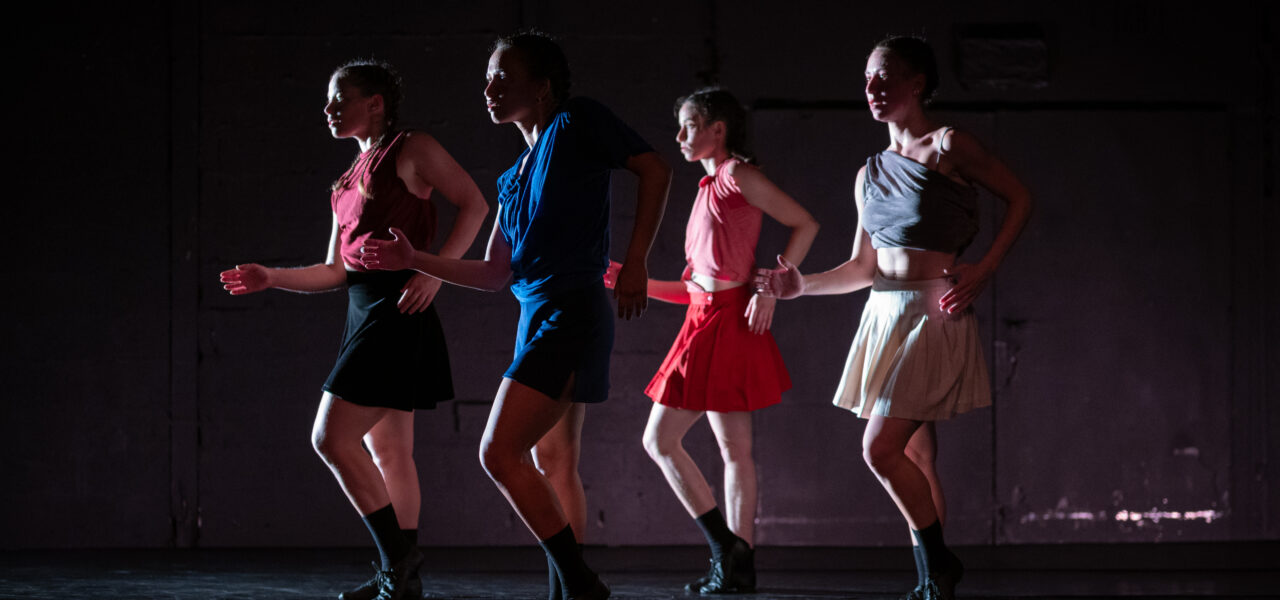
*Photo by Yair Meyuhas
Seated in the first of two rows in Studio Ora at the Suzanne Dellal Centre on Thursday night, I read through the program notes of Magnolia by Noa Shadur. “An improvisation-based dance work for four dancers…”. The bold print of the word improvisation gave me a moment’s pause. I imagined soft cotton pants, measured breathing and slowly evolving physical exchanges. The ensuing hour was the stark opposite.
Four young female dancers entered into the space dressed in pleated skirts, deconstructed vintage cotton t-shirts, black socks and black jazz shoes. Their hair was styled in carefully woven braids. At first glance there is nothing terribly interesting about the costumes yet as the piece unfolds, the exquisite treatment of the garment draws the eye to different cut outs and rouches. These dancers look like the effortlessly cool girls you see riding a bike in Park Hamesila or sitting in cafes around the city.
From the first seconds of the piece, the mechanism seemed clear. Loud techno music played as Noa Gronich and Lal’el Pillora crouched in one corner, beginning to nod their heads to the beat. The nods grew into a full body reaction to the sound. Their duet expanded into a quartet as Maya Kahanov and Shaked Weiner joined in.
The pace of the work is relentless, transitioning from one rhythm to another, one pattern to the next, one dancer leading switched out for another. The dancers show no signs of listening for cues. Instead, they appear telepathically connected, pivoting and exchanging material with uncanny precision. Improvisational impulses are woven into a tightly organized, ever-shifting and unpredictable structure.
Buried inside the choreography are hints of voguing and nightlife culture. Yet rather than functioning as recognizable references, these influences are absorbed into the fabric of the work, reimagined through Shadur’s compositional voice and the dancers’ meticulous execution.
From very early in the piece, one can see that the physical effort of the dancers is immense. Fifteen minutes into the piece, they are all visibly sweating, their sculpted t-shirts slowly darkening. And yet, they seem calm, focused and even joyful. Their exertion does not read as suffering; rather, they seem fully engaged in the task at hand. There seems to be as much pleasure in performing Magnolia as there is in watching it. Perhaps even more.
Shadur uses simple means, dance and music, yet her mastery of both creates a third, beguiling thing. The intricacy of the movement, the force and flow of the various techno rhythms woven together by Shadur’s longtime collaborator Shahar Amarillo establish a steady build. Somehow, Magnolia’s relentless momentum gave me a respite from my overactive mind, from the convergence of end-of-June obligations and the ceaseless to-do lists coursing through my veins. The piece allowed me to focus on something beautifully evasive, each moment crystallizing and evaporating before I could fully grasp it.
And just as the piece began, so it ended, suddenly, with the dancers walking nonchalantly off the stage. The work done, the shapes made, the music played, they exited the stage all at once, leaving the audience to catch our breath.
Noa Shadur presented ‘Magnolia’ on June 18 at the Suzanne Dellal Centre’s Studio Ora.


Photo Yair Meyuhas
Ori Lenkinski is a Tel Aviv-based dancer, actress, choreographer and journalist. Her work, be it on stage, the Internet or on paper, is devoted to exploring the connection between words and movement.
As a dancer, Ori has worked with independent choreographers in the USA, Europe and Israel. Ori’s writing has been published in Dance Magazine, The Huffington Post, The Jerusalem Post, Haaretz and others. She is the founder and editor of www.creativewriting.me, an online platform to response to performance. Her choreographic works include The Painting, Portrait #2, The Suit, Meet Me in the Market, Help Desk, Birth Preparation Course, a dance piece, Jackie Pink and Black, Escape Room as well as the dance films Carriage and Expecting. Ori’s works have been presented throughout Israel, Asia, North America and Europe.