
Multiplication by Subtraction: Looking at ‘Take Off’ by Hani Sirkis
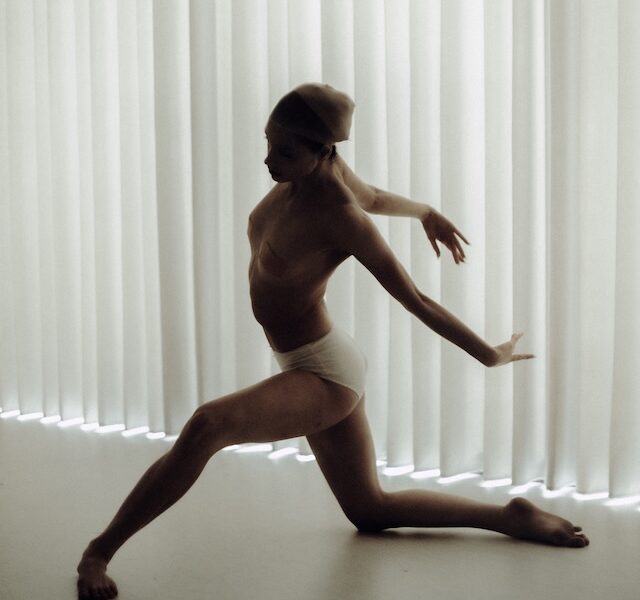
*Photo Yoav Erteschik
In the mid-2000s, I was a bartender at Galapagos Art Space, a sprawling venue in Williamsburg. My nights were Thursdays and Saturdays, but sometimes I covered Mondays, the famed burlesque night. The bar swelled past capacity, inside and out, our Hasidic neighbors from South Williamsburg lining up along the front window to ogle while maintaining their distance.
Burlesque night walked a fine line. The crowd could turn on a hairpin, from delighted to dangerous. When it tipped too far, Galagagos’ elusive owner Robert Elmes would summon Scotty the Blue Bunny to restore order.
Scotty was enormous, over six feet tall, thick through the chest. He entered in a baby blue bunny suit layered with a bright yellow banana costume, holding an actual banana. A brassy tune played. Slowly, seductively, he peeled it. And then, on the final note, he swallowed it whole.
It was a magic trick, but also a warning. A reminder that control could be lost and regained in the same gesture.
I thought of Scotty while watching Hani Sirkis in Take Off.
She, too, walks that line.
The piece begins with Sirkis dressed to the nines, pulled from her self-sewn drag wardrobe, and proceeds by subtraction. Throughout the piece she is accented by two identical twins, part bouncers part wranglers, a circus-esque move. These nonplussed assistants follow her around with lighting instruments, changing angles, choreography and filters with every scene.
Each costume piece removed reveals not only Sirkis’ body but a transformation. A new character. A reference. A provocation. A version of how a body might be read.
She is not undressing.
She is multiplying.
Like Scotty, she trades in control.
Not the body, the terms of looking.
Her trajectory, from Batsheva dancer to drag persona to influencer, is present in the fibers of this performance.
In Take Off, Sirkis lays bare the price of shapeshifting. Dancers are shapeshifters. So are drag performers. This show is an opus to slipping between roles, conventions, expectations.
You can feel the influence of Batsheva on her, not as history, but as technique: the learned ability to grip an audience and not release them. What she does with that grip belongs to another world entirely, shaped by drag, nightlife, and the strange intimacy of being watched both onstage and online.
The references: The Stripper, The Little Mermaid, The Dying Swan, each take a bite out of society’s expectations of women, particularly performers, which Sirkis effectively chews up and spits out.
In one scene, her head appears from behind a curtain: her looming presence from earlier scenes reduced to a delicate face, a stocking cap, smudged clown white makeup. She grimaces through “Vesti la Giubba,” from Pagliacci.
“Put on your costume and apply makeup to your face.
The people pay, and they want to laugh.”
In other words, slap on that smile, Hon.
If, in her life as a dancer, Sirkis was a tool for others, here she has full agency.
What she chooses to do with that power is not to dazzle, but to dismantle.
The tough girl softens. The diva cracks.
At one point, she removes her false eyelashes and places them in her mouth. Crouched low, jaw twitching, the hairs tremble. A grotesque spider/woman, she lingers at the edge of the stage as her assistants blithely reorganize the set.
There is nothing sexual about the incremental nudity. As the clothes come off, so does the artifice. What remains is a real, live phenomenon.
As Tchaikovsky’s Dying Swan begins and she rises into fifth position en relevé, I think of Ani Difranco’s lyric: everyone harbors a secret hatred for the prettiest girl in the room.
This show ruffled many a feminist feather. Is this empowerment or submission? Irony or sincerity? Has Sirkis abandoned the male gaze or internalized it? We are comfortable applauding imperfection, disruption, refusal. But when a woman is precise, skilled, beautiful, the looking feels too obvious, prescriptive. So we look for the flaw. We ask for justification.
Sirkis offers none.
She seems to be doing this because she can, because she has the technique, the chops, the body and mind for it, and refuses to apologize.
After perching on the front of the stage and removing the last relics of her costume, she slips through the closed curtain, dangling a hand holding her girly white underwear before letting them fall to the floor.
When the curtains part, she stands fully nude. She raises her arms to her assistants. They bow.
I am surprised to see her bow nude. The audience erupts, unpinning their pants from the upholstery to rise. The man in front of me says “wow” for the fifteenth time.
But Sirkis does not recover. She remains folded forward, her bare arms reaching upward.
The faux bow is another trick. It is a beckoning to reconsider this longed-for ritual, the final release from the performance’s grip.
Those of us standing flinch, realizing we have fallen prey to a prescribed choreography.
As we settle back down, Sirkis rises and begins to move, traces of joy crossing her now bare face.
The assistants plod onto the stage once more. They pull cords. The curtains drop. The space collapses. What we thought was background reveals itself as another mechanism.
A burlesque of the theater itself.
The strip is no longer the body.
The strip is the stage.
Scotty restored order with a warning.
Sirkis restores it by exposing the system that made the spectacle possible.
At the end, she gently moves into the exposed areas of the stage.
The lights fade on her in motion.
When she bows again, she is clothed.
And we rise a second time, perfectly on cue.
Hani Sirkis presented ‘Take Off’ on April 15, 2026 at the Suzanne Dellal Centre.


Photo by Yair Meyuhas
Ori Lenkinski is a Tel Aviv-based dancer, actress, choreographer and journalist. Her work, be it on stage, the Internet or on paper, is devoted to exploring the connection between words and movement.
As a dancer, Ori has worked with independent choreographers in the USA, Europe and Israel. Ori’s writing has been published in Dance Magazine, The Huffington Post, The Jerusalem Post, Haaretz and others. She is the founder and editor of www.creativewriting.me, an online platform to response to performance. Her choreographic works include The Painting, Portrait #2, The Suit, Meet Me in the Market, Help Desk, Birth Preparation Course, a dance piece, Jackie Pink and Black, Escape Room as well as the dance films Carriage and Expecting. Ori’s works have been presented throughout Israel, Asia, North America and Europe.