
תקווה היא דבר עם נוצות
*English follows
תקווה היא דבר עם נוצות: מחשבות על המופע Keep It Up מאת דרור ליברמן וקזויו שיונוירי
מאת ג’וי ברנרד
“תקווה היא דבר עם נוצות –
היושב בנפש על זלזל –
והיא שרה שיר בלי מילים –
ולא חדלה – כלל”
– מתוך “תקווה היא דבר עם נוצות” מאת אמילי דיקינסון, בתרגומו של שמעון זנדבנק
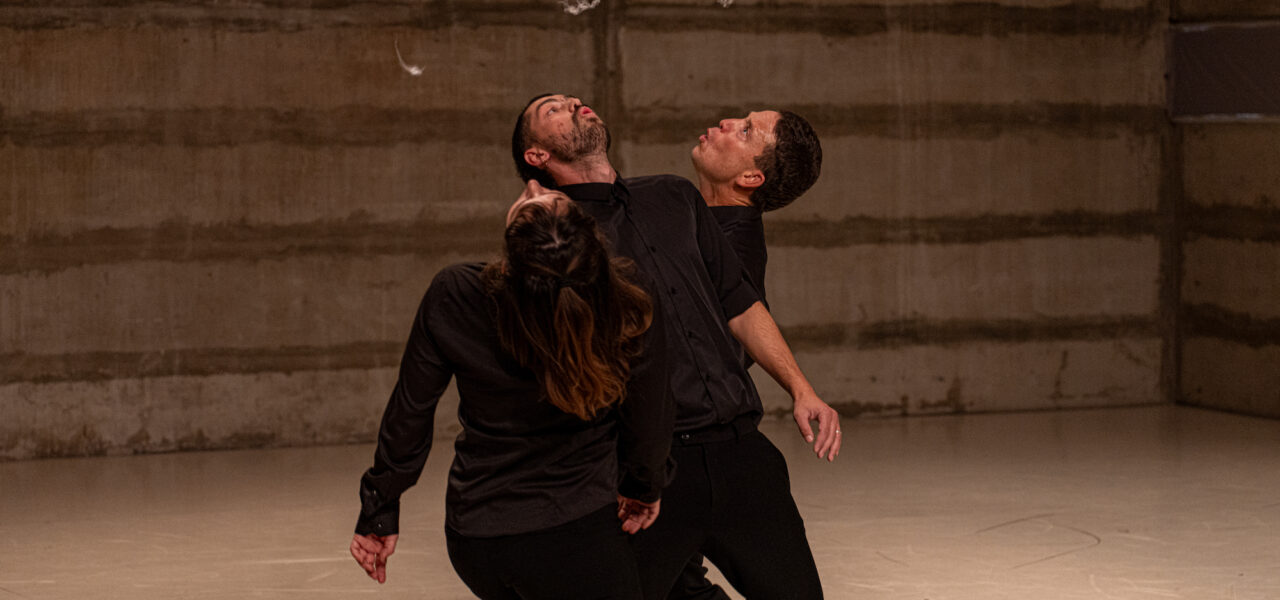
אלו המילים שהתנגנו בראשי במוצאי ערב שבת האחרון, בשעה שצפיתי ברקדן זיו קוטליצקי מתקדם אל מרכז אולם זהבה בסוזן דלל, שולף נוצה לבנה ומשגר אותה מעלה באמצעות נשיפה ארוכה של אוויר שלכד בריאותיו, פרישת בית החזה והטייה של הגולגולת והצוואר לאחור בתנוחת ה-high release השגורה במחול המודרני, שברגע אחד הופקעה לחלוטין מההקשר המסוגנן שעימו המחווה הגופנית הזו מזוהה.
על אף שעמד ישירות אל מול הקהל שהתגודד סביבו בשורות צפופות כדי לצפות במופע Keep It Up, שום דבר בנוכחותו של קוטליצקי לא תבע תשומת לב מיוחדת או היה חגיגי במיוחד עד ששלף את הנוצה שלו. שפת גופו כשהילך על הבמה הייתה ניטרלית, החולצה המכופתרת השחורה, הרכוסה עד הצוואר ומכנסי העבודה השחורים שעטה שיוו לו מראה של פועל במה, וההבעה שלו הייתה מרוקנת, חתומה, כמעט בלתי חדירה.
אך מרגע ששחרר לאוויר את הנוצה שלו והחל לנשוף עליה, מתעקש להשאירה מרחפת בחלל, הייתי ממוגנטת לכל תנועה שלו – עד שכמעט לא שמתי לב שבהדרגה הצטרפו אליו ארבעה פרפורמרים נוספים: מיכל הולצמן, גיל צירלין, דרור ליברמן וקזויו שיונוירי (ליברמן ושיונוירי הם שני היוצרים העומדים מאחורי העבודה, שנוצרה תחת מטריית Takedown Productions, השם שהם חולקים ככוריאוגרפים ופרפורמרים הפועלים בצמד מזה עשור). יחד, החמישה – לבושים כולם בתלבושת זהה לזו של קוטליצקי, ומקפידים על הבעה מרוקנת ככל האפשר, שהלכה ונמלאה חיות, נטענת במגוון משמעויות ככל שהעבודה התקדמה – יצאו למסע, שבמהלכו כל אחד ואחת מהם.ן רקדו דואט (ולעיתים גם טריו, וקוורטט; עוד על כך בהמשך) עם נוצה משלהם.ן. כשכבר החלו, קשה היה להתיק את המבט מכל אחד מהם.ן, והעיניים התרוצצו ביניהם.ן לאורכו ולרוחבו של החלל, חוששות להחמיץ אפילו את המחווה המינורית ביותר.
ואכן, מינוריות היא נקודת המוצא, או סוד הקסם של היצירה. יש משהו אמיץ להפליא בבחירה הכוריאוגרפית הזו, שהיא בגדר חשיפה של מנגנון הפעולה המכונן את המופע החל משניותיו הראשונות ועד לסופו, כעבור קצת פחות משעה מאוחר יותר. נוכח הנטייה הרווחת של יוצרי מחול להיעזר באינספור תכסיסים בימתיים העומדים לרשותם – החל מפסקול דרמטי וכלה בנגינה חיה על גבי הבמה, מתלבושות צבעוניות ועד שימוש במגוון אביזרים – החלטתם של ליברמן ושוינוירי לירות את אקדח הכוונה המטאפורי שלהם כבר במערכה הראשונה ולתת להדף להניע אותם ואת הפרפורמרים הפועלים עימם, מבלי להישען על אף גירוי או מניפולציה תיאטרלית אחרים, אינה רק אמיצה אלא גם נדיבה. זוהי החלטה נדיבה משום שהיא נותנת אמון בצופים מעצם הבקשה שהיא מציבה בפנינו: להתמסר לחווית צפייה עשירה אך מדודה, כמעט מדיטטיבית, שנפרשת באיטיות כמניפה בעולם בו אנו רגילים שכל החושים שלנו מותקפים בכל עת, מכל הכיוונים, על ידי אינסוף גירויים, הן במציאות והן באמנות (שלעיתים קרובות מהדהדת את העודפות המאפיינת את העידן בו אנו חיים.ות).
סימפוניה של הישרדות
אפשר לתמוה נוכח המינימליזם הצורני הזה, אפשר אפילו להתבלבל לרגע ולחשוב: “מה כבר יכול לקרות על הבמה אם זה מה שהם יעשו במשך שעה?”, אך זו תהיה טעות, שכן העבודה הזו היא מופת של תחכום פרפורמטיבי מעודן. יחד, חמשת מחוללי הנוצות מראים לנו שכאשר הבמה מתערטלת מאיפורי התפאורה, הפנים חפות מאקפרסיביות מבוימת והגוף לא מבצע פראזות תנועתיות בתוך החלל לשם ביצוען אלא ביחס ישיר לאובייקט ובמטרה להניעו, הכל יכול לקרות. כשגופיהם של הפרפורמרים מכוילים כולם כמיתרים מתוחים, מוכווני מטרה אחת בלבד – להשאיר את הנוצות באוויר, to keep it up, כפי ששם היצירה מרמז – אזי הם נחשפים במלוא פגיעותם ועוצמתם המטלטלות, ולרגעים אף נחווים כפסלים אנושיים נושמים, רוטטים, מזיעים, מתקרבים זה לזה, מצטלבים במסלולי המרדף האינדיבידואלים שלהם ושוב מתרחקים. הראשים שמביטים מעלה, בתי החזה שעולים ויורדים כמטרונומים המכתיבים את קצב התנועה ואת קצב ריחופן וצניחתן של הנוצות, השפתיים המשתרבבות לנשוף אוויר, שכמות שמתחככות ברצפה כשפלג הגוף העליון נגרר לאורכה, כפות הרגליים שמחליקות על הקרקע ומוצאות בה נקודות משען ארעיות על מנת להתגלגל על הגב או על הגחון, העיניים שמפלבלות, ממצמצות כנגד פנסי התקרה ומתאמצות לעקוב אחר הנוצות הכמעט שקופות שנטמעות באוויר – כל איבר וכל תנוחה, יחד ובנפרד, הופכים לכלים מרהיבים המפיקים בתנועתם את מנגינת הסימפוניה של השתדלות, שלא לומר הישרדות.
קצת בדומה לדיקינסון, שאת שירה ציטטתי בפתח דברי, גם השפה הבימתית של ליברמן ושוינוירי בעבודה הזו רזה ומפוסקת בהחלטיות, מחולקת לשלל סצינות שאמנם נובעות מגופם של הפרפורמרים באופן קולח שנראה אינטואיטיבי אך ברור שהן מתוכננות לעילא ובקפידה. בדומה לדיקינסון, שמדמיינת לעצמה תקווה בתור “דבר עם נוצות” ומתווה מהלך הדרגתי של נפש שנאחזת באותו רגש נוצתי בעיקשות, רגש שהולך ומתחדד מדימוי לדימוי ומשורה לשורה (“שמעתי אותה בארצות הקרה- ובים הזר והסעור – אך מעולם – גם ברע – לא ביקשה ממני פירור”) , גם אצל ליברמן ושוינוירי המצב ההתחלתי הפשוט-לכאורה – חמישה פרפורמרים עומדים על במה, נושפים על נוצות, מתעקשים להשאירן באוויר לא משנה מה, כנגד חוקי הגרביטציה שמאיימת להפילן – הוא מצע להשתרשרותה של סדרה של מצבים ודימויים שהולכים ומתפתחים, מתפרקים ומתלכדים, לפרקים מצחיקים ולעיתים מפלחי לב, ובעיקר: ישירים, ברורים, לא מתאמצים להציג או להשיג משהו שהם לא, אך כן מתבוססים במאמץ פיזי ומנטלי כאחד.
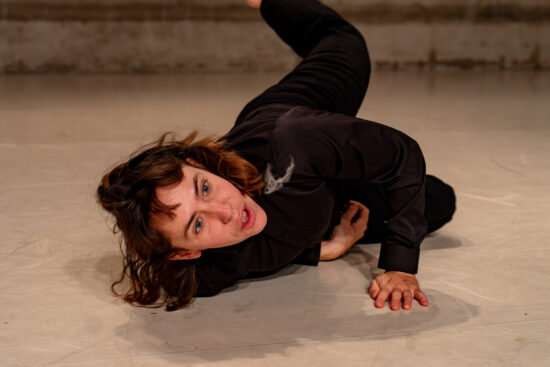
Photo Omer Radak
בתוכנייה אני קוראת שמדובר בעבודה השלישית מתוך טרילוגיה של היוצרים הנקראת “עבודות עמל”; לדאבוני לא ראיתי את שתי העבודות שקדמו לה, אך אני בהחלט יכולה להבין למה החליטו למקם את היצירה הנוכחית תחת הכותרת של משפחת העבודות הזאת. העמל אליו ליברמן ושוינוירי מתייחסים בכותרת הטרילוגיה וממשים בצורה כה פואטית ביצירה זו, אותה עבודה מאומצת שמתחיל קוטליצקי לבדו ומקבלת פרשנות תנועתית אישית אצל כל אחד ואחת מהרקדנים.ות, הוא העמל מז’אנר ריקודי המטלות (Task Dances) – סוגת מחול שפותחה בארה”ב של שנות ה-60 על ידי חברי קבוצת תיאטרון-מחול ג’דסון ובה המטלה הפיזית העומדת בלב היצירה היא המפתח לתנועתו.ה של הרקדן.ית.
חוקרת הפרפורמנס ד”ר ג’וזפין ויקסטרום מיטיבה להגדיר את כוחה המהפנט של סוגת מחול זו: “המתח בעבודות הללו הופך אותן למעין ‘בעיה אפיסטמולוגית’ במובן הקנטיאני (הכרוך בשאלת גבולות האפשרות). אך בעוד שהאפיסטמולוגיה של קאנט דנה בתנאי אפשרות החוויה והידע האוניברסליים, במרכזה של צורת המחול הזו ניצבת שאלת הגבולות והתנאים של האמנות”. (תרגום שלי מתוך הספר Practices of Relations in Task-Dance and the Event-Score, הוצאת רוטלדג’, 2021, עמ’ 16).
ריקוד בין הכובד לחסד
היצירה Keep It Up מוצלחת משום שהיא מתעקשת, מעצם אורח הפעולה המניע אותה, לקיים את הדיון האפיסטמולוגי בדבר גבולות המדיום המחולי. אך מה שהופך את העבודה הזו לכה מפעימה הוא העובדה שיוצריה לא נשארו רק בגבולות הטריטוריה הפיזית, בבדיקה של מה מניע תנועה ואיך יכול להיראות מאמץ הכרוך במנגנון הנשימה (שכן, מטלת השארת הנוצות תלויות בין שמיים וארץ כרוכה במאמץ רב של הריאות ובריכוז רב של המבט וכל תשומת הלב הגופנית של הפרפורמרים.ות). הם השכילו להפוך את הבדיקה הזו לנקודת מקפצה, שממנה הם צוללים למחקר של יחסים: של הרקדנים.ות זה עם זו, שלהם.ן מול עצמם.ן, ושלהם.ן אל מול העולם.
בספרה “הכובד והחסד” (1947), הפילוסופית והמיסטיקנית הצרפתייה סימון וייל קבעה כי “כל תנועות הנפש נשלטות על ידי חוקים מקבילים לחוקי כוח-הכובד בחומר. יוצא מן הכלל יחיד הוא החסד… ככלל, מה שאנו מצפים לקבל מאחרים נקבע על-ידי פעולת כוח-הכובד עלינו: מה שאנו מקבלים מהם נקבע על-ידי פעולת כוח-הכובד עליהם. לפעמים, שני הדברים תואמים הדדית (במקרה); תכופות לא”. אי אפשר לצפות בחמישייה נאבקת בכוח הכובד, מנסה לקרוא עליו תיגר, לקיים איתו, עם הנוצות, עם עצמם.ן וזה עם זו משא ומתן מבלי לחשוב על מילותיה של וייל, ולראות בגופים המתנועעים שלהם.ן מעין התגלמות עכשווית של מילותיה.
המשחק שליברמן ושוינוירי יצרו מושתת על מבנים כוריאוגרפיים של מאבק, שנקטע לעיתים לטובת הקלה שמאפשרת להם וגם לנו, הצופים, להסדיר נשימה, עד שהיא נעלמת כשם שבאה. הנה הרקדן גיל צירלין מתקרב לרקדנית מיכל הולצמן, ושניהם מתאחדים עם קוטליצקי; לרגע אחד הם דבוקה אחת, כמו אחים לאותה משפחה. הם נושמים ונושפים, עד שמישהו מהם נדחק החוצה, ואז שוב, ושוב, כמו בתיגרת אחים שיוצאת משליטה. הולצמן מתקרבת אל צירלין, מניחה לעמוד השדרה שלה להתפתל ולזרועותיה להיכרך סביבו, אך הוא הודף אותה בכוח עד שהיא כמעט נופלת, והלב נחמץ. ואז, בבת אחת, נחמה: שוינוירי וליברמן מתקרבים זה לזו בדואט ארוך, כמו מוצאים זה את זו משני עברי העולם. ידיו תופסות את ראשה, זרועותיה מונחות על כתפיו, המרחק ביניהם שואף לאפס, ההישרדות האינדיבידואלית ביקום הופכת לשיתוף פעולה פלאי, לזוגיות. הרבה אחרי שהם מתרחקים זה מזו, נותנים לסחף התנועה והמרדף אחר הנוצות לקחת אותם הלאה, הדימוי של האחדות שלהם ממשיך להדהד אחריהם במרחב, רישום רגעי ויפהפה של חסד שנצרב בתודעה גם ואולי בגלל שפתע נגמר.
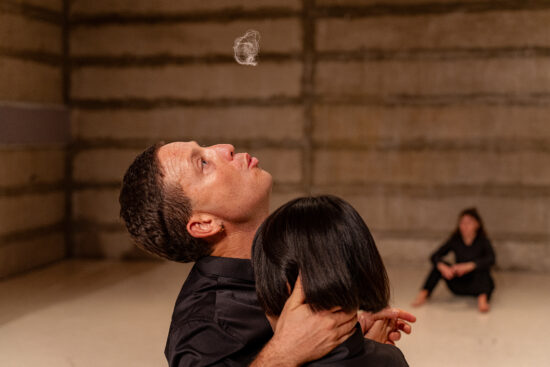
Photo Omer Radak
לכל אחד ואחת מהרקדנים.ות ישנה דרך משלו להחזיק את גופם.ן ולהניע אותו, לקיים את המטלה. הדרכים השונות הללו מצטיירות כאנלוגיה לדרכים הרבות והמגוונות שבהן אנו מתמודדים עם עול הקיום. בתחילת העבודה ולאורך מקטעים רבים מתוכה, דרכה של שוינוירי היא אצילית, מתונה ומאופקת-משהו: מבטה רך אך דרוך וממוקד להפליא בעת שהיא מתקדמת ונסוגה לאט על ברכיה, נשענת על עקביה בריכוז, כמעט ולא משה מהתנוחה שוודאי מכאיבה לאורך זמן, ודורשת ממנה התמדה וסיבולת. לעומתה, ליברמן מציג לאורך העבודה איכות עקבית במידה שווה, אך נבדלת – זו של כוח מתפרץ. הוא שובר קשר עין עם הנוצה שלו, מסב אליה את גבו, מתרחק ממנה מרחק רב ואז פוצח בריצה בעוד שהנוצה צונחת בזריזות מטה. כדי להשאירה באוויר, הוא מנמיך גובה כמו עיט שפתע צולל אל טרף, צונח אל הרצפה אך אף פעם לא מתרסק אלא מתגלגל בחינניות שוב ושוב באינספור כיוונים, מאזן את המשקל שלו מבלי לאבד מגע עם הנוצה שלעברה הוא נושף, מתעקש להפיח בה חיים כנגד כל הסיכויים. כשהקומפוזיציה מגיעה לכדי מאזן, ליברמן הוא זה שמפר את השלווה, או מחולל את העלילה – כשהוא פורץ בספרינט מצידו האחד של האולם לקצהו השני, או כשהוא מחליט, באיבחה אחת, להפנות את ראשו בחדות ולהתחיל לרוץ במעגלים, ריצה שאליה מצטרפים.ות האחרים.ות. בדומה לו, גם צירלין מרבה למתוח את גבולות הסיבולת שלו-עצמו. הוא מרפה מהנוצה שוב ושוב, בודק בהפגנתיות עד כמה הוא יכול להתרחק ממנה, לפרקים אפילו יוצא לעמוד בשולי הסטודיו או בינות המושבים, עד שהוא חוזר בריצת אמוק אל הבמה ומשתטח על הרצפה בסדרה של התרסקויות-הצלות שהן נועזות ומרוממות נפש כשם שמכאיב לצפות בהן.
היצירה נגמרת כמעט כמו שהחלה. ארבעת הרקדנים נסוגים, משאירים את קוטליצקי לבדו. הם יושבים בשורה, גבם לקהל, כמו מהדהדים עבורנו את העובדה שהיינו עדים אילמים לניסיון המתמיד, חסר התוחלת שלו, שהוא למעשה תמונת מראה של ההתנסות הקיומית חסרת הפשר של כולנו. כשאני מתבוננת בו עומד בדד כפי שעמד בתחילת העבודה, נושם ונושף אל עבר הנוצה, אין זכר לשובל התנועות שהתקיימו איתו ולצידו ואין הכרעה במאבק. האמנם?
הרי הוא עבר כל כך הרבה, וכך גם הארבעה שאיתו, וכל מי שהביט בהם. לרגע הוא נראה לי כמו סיזיפוס מודרני, רק שבמקום לגרור סלע במעלה ובמורד ההר הוא מנשים נוצה. המחשבות שלי נודדות למסה “המיתוס של סיזיפוס”, שפירסם הפילוסוף אלבר קאמי ב-1942 ובה ניסח את עיקרי משנתו האקזיסטנציאליסטית. קאמי מציג את דמותו המיתית של סיזיפוס, שנידון לחיי סבל מעגליים שלא נגמרים, כמטאפורה לחייהם של בני האדם המודרניים. אצל קאמי אין חשיבות לתוצאה או ליעד של סיזיפוס, אלא לפעולתו החוזרת ונשנית, המגלמת את עצם הקיום. הרבה אחרי שהאורות באולם זהבה נדלקים, החמישה משתחווים נוכח מחיאות הכפיים ואני נפלטת אל הרחוב, אני עוצמת את העיניים ומדמיינת את הנוצות מרחפות באוויר, את ההכרח to keep it up. אני חושבת על טענתו של קאמי בדבר הסיכוי למצוא משמעות על אף הטרגדיה שבמטלה הסיזיפית. המשמעות, הוא כתב, מצויה במרד, בחירות ובתאווה; הם אלו שהופכים את הגורל לנסבל. הם גם העקרונות שכה נוכחים בעבודה הזו, ולכן הופכים אותה לכזו מטלטלת. כשאני מפלסת דרך בין המוני הצופים שבאו לראות את ההופעות האחרונות הנועלות את הפסטיבל, אני נזכרת שאת הפרק האחרון בספרו קאמי חתם במילים: “יש לחשוב על סיזיפוס שמח”.
Keep It Up עלתה במסגרת “חשיפה בינלאומית למחול” 2025 במרכז סוזן דלל ב-6.12.2025.
Hope Is a Thing with Feathers: Thoughts on Keep It Up, by Dror Liberman and Kazuyo Shionoiri
By Joy Bernard
“Hope is the thing with feathers—
That perches in the soul—
And sings the tune without the words—
And never stops—at all—”
—from “Hope Is the Thing with Feathers” by Emily Dickinson.
These were the words playing in my mind last Saturday night, as I watched dancer Ziv Kotlitzky advance toward the center of the Zehava Hall at Suzanne Dellal. He pulled out a white feather and sent it upward with a long exhalation of air stored in his lungs, opening the chest and tipping the skull and neck back in the high-release position familiar from modern dance, though in a single moment, the gesture was stripped entirely of the stylized context with which it is normally associated.
Even though Kotlitzky stood directly before the audience, gathered around him in tight rows to watch Keep It Up, nothing in his presence demanded special attention nor felt particularly ceremonial, until he drew that feather. His body language as he walked onstage was neutral; the black buttoned-up shirt and black work pants he wore made him look like a stagehand; his expression was drained, sealed, almost impenetrable.
But from the moment he released the feather into the air and began blowing on it, insisting it stay floating in the space, I found myself magnetized by his every movement — so much so that I barely noticed four more performers gradually joining him: Michal Holtzman, Gil Zirlin, Dror Liberman, and Kazuyo Shionoiri (Liberman and Shionoiri are the creators behind the work, made under the umbrella of Takedown Productions, the name they share as a choreographic and performance duo for the past decade). Together, the five, dressed identically to Kotlitzky, maintaining expressions as emptied-out as possible, faces that slowly filled with vitality and accumulated meanings as the work unfolded, set out on a journey in which each performer danced a duet (and at times a trio or quartet; more on that later) with their own feathers. Once they began, it was nearly impossible to take one’s eyes off any of them. My gaze darted across the space, afraid to miss even the smallest gesture.
A Minor-Key Symphony
Indeed, smallness is the starting point, the secret of the piece’s magic. There is something remarkably brave in this choreographic choice, which is nothing less than an exposure of the mechanism that drives the performance from its first seconds until its end, just under an hour later. Given the widespread tendency among dance makers to rely on the countless theatrical tricks at their disposal, from dramatic soundtracks to live music, from colorful costumes to an array of props, the decision by Liberman and Shionoiri to fire their metaphorical “starter pistol” already in the first act and let its recoil propel them and their performers forward, without leaning on any other theatrical stimulus or manipulation, is not only brave but generous. It is generous because it places trust in the audience through the very demand it makes of us: to surrender to a viewing experience that is rich yet measured, almost meditative, unfolding slowly like a fan in a world where we are used to having our senses attacked at all times and from all directions, both in life and in art (which so often echoes the excesses of our era).
One might wonder, faced with this formal minimalism, “What could possibly happen onstage if this is what they will do for an hour?” But that would be a mistake, for this work is a model of refined performative sophistication. Together, the five feather-bearers show us that when the stage is stripped of its scenic make-up, when the faces are free of staged expressivity and the body does not perform movement phrases merely for their execution but only in direct relation to the object, with the purpose of propelling it, anything can happen. When the performers’ bodies are tuned like taut strings, directed toward a single goal, to keep the feathers in the air, to keep it up, as the title suggests, they are revealed in all their vulnerability and tremulous strength.t times they even resembled breathing human sculptures: vibrating, sweating, drawing near, crossing one another’s paths in their individual pursuits, then diverging again. Heads tilted upward; chests rising and falling like metronomes dictating both bodily tempo and the fluttering of the feathers; lips pursed in exhalation; shoulders scraping the floor as torsos drag along it; feet sliding to find temporary footholds before rolling onto back or belly; eyes blinking against the ceiling lights, straining to track the nearly transparent feathers dissolving into the air — every limb and posture, together and apart, becomes an exquisite instrument playing the symphony of effort, not to say survival.
Like Dickinson’s Feathered Feeling
A little like Dickinson, whose lines opened this review, Liberman and Shionoiri’s stage language is lean and decisively punctuated, divided into scenes that emerge fluidly from the performers’ bodies in a way that appears intuitive, though clearly crafted with precision. As Dickinson imagines hope as “a thing with feathers,” outlining a gradual course of a soul clinging stubbornly to that feathery feeling, growing sharper from image to image, line to line (“I’ve heard it in the chillest land— / And on the strangest Sea— / Yet, never, in Extremity, / It asked a crumb—of Me.” )— so too in this work, the seemingly simple initial circumstance — five performers standing onstage, blowing at feathers, insisting they stay aloft against gravity, is a ground for a chain of evolving states and images: decomposing, coalescing, sometimes funny, sometimes heart-piercing, always direct, clear, unpretentious, yet steeped in both physical and mental effort.
Photo Omer Radak
The program notes explain that this is the third work in a trilogy titled “Labors of Work.” I have not seen the previous pieces, to my regret, but I can certainly understand why the creators placed this work under that thematic umbrella. The “labor” referred to in the trilogy’s title, and made so poetically manifest here, beginning with Kotlitzky’s lone effort and transformed by each dancer into their own movement interpretation, is the labor known from task-based dance: a genre developed in the Judson Dance Theater of the 1960s in the U.S., in which the physical task at the heart of a work becomes the key to the dancer’s movement.
Performance scholar Dr. Josefine Wikström captures the genre’s hypnotic power:
“The tension in these works turns them into a kind of ‘epistemological problem’ in the Kantian sense (concerning the limits of possibility). Yet while Kant’s epistemology addresses the conditions of universal experience and knowledge, at the center of this dance form stands the question of the limits and conditions of art.”
(from Practices of Relations in Task-Dance and the Event-Score, Routledge, 2021, p. 16)
Between Gravity and Grace
Keep It Up succeeds because it insists, through its own modus operandi, on engaging the epistemological question of dance’s boundaries. But what makes it so moving is that its creators do not remain solely within physical territory, questioning what motivates movement or how exertion manifests in breathing (for indeed, the task of keeping the feathers suspended requires enormous lung effort and intense focus of gaze and bodily attention). They turn this inquiry into a springboard for exploring relationships: between the dancers, between each dancer and themselves, and between them and the world.
In her book Gravity and Grace (1947), the French philosopher and mystic Simone Weil wrote: “All the movements of the soul are controlled by laws analogous to those of physical gravity. The only exception is grace… As a rule, what we expect from others depends on the effect of gravity upon ourselves; what we receive from them depends on the effect of gravity upon them.” It’s impossible to watch the five struggle with gravity, challenging it, bargaining with it, with the feathers, with themselves and each other, without recalling Weil’s words, and seeing in their moving bodies a contemporary embodiment of her insights.
The game Liberman and Shionoiri constructed is built on choreographic structures of conflict. At times the struggle is interrupted by moments of relief that allow them, and us, the viewers, to catch our breath, until that relief vanishes as suddenly as it arrived. Here is dancer Gil Zirlin approaching dancer Michal Holtzman, and the two of them join with Kotlitzky; for a moment they are a single cluster, like siblings of the same family. They inhale and exhale until one of them is pushed out, and then again, and again, like a sibling brawl spiraling out of control. Holtzman approaches Zirlin, letting her spine twist and her arms coil around him, but he pushes her away forcefully until she nearly falls, and the heart clenches. And then, suddenly, solace: Shionoiri and Liberman approach one another in a long duet, as if finding each other from opposite ends of the world. His hands hold her head, her arms rest on his shoulders, the distance between them collapsing almost to nothing. Individual survival in the universe transforms into wondrous cooperation—into partnership. Long after they drift apart, letting the pull of movement and the chase after their feathers carry them onward, the image of their unity continues to echo across the space, a fleeting, beautiful imprint of grace etched in the mind, perhaps precisely because it ended so abruptly.
Photo Omer Radak
Each dancer has their own way of holding and moving their body, of fulfilling the task. These differing approaches form an analogy to the many varied ways we cope with the burden of existence. At the beginning of the piece, and throughout much of it, Shionoiri’s mode is noble, measured, somewhat restrained: her gaze soft yet astonishingly focused as she moves forward and back slowly on her knees, leaning on her heels with concentration, hardly shifting from a posture that surely becomes painful over time and demands perseverance and stamina. In contrast, Liberman maintains a similarly consistent but distinct quality, one of explosive power. He breaks eye contact with his feather, turns his back to it, distances himself dramatically, then bursts into a run as the feather drops quickly downward. To keep it aloft, he lowers his body like a bird of prey suddenly diving, plunging toward the floor but never crashing—rolling gracefully again and again in countless directions, balancing his weight without losing contact with the feather he blows toward, determined to breathe life into it against all odds. When the composition settles into balance, Liberman is the one to disrupt the calm, or propel the narrative—by sprinting from one end of the hall to the other, or by suddenly whipping his head sharply and beginning to run in circles, a run the others soon join. Like him, Tzirlin repeatedly pushes the boundaries of his own endurance. He releases the feather again and again, testing theatrically how far he can get from it, sometimes even stepping to the studio’s edge or among the seats, before racing back in a frantic dash and hurling himself onto the floor in a series of crash-and-save movements, daring and uplifting, yet painful to watch.
The piece ends almost as it began. The four dancers retreat, leaving Kotlitzky alone. They sit in a row, their backs to the audience, as if echoing for us the fact that we have been silent witnesses to his constant, futile effort — a mirror of our own senseless existential striving. As I watch him standing alone just as he did at the start of the piece, inhaling and exhaling toward the feather, there is no trace of the trail of movements that existed with and around him, and no resolution to the struggle. Or is there?
After all, he has been through so much, and so have the four who joined him, and everyone who watched them. For a moment he seems to me like a modern Sisyphus, only instead of hauling a boulder up and down a mountain, he is animating a feather. My thoughts drift to The Myth of Sisyphus, the essay philosopher Albert Camus published in 1942, in which he articulated the core of his existentialist thought. Camus presents the mythic figure of Sisyphus, condemned to endless circular suffering, as a metaphor for modern human life. For Camus, the outcome or goal of Sisyphus’s labor is irrelevant, what matters is the repeated act itself, embodying the very essence of existence. Long after the lights in the Zehava Hall come up, the five bow to applause and I spill out into the street, I close my eyes and imagine the feathers floating in the air, the necessity to keep it up. I think of Camus’s claim that meaning can be found despite the tragedy of the Sisyphean task. Meaning, he wrote, lies in rebellion, freedom, and desire; these are what make fate bearable. They are also the principles so deeply present in this work, and therefore what make it so powerful. As I weave my way through the crowds who came to see the closing performances of the festival, I recall that Camus ended his book with the words: “One must imagine Sisyphus happy.”
Keep It Up was presented as part of International Exposure for Dance 2025 at the Suzanne Dellal Center on December 6, 2025.
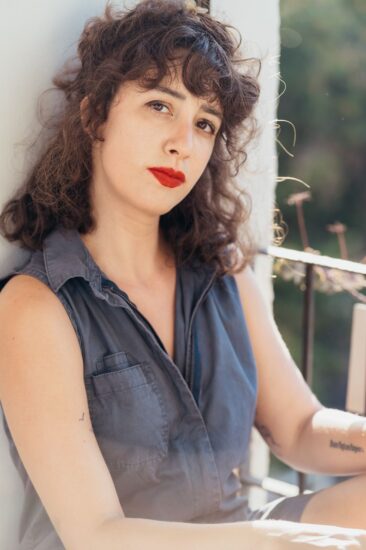
Joy Bernard is a choreographer, dancer, actress, multidisciplinary artist and writer. She creates in dance, physical and visual theater, writing, video and sound. She has been commissioned to create and perform her works in various museums, galleries, dance and film festivals across Israel, Europe and Asia.
For the past decade, in addition to her artistic practice Joy has been working as a journalist and critic, specializing in visual arts and dance. Her writing has been published in numerous newspapers and journals, such as: Haaretz, The Jerusalem Post, Flash Art, Collectors Agenda, The Art Newspaper, Portfolio Magazine, Erev Rav, literary magazine Granta and others. She has been a member of the Creative Writing team since 2024.
Joy holds a B.Dance from the Jerusalem Academy of Music and Dance, where she is currently attaining her M. Dance. She is presently training to become a Feldenkrais teacher and therapist.