
בשבח השאלות: רשמים של ג’ני בירגר על ‘דברים ראשונים’ מאת מיכאל גטמן
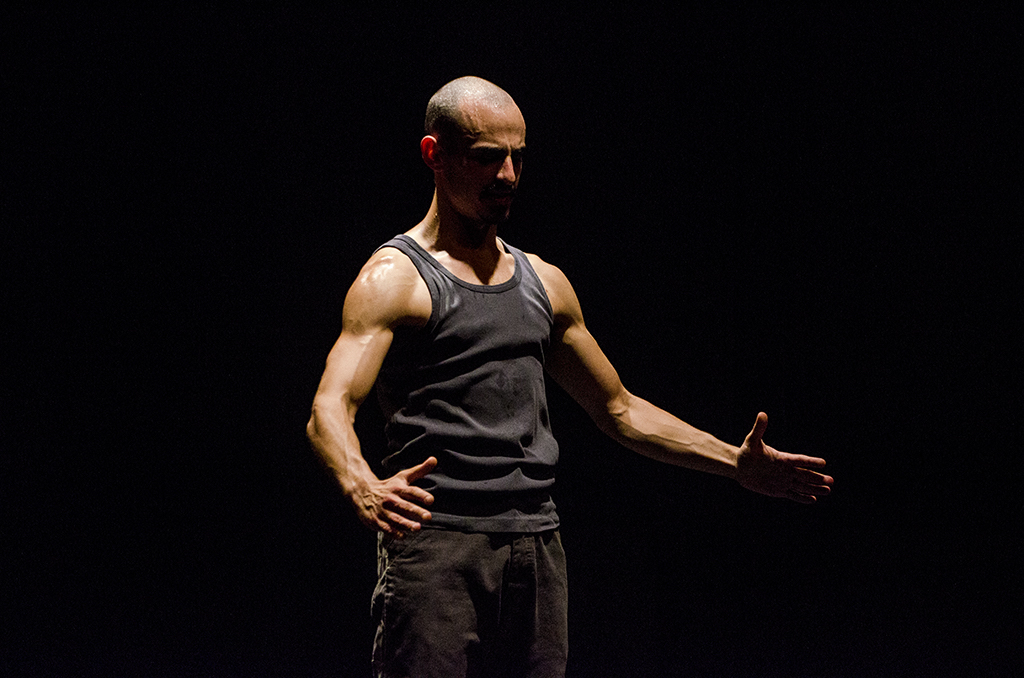
Photo by Cecchini
*English follows
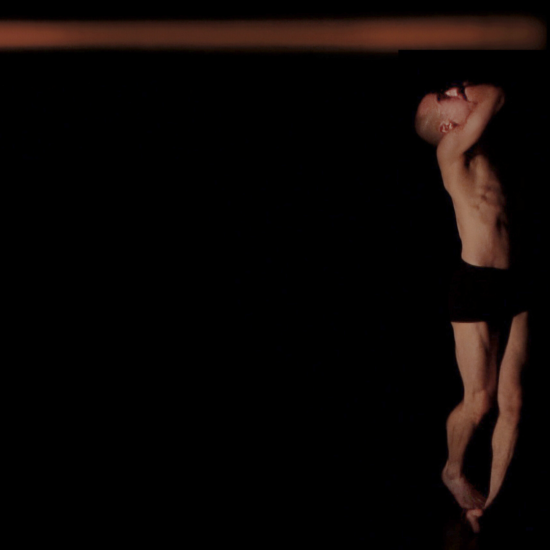
Photo Nadia Chen Perlov
“אומרים שהמשפט הראשון בכל נאום הוא הקשה ביותר. הנה הוא מאחוריי”. מילותיה של המשוררת ויסְלָבָה שימבורסקה מדגישות את הרטט המיוחד של הדבר הראשון, שהעז להפר את שלוות הדף הלבן ולהציע מילים ורעיונות שאולי עוד ישתנו וימחקו, אך נבנים כולם על אותו רגע דרמטי שבו המציאות השתנתה מאין ליש. הראשון משמעותי מכל מספר אחר, גבוה ככל שיהיה, והוא טומן בחובו את המעבר מן הנודע אל הלא נודע.
“דברים ראשונים” מאת מיכאל גטמן, בביצועו הווירטואוזי של אריאל גלברט, היא יצירה מרתקת, עמוקה ורבת פנים. רסיסי מידע טקסטואליים ומוסיקליים פוגשים כוריאוגרפיה מזוקקת, ויחד הם שואלים את השאלה הראשונית ביותר: מהי החוויה האנושית? כבר מעצם בחירת שמה מושכת היצירה אל תוך מבוך מחשבתי, שכן כיצד ייתכן שכמה דברים יהיו ראשונים? לאורך המופע, נגלה פעם אחר פעם שחשיבה רק תמשוך אותנו עמוק יותר לתוך הסבך, בעוד שהיכולת להישאר עם השאלות והרמיזות, מבלי למהר לענות עליהן, תאפשר לנו לצלול לתוך עצמנו.
היצירה בנויה משלושה פרקים, נפרדים אך גם מחוברים בחבל טבור אחד: גוף, קצב, שפה.
גוף
קול נשי רך ואסרטיבי מזמין את הקהל לכבות טלפונים ניידים, מזכיר שהצילום אסור בהחלט ומאותת שבעוד רגעים ספורים ירד החושך והמופע יתחיל. המופע אכן מתחיל, אך במקום החשכה התאורה מתעצמת עד כדי תחושה של נוכחות כמעט אלוהית על הבמה השחורה באולם ירון ירושלמי. עיניי מסונוורות באי-נוחות אך גם מתמלאות ציפייה. קשה לדעת כמה זמן נמשך הרגע הזה ואם הוא נחווה כארוך או קצר מן המציאות; עלומת האור הצליחה לערער את המצפן הפנימי של תחושת הזמן.
ההחשכה המיוחלת מגיעה לבסוף. בעוד ריבועים אדומים עוד מרצדים בשדה הראייה שלי, הרקדן אריאל גלברט נכנס לבמה, מתמקם ושוהה בתנוחה ראשונה. התאורה חוזרת, אך הפעם מאופקת ואפלולית, ומאפשרת להבחין בנוכחות הגוף מבלי להבין עדיין כיצד הוא מאורגן. אני תוהה מהו הצפון של גופנו, אותו עוגן המאפשר ניווט וקריאה של שאר האיברים המוחשכים. אולי התשובה מובנת מאליה, אך היא תפסה אותי לא מוכנה: רק ברגע שזיהיתי את ראשו ופניו הצלחתי להשלים את הפאזל ולפענח את התנוחה השלמה. הבמה מחשיכה שוב, ואריאל נע באיטיות אל עבר הדימוי הבא. גופו המרשים והמשורטט, חשוף מלבד בגד תחתון שחור, מאפשר התבוננות בכל שריר ונים, כמעט כמו צפייה בפסל של מיכלאנג’לו בתנועה. ההבנה דורשת זמן ומשאבים, בעוד שהחוויה החזותית מזינה את הדמיון מהרגע הראשון. תנועתו האיטית נותרת קרובה לקרקע ומאפשרת להעריך גוף שהוא מסה, דימוי ובו-בזמן תהליך מתמשך של השתנות. ברקע נשמעים צלילים שמזכירים קריאות של חיות וציפורים, לא תמיד נעימים, ומייצרים תחושה של הימצאות בטבע לא מבוית.
תנועות קטנות בכפות הרגליים ובאצבעות הידיים חודרות אל תוך הסטטיות הפיסולית. הן מביעות את עצמן בעדינות, כמו לוחשות מילה או שתיים, ושבות לשתיקה. אל תוך הפסקול חודרים בהדרגה צלילים אנושיים יותר, המרמזים על משמעות. כפי שהעיניים נזקקו לזמן כדי להסתגל לחושך, גם האוזניים מבקשות זמן לכיול מחודש ולהתמצאות במרחב המכיל את המילים “כן” ו”לא”. קול נשי מתוך הפסקול חוזר עליהן באנגלית, בנחישות הגובלת בדחיפות, אך בהיעדר הקשר אני נדרשת להמתין עם הפרשנות ולהתמסר אל המצלול והמקצב שהן מייצרות. גם תנועתו של אריאל משתנה. הוא מאפשר לגפיים להתפרץ לרגע, למשוך אותו ממקומו, ואז לשוב אל האיטיות והסטטיות. האם הוא מגיב למילים, או אולי המילים מגיבות לתנועתו? האנרגיה העצומה שגופו פולט בפולסים קצרים מרשימה ומפחידה בעת ובעונה אחת; זה כבר אינו הגוף של תחילת המופע. הכוח המתפרץ של הגפיים מאפשר לו להתרומם על רגליו, שלעיתים נכרכות זו בזו, משתרכות, אולי עדיין אינן מוכנות לגמרי לשאת את משקלו. פיו לופת את ידו במחוות ריסון עצמי, ואני תוהה אם מדובר בכאב או אולי במחווה של נחמה עצמית בתוך עולם בלתי צפוי, כמו שנאמר בביטוי: “מוטב הרע המוכר מן הטוב שאיני מכיר”.
הפיסוליות של תחילת הפרק שבה ומופיעה לעיתים בדמות פסלים שאני מזהה בגופו של אריאל, או לכל הפחות מדמיינת בעיני רוחי. כך למשל עולה לנגד עיניי “האיש החושב” של אוגוסט רודן, היושב כשאגרופו תומך בראשו הכבד ושקוע במחשבותיו. אלא שבעוד הפסל מציב את החושב בעמדה יציבה ובטוחה, כאן, תוך כדי תנועה, הדימוי נראה שפוף וכפוף לכוח המשיכה, כשאגרופו חלש מכדי לשאת את משקל הראש.
הפרק הראשון מסתיים כאשר אריאל יורד מן הבמה ומתיישב בשורה הראשונה, כצופה מן הקהל. גופו המתנשם והנוטף זיעה נושא עמו את זיכרון הדברים. תוך כדי שתייה, ניגוב הגוף והחלפת בגדים, הוא מכין את פרק מספר שתיים.
קצב
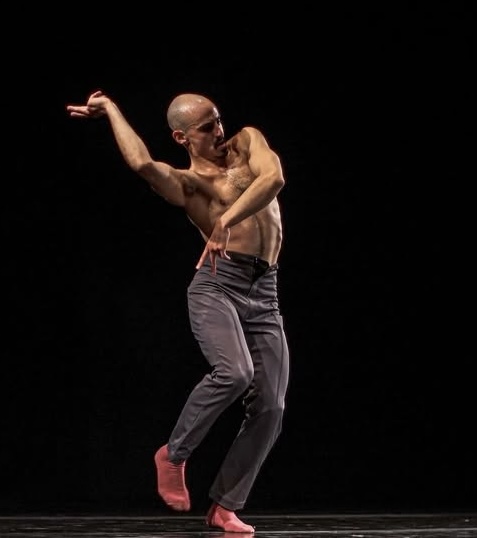
Photo by Fernanda Valius
השפה שלנו מורכבת ממשפטים, המורכבים ממילים, המורכבות מהברות. האפשרות לפרק דבר-מה לחלקים היא גם האפשרות לחבר אותו בדרכים חדשות. המילה האנגלית למפרק היא joint ובעוד שהאנגלית בוחרת ברעיון החיבור והעברית בפירוק, שתיהן נוגעות באמת אחת. אריאל, היושב עדיין על כיסאו בשורה הראשונה בקהל, מתחיל להפיק צלילים והברות שכמעט בוקעים בעל כורחם מגרונו ומניעים את גופו באימפולסיביות. מקצבם של עיצורים חורקים והברות שוברות-שיניים מניע אותו עד לעמידה, בעוד הפסקול ברקע מגמגם אף הוא ומשתעשע עם מילים (לימים אני לומדת שמדובר בהקלטות מתוך הספרים של גרטרוד שטיין). מה שנשמע תחילה כג׳יבריש מקבל בהדרגה אופי שפתי מובחן, ואני מתחילה לזהות גדמים של מילים ברוסית, בעברית ואולי גם בשפות נוספות שאינני מכירה. אריאל הופך לצינור שדרכו השפה בוקעת, בדרך לא דרך, מנותקת ומפורקת. גם בהיותו לבדו על הבמה, הוא עטוף באנשים שאיתם הוא מנהל ויכוחים, שיחות ערות ולעיתים אף מתלוצץ. זהו חלק מופתי ביצירה דווקא בהיותו מצוי באזור הביניים, לא שלם ולא מושלם, אך מדבר עם החלקים המוסתרים והעתיקים של הוויתינו, אולי כשבעצמינו עוד לא היינו שלם ומושלם.
לבוש במכנסיים אפורות וגבריים אדומות, אולי כרפרנס לסיפור והבלט שבא בעקבותיו “נעליים אדומות”, אריאל מתמקם במרכז הבמה והרעשים בתוכו ומחוצה לו נרגעים. אנחנו עוברים לסונטה מס. 1 לפסנתר מאת לודוויג בטהובן, אותה הוא מתחיל לנגן בכפות רגליו המיומנות. בדומה לחלק הקודם, אריאל מפרק ומרכיב מחדש שפות תנועה שונות, ביניהן אני מזהה את הבלט הקלאסי, פלמנקו, ריקודים קווקזיים, האוס וסגנונות נוספים שמקורם ברחוב. כל אחד מהם נושא עמו לקסיקון של תנועות וקודים, וכאן הם מתערבבים ללא בושה, כמו צבעי מים, מלכלכים זה את זה ומייצרים צבעים חדשים. הפוליריתמיקה שנכחה ביצירה מראשיתה מגיעה כאן לשיאים חדשים, וגם הפסקול משתנה ומתערער. בטהובן נאלץ לחיות עם קולות זרים של אמנים אחרים, מחיאות כפיים, חלק שנשמע כמו יודל, תיפוף אלקטרוני ועוד. המצפן מסתובב באי-נחת, אך אריאל נע מדבר לדבר במיומנות רבה ומרשימה – בין אם הפוקוס הוא על ההצלחה של פעולתו ובין אם דווקא מודגש הכישלון או הוויתור על המהלך אותו התחיל אך בחר שלא להשלים. שאלת ההצלחה שבכישלון הזכירה לי את עבודותיו של נואה סולייה, שמתעסק גם הוא בשאלות של שפה, לקסיקון ומערך הציפיות שנלווה אליהם. ביצירתו The Kingdom of Shades הוא משתמש בציפיות של הצופה שמכיר את לקסיקון הבלט הקלאסי ומייצר שפה תנועתית מרתקת של התחלות, כישלונות וחצאי-תנועות. מכישלון להצלחה, ממוכרות לזרות.
שאלה שהלכה בתחילת הפרק השני ורק התגברה, במקביל לקרשנדו של השכבות המוסיקליות השונות, נגעה במקור ההבדלים בין מילוני התנועה השונים. ללא ספק הקווים של הבלט הקלאסי נבדלים מהקווים של הפלמנקו או היפ הופ, אך בסופו של דבר כאן, הן חולקות במה אחת ומייצרות את התמהיל הייחודי המנגן את בטהובן נאמנה – ואולי אף יותר מדויק מכל סגנון בנפרד. אם לא הכרנו את השמות השונים הניתנים לכל טכניקה, האם היינו רגישים לשונות ביניהן באותה המידה? אריאל מתיישב שוב בשורה הראשונה, מחליף את בגדיו לסט האחרון, ואנחנו עוברים לפרק האחרון שאולי פותח את הדלת לתשובה.
שפה
אריאל חוזר ומתמקם במרכז הבמה. ידיו המיומנות עולו ונפגשות מעל הראש ומורידות שני אנכים כלפי מטה. הן נעצרות כאילו מחזיקות דבר-מה בלתי נראה ביניהן והמתח ביניהן מחשמל. This הוא אומר בסיום הפראזה התנועתית ומגדיר את המילה הראשונה בלקסיקון החדש, בו יש קשר בין הצורה של המילה והמשמעות שלה. This. המילה והתנועה חוזרים על עצמם, אך נבדלים באופן בלתי נמנע. ניתן לשכפל את המילה הכתובה אך במציאות של השפה המדוברת והנרקדת כאן מול עינינו, כל מבע הוא חד-פעמי. הבדלים קטנים במהירות, כיווניות, וטון הדיבור מייצרים עולם לתוכו אפשר לצלול למשך זמן רב.
Photo by Cecchini
Is היא המילה הבאה. כפות הידיים נעות לעבר הצוואר ונעצרות במרחק של כמעט מגע. כשיש כבר שתי מילים, אפשר להתחיל לשחק. באמצעות חזרתיות, שינויי סדר ואינטונציה, אריאל יוצר פראזות מרתקות, המשחקות בעת ובעונה אחת עם המשמעות ועם ההבעה התנועתית. Is this this? This is. Is this this this? המילה הכתובה לא תוכל להעביר את המורכבות של המשפטים הללו, ואת העונג הגלום בתוכם.
It. הידיים מושטות לפנים בהצלבה, פנים כף היד פונה אלינו, מחווה שהיא בין בקשה לדחיפה. מילה נוספת, מרחב נוסף. מהדו-מימד לתלת-מימד. שאלות ומשפטים מצטרפים זה לזה, נטווים לכדי טקסט לשוני ופיזי מדויק, מטלטל ומעורר. לעיתים השפה היא הסוס המוביל, ולעיתים זה הגוף, והכרכרה דוהרת במהירות.
מילים נוספות מצטרפות ומרחיבות את עושר המבעים ואת מורכבותם. זוהי שפה מסוג אחר, כזו הבוררת את מרכיביה בקפידה ומחברת בין הגוף למיינד. גם השפה התנועתית נבדלת מזו של הפרקים הקודמים. היא נדמית בסיסית יותר, נטולת סממני זהות מובחנים. תנועות יומיומיות, כמו מבט המופנה מעלה או מחוות ידיים של הטחת אגרופים הצידה, מופיעות כאן בפשטותן. הקשר בין צורת המילה למשמעותה לעיתים גלוי ולעיתים אישי יותר, אך תמיד נוכח. יכולתו של אריאל להיות רהוט הן במילים הנאמרות והן באילו הנרקדות מרשימה במיוחד; משמעות מביאה עימה מחויבות.
כשעליתי לארץ בגיל עשר, יכולתי להבין את המציאות נגדעה בבת אחת. העולם שנפרש בפניי, שכבר בשנות התשעים המוקדמות היה לח ודחוס, הרגיש מוכר וזר בעת ובעונה אחת. הכבישים היו כבישים, הפרחים היו פרחים, האנשים היו אנשים, אך זה לא היה מה שהכרתי. לחוסר ההבנה היו השלכות קיומיות, ולכן הצורך לדעת ולהבין קדם לכל – הראשון. דודתי, שעלתה שלוש שנים לפניי והייתה המקומית מבינינו, הסבירה לי שהפרח האדום שאני רואה בכל חצר הוא הוורד הישראלי. כך למדתי את המילה ורד. רק שנים אחר כך גיליתי שמדובר למעשה בהיביסקוס, ושאין קשר של ממש בין השניים. ובכל זאת, עבורי הם נותרו קשורים לעד, חברים בעולם של אי-הבנות וחוסר דיוקים. A rose is a rose is a rose כתבה גרטרוד שטיין ומזכירה לנו שהעולם שמעבר למילים קיים וממשי, ושלא משנה איך נקרא לדברים, הם נשארים הם עצמם. האמנם?
הפרק השלישי ביצירה פותח דלת לעולם חדש, שבו כל ורד הוא שונה וייחודי. המבע המילולי והפיזי מחוברים ומהדהדים זה את זה, ומאפשרים הבנה החורגת ממה שנקלט בחושים בלבד. הפסקול שמלווה את היצירה מתחילתה ועד סופה, הבנוי שכבות של שברי מילים, פיסות משפטים וחלקי פראזות מוזיקליות, מובא כאן במלוא עוצמתו (שלעיתים עוצמתי ועמוס מדי עבורי) ובמלוא חוסר שלמותו. חלקי הפאזל מפוזרים באולם ירון ירושלמי, ויופיה של “דברים ראשונים” טמון בכך שהם יכולים להתחבר לשברי הסיפורים והזיכרונות של כל אחד ואחת בקהל. הצלע התומכת מצויה בתוכנו, ודרכה ניתן לצלול אל תוך השברים של עצמנו וליצור דבר-מה חדש. To ask. אריאל מרים את מבטו מעלה, עבורי זהו זיקוק של האנושיות כולה. לאהוב את השאלות עצמן, כפי שרילקה כותב.
מיכאל גטמן הציג את ׳דברים ראשונים׳ ב25.12.2025 במרכז סוזן דלל.
In Praise of Questions
Impressions by Jenny Birger on First Things by Michael Getman
Photo Nadia Chen Perlov
“They say the first sentence of any speech is the hardest. Here it is, behind me.” The words of the poet Wisława Szymborska underscore the particular tremor of the first thing, the one that dared to disrupt the calm of the blank page and to offer words and ideas that may still change or be erased, yet are all built upon that dramatic moment in which reality shifted from nothingness into being. The first is more significant than any other number, however high it may be, and it holds within it the passage from the known into the unknown.
First Things by Michael Getman, performed with virtuosity by Ariel Gelbart, is a fascinating, deep, and multi-layered work. Fragments of textual and musical information meet a distilled choreography, and together they ask the most fundamental question: what is the human experience? From the very choice of its title, the work draws us into a conceptual labyrinth, for how can there be several first things? Over the course of the performance, it becomes clear again and again that thinking will only pull us deeper into the thicket, while the ability to remain with questions and hints, without rushing to answer them, allows us to dive inward.
The work is structured in three chapters, distinct yet connected by a single umbilical cord: body, rhythm, language.
Body
A soft yet assertive female voice invites the audience to switch off mobile phones, reminds us that photography is strictly forbidden, and signals that within moments the lights will go down and the performance will begin. The performance does begin, yet instead of darkness the lighting intensifies to the point of evoking an almost divine presence on the black stage of the Yaron Yerushalmi Hall. My eyes are dazzled uncomfortably, but also filled with anticipation. It is hard to know how long this moment lasts, or whether it feels longer or shorter than it actually is. The veil of light manages to unsettle the inner compass of time perception.
The longed-for blackout finally arrives. While red squares still flicker in my field of vision, the dancer Ariel Gelbart enters the stage, positions himself, and remains in an initial pose. The light returns, this time subdued and dim, allowing the presence of the body to be perceived without yet understanding how it is organized. I wonder what the north of our body is, that anchor which allows navigation and reading of the other darkened limbs. Perhaps the answer is obvious, but it catches me unprepared. Only when I recognize his head and face am I able to complete the puzzle and decipher the full posture. The stage darkens again, and Ariel moves slowly toward the next image. His striking, sculpted body, naked except for black underwear, allows observation of every muscle and sinew, almost like watching a Michelangelo sculpture in motion. Understanding requires time and resources, while the visual experience feeds the imagination from the very first moment. His slow movement stays close to the ground and allows appreciation of a body that is mass, image, and at the same time an ongoing process of transformation. In the background, sounds reminiscent of animal and bird calls are heard, not always pleasant, creating a sense of being in untamed nature.
Small movements in the feet and fingers pierce the sculptural stillness. They express themselves delicately, as if whispering a word or two, and then return to silence. Gradually, more human sounds enter the soundtrack, hinting at meaning. Just as the eyes needed time to adjust to the dark, the ears too ask for time to recalibrate and orient themselves in a space that contains the words “yes” and “no.” A female voice in the soundtrack repeats them over and over, with a determination bordering on urgency, yet in the absence of context I am asked to delay interpretation and surrender to the sound and rhythm they create. Ariel’s movement changes as well. He allows the limbs to burst out for a moment, pulling him out of place, and then to return to slowness and stillness. Is he responding to the words, or perhaps the words are responding to his movement? The immense energy his body emits in short pulses is impressive and frightening at the same time. This is no longer the body of the beginning of the performance. The eruptive power of the limbs enables him to rise to his feet, which at times wrap around each other, dragging, perhaps still not entirely ready to bear his weight. His mouth grips his hand in a gesture of self-restraint, and I wonder whether this is pain or perhaps an act of self-comfort within an unpredictable world, as the saying goes, better the devil we know than the one we don’t.
The sculptural quality of the beginning of the chapter reappears at times in the form of statues I recognize in Ariel’s body, or at least imagine in my mind’s eye. One such image is Auguste Rodin’s The Thinker, seated with his fist supporting his heavy head, immersed in thought. Yet while the sculpture places the thinker in a stable, secure position, here, in motion, the image appears slumped and subject to gravity, the fist too weak to carry the weight of the head.
The first chapter ends when Ariel steps off the stage and sits in the front row as a member of the audience. His breathing body, dripping with sweat, carries the memory of what has occurred. While drinking, wiping his body, and changing clothes, he prepares for chapter two.
Rhythm
Photo by Fernanda Valius
Our language is composed of sentences, composed of words, composed of syllables. The ability to break something down into parts is also the ability to reassemble it in new ways. The English word joint emphasizes connection, while the Hebrew parallel mifrak (root p.r.k.) emphasizes separation and disassembly – yet both touch upon the same truth. Ariel, still seated in his chair in the front row, begins to produce sounds and syllables that seem to burst involuntarily from his throat, moving his body impulsively. The rhythm of creaking consonants and tongue-twisting syllables drives him to standing, while the soundtrack behind him also stutters and plays with words. I later learn that these are recordings from the books of Gertrude Stein. What initially sounds like gibberish gradually takes on a distinct linguistic character, and I begin to recognize stumps of words in Russian, Hebrew, and perhaps other languages I do not know. Ariel becomes a conduit through which language erupts, in a roundabout way, detached and fragmented. Even as he stands alone on stage, he is surrounded by people with whom he argues, conducts lively conversations, and at times even jokes. This is a masterful part of the work precisely because it exists in an in-between zone, not whole and not complete, yet speaking to the hidden and ancient parts of our being, perhaps from a time when we ourselves were not yet whole and complete.
Dressed in gray trousers and red men’s shoes, perhaps a reference to the story and ballet The Red Shoes, Ariel positions himself at the center of the stage, and the noises inside and around him subside. We move to Piano Sonata No. 1 by Ludwig van Beethoven, which he begins to play with his skilled feet. As in the previous section, Ariel dismantles and reassembles different movement languages, among which I recognize classical ballet, flamenco, Caucasian dances, house, and other street-derived styles. Each carries its own lexicon of movements and codes, and here they mix unabashedly, like watercolors, staining one another and producing new hues. The polyrhythmic quality present from the beginning of the work reaches new peaks here, and the soundtrack too changes and destabilizes. Beethoven is forced to coexist with foreign sounds by other artists, applause, something that sounds like yodeling, electronic drumming, and more. The compass spins uneasily, yet Ariel moves from one thing to another with remarkable skill, whether the focus is on the success of an action or, conversely, on failure or the abandonment of a move he began but chose not to complete. The question of success through failure reminded me of the works of Noé Soulier, who also engages with questions of language, lexicon, and the expectations that accompany them. In his work The Kingdom of Shades, he uses the expectations of a viewer familiar with the lexicon of classical ballet to create a fascinating movement language of beginnings, failures, and half-movements. From failure to success, from familiarity to strangeness.
A question that arose at the beginning of the second chapter and only intensified alongside the crescendo of the various musical layers concerned the source of differences between the different movement dictionaries. Undoubtedly, the lines of classical ballet differ from those of flamenco or hip hop, yet ultimately here they share a single stage and produce a unique mixture that plays Beethoven faithfully, and perhaps even more accurately than any one style alone. If we did not know the different names given to each technique, would we be as sensitive to their differences? Ariel sits once again in the front row, changes into the final costume, and we move to the last chapter, which may open the door to an answer.
Language
Ariel returns and positions himself at the center of the stage. His skilled hands rise, meet above his head, and draw two vertical lines downward. They stop as if holding something invisible between them, and the tension between them is electric. “This,” he says at the end of the movement phrase, defining the first word in a new lexicon, in which there is a connection between the form of the word and its meaning. This. The word and the movement repeat themselves, yet inevitably differ. The written word can be replicated, but in the reality of spoken and danced language unfolding before our eyes, every utterance is singular. Small differences in speed, direction, and vocal tone create a world one can dive into for a long time.
Photo by Cecchini
“Is” is the next word. The palms move toward the neck and stop just short of contact. Once there are two words, one can begin to play. Through repetition, shifts in order, and changes in intonation, Ariel creates fascinating phrases that simultaneously play with meaning and with bodily expression. Is this this? This is. Is this this this? The written word cannot convey the complexity of these sentences, nor the pleasure contained within them.
“It.” The hands extend forward, crossing, palms facing us, a gesture that is somewhere between a request and a push. Another word, another space. From two dimensions to three. Questions and sentences join one another, woven into a precise, unsettling, and stirring linguistic and physical text. At times language leads the horse, and at times it is the body, and the carriage races ahead.
Additional words join in, expanding the richness and complexity of expression. This is a different kind of language, one that selects its components carefully and connects body and mind. The movement language too differs from that of the previous chapters. It appears more basic, stripped of clear markers of identity. Everyday movements, such as a gaze directed upward or hand gestures of punching sideways, appear here in their simplicity. The relationship between the form of the word and its meaning is sometimes evident and sometimes more personal, but it is always present. Ariel’s ability to be articulate both in spoken words and in danced ones is particularly impressive. Meaning brings with it responsibility.
When I immigrated to Israel at the age of ten, my ability to understand reality was cut off abruptly. The world that unfolded before me, already humid and dense in the early 1990s, felt familiar and foreign at the same time. Roads were roads, flowers were flowers, people were people, yet it was not what I knew. This lack of understanding had existential implications, and therefore the need to know and to understand preceded everything else, the first. My aunt, who had immigrated three years before me and was the more local among us, explained that the red flower I saw in every yard was the Israeli rose. Thus I learned the word rose. Only years later did I discover that it was in fact hibiscus, and that there is no real connection between the two. And yet, for me they remain forever linked, companions in a world of misunderstandings and inaccuracies. “A rose is a rose is a rose,” wrote Gertrude Stein, reminding us that the world beyond words exists and is real, and that no matter what we call things, they remain themselves. Or do they?
The third chapter of the work opens a door to a new world, in which every rose is different and unique. Verbal and physical expression are connected and resonate with one another, enabling an understanding that goes beyond what is perceived by the senses alone. The soundtrack accompanying the work from beginning to end, built of layers of word fragments, pieces of sentences, and parts of musical phrases, is presented here in its full power (at times too powerful and dense for me) and in its full imperfection. The puzzle pieces are scattered throughout the Yaron Yerushalmi Hall, and the beauty of First Things lies in their ability to connect with the shards of stories and memories carried by each person in the audience. The supporting pillar resides within us, and through it one can dive into one’s own fragments and create something new. To ask. Ariel lifts his gaze upward, and for me this is a distillation of all of humanity. To love the questions themselves, as Rilke writes.
Michael Getman presented ‘First Things’ on December 25, 2025 at the Suzanne Dellal Centre.
 ג’ני בירגר
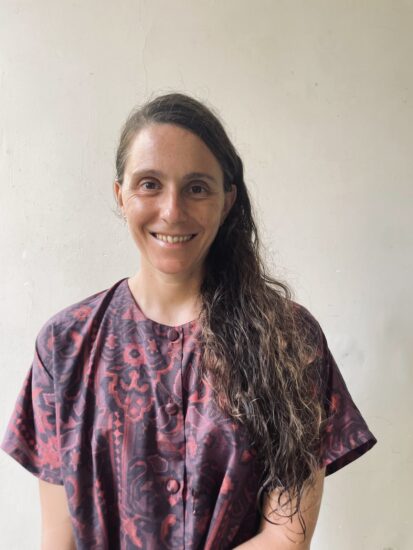
נולדה ב-1984 בקייב, אוקראינה, כיום חיה ופועלת בתל אביב.
יוצרת וחוקרת גוף רב-תחומית, פרפורמרית ומורה. יצירות הוידיאו-דאנס שלה הוקרנו במבחר פסטיבלים בארץ ובעולם (ביניהם Cinedans, Cyprus Film Festival, Burgundy Video Dance Festival, בית הנסן). בעלת קשת רחבה של הכשרה פיזית ואקדמית, ומחפשת ליצור חיבורים וקשרים חדשים בין גופי ידע שמדברים מטבעם בשפות שונות. בשנים האחרונות חוקרת את הממשק בין תנועה ומילים; דרכים ליצור חומר כוריאוגרפי בזמן אמת; תנועה בתוך מים ומחולות ממערב אפריקה. מלמדת שנים רבות בפרויקט “קהילה בתנועה” המקיימת שיעורי מחול עבור א.נשים החיים עם מחלת הפרקינסון (סטודיו יסמין גודר), כמו גם יוגה ופילאטיס באופן פרטי.
Jenny Birger
Born in 1984 in Kyiv, Ukraine, currently lives and works in Tel Aviv.
A multidisciplinary artist and researcher, performer, and teacher. Her video-dance works have been screened at selected festivals in Israel and abroad (including Cinedans, Cyprus Film Festival, Burgundy Video Dance Festival, Hansen House). She holds a wide range of physical and academic training and seeks to create new connections and links between bodies of knowledge that naturally speak different languages.
In recent years, she has been researching the interface between movement and words; ways of creating choreographic material in real time; movement in water; and dances from West Africa. She has been teaching for many years in the project Movement Communities, which holds dance classes for people living with Parkinson’s disease (Yasmeen Godder Studio), as well as teaching yoga and Pilates privately.