
The performative event as a letter asking to be read: Thoughts about “Listening to the Planets” by Ari Teperberg
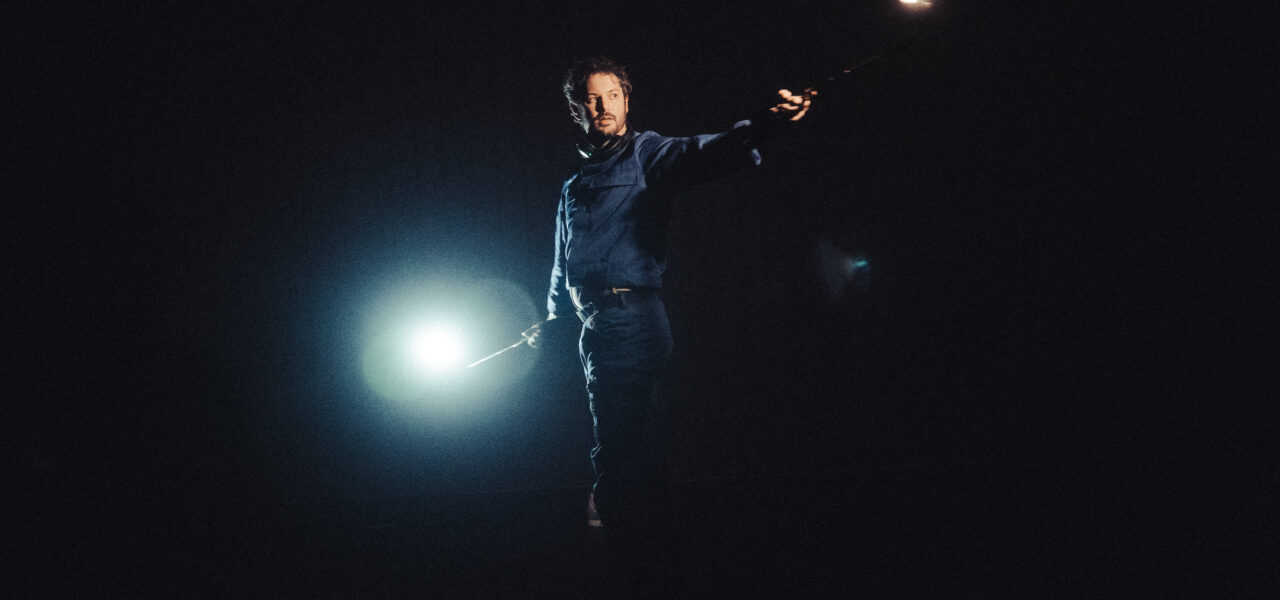
*Photo by Gergely Ofner
*Hebrew follows
By Joy Bernard
In 1979, the rock band “The Police” released the first single from their second studio album, titled “Reggatta de Blanc.” The single, “Message in a Bottle,” became a beloved and iconic song over the years, mainly due to the opening guitar solo — which became one of the most poignant examples of the distilled sound of the post-punk, New Wave music genre. Forty-five years after this song was first aired in the grey and cold streets of London, I found myself sitting in the darkened hall of the Habait Theater in sunny Jaffa and humming the lyrics of the song to myself while attending the premiere of “Listening to the Planets” by Ari Teperberg.
I’ll send an SOS to the world
I hope that someone gets my
I hope that some get my
I hope that someone gets my message in a bottle, yeah
A year has passed since I wrote my note
I should have known this right from the start
Only hope can keep me together
Teperberg, a multidisciplinary artist, performer, theater and opera director, doesn’t exactly look like Sting, nor does he use this song in his new work. So why was I reminded of this lovely tune? “Message in a Bottle” is a song sung from the perspective of a lonely man, a sole and solitary survivor of a shipwreck on a stranded island. The narrator tries to send a message to the world in the form of a letter he places in a bottle on his quest for love. He doesn’t receive any response, and after a full year passes he gives up, believing that he has been destined to stay alone — until he discovers that “a hundred billion” similar bottles, containing letters, have been washed up on his shore. These bottles contain similar signals, like-minded attempts to commune with the world.
The narrative of “Listening to the Planets” is reminiscent of the one constructed by Sting in his song: Much like the British rockstar, Teperberg is trying to send his own message in a bottle, signals from both distant and near past, which are aimed both at the viewers and at his future self. Teperberg’s deserted island is the stage; the letter in his case is the performance itself, which is actually based on a series of letters he composed partially to himself and partially to an audience. In these letters he describes his life in Amsterdam, where he has been living in recent years, as well as his experiences in his native land, Israel, which he frequently visits.
Teperberg may appear solo on stage, but through his ever-meandering monologue he is joined by various versions of himself and of reality, which he attempts to bring to life: A decade-younger Teperberg, who is trying to imagine what he will look like as he gets older (“Who is this Ari standing in front of you?”, he asks us, as if lending us the authority to tell him something about himself that he doesn’t know, thereby cleverly ruminating on the level of intimacy a performer can cultivate with his audience, a kind of intimacy that is different from any other relationship we maintain in our lives); Teperberg of two years ago, when the war broke out; Teperberg writing a text for this show while lying in bed in his European apartment; Teperberg suffering from insomnia while visiting his childhood home and coping by writing yet another text for this show; Teperberg of last night, who was sitting on the beach in Tel Aviv after premiering this work in Hebrew for the first time and yearning for all the tickets of today’s show to be sold out.
Teperberg isn’t only traveling back and forth on his personal timeline; he is also moving along the nonlinear timeline of his country, from which he emigrated. When he tells us about the war through his viewpoint, those of us who haven’t left Israel over the past few years can suddenly see our familiar pain through a different lens; and at the same time, we are exposed momentarily to his pain, the pain of an Israeli in self-imposed exile who watches his home going up in flames from afar and can’t do anything about it.
Imagining life tomorrow, in two days, in a decade
Unlike Sting, who wrote somewhat of a happy ending in the last verse of his song, one that suggests that the narrator isn’t entirely alone on his island, Teperberg isn’t quick to offer us a resolution for the conflict. He insists on staying alone with his pain on stage, perhaps as a key statement through which his work can be interpreted. The artistic interest doesn’t lie in finding a concrete addressee for his performative letter, but rather in the ability to imagine such an addressee. This ability allows him, as a creator, to write a monologue for years and then perform it on stage. It is exactly this insistent ability that sets us, artists, apart from other people — we might not be the most optimistic creatures, but we are life affirming in the sense that we try throughout our lives, usually against all odds, to cultivate this evasive character trait: the imagination. It is our imagination that launches us from the here and now into the future, akin to how a slingshot launches a stone.
Teperberg has refined the practice of journaling, a routine act for many people, artists and non-artists alike, and turned it into high art. Equipped with a charismatic but distinctly non-dramatic and overtly comfortable-in-its-own skin stage presence, Teperberg eloquently and honestly manages to turn diary entries that normally wouldn’t see the light of day into a performative act. This act isn’t just a means of poking himself in the gut; it’s a sort of performative exercise that charms the viewers. Here Teperberg’s generosity as a performer is especially apparent: His total devotion to the exposed nature of his show doesn’t give us any other option but to completely devote ourselves too. When we become as deeply involved as he is, we might begin to realize that we can apply to our own lives the same alienation that Teperberg employs as a strategic artistic mechanism, and thus find renewed interest in the multiple layers of memory and experience that make up our individual lives, a new-found fascination with the fact that our internal timelines are necessarily diachronic but not entirely synchronic.
In geology, the term “diachronism” refers to a rock formation in which the material, although similar in nature, is of different ages at the locations where it was deposited. This deposition occurs as a result of the transgression or regression of the sea level. As the shoreline advances or retreats, a sequence of sediments may be left behind. The rocks remain continuous on the surface, but their age varies according to the changing position of the shoreline. When I watch Teperberg employing the most minimalistic theatrical means imaginable — a chair, a pair of headphones, his own cellphone, a few sticklights, his own body standing up and sitting down, his eyes fluttering shut and opening up, as though blinded by the light of an internal reverie — I come to believe that he has managed to develop a holistic performative dialect that completely embodies this phenomenon. “Listening to the Planets” is a work in which Teperberg uses both his body and his voice to embody the imprints left by life’s various experiences, manifesting into action his mental ability to be multiple versions of the self, from different ages and times, all at once.
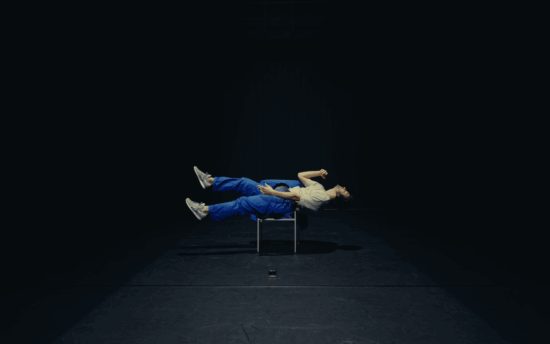
Teperberg doesn’t need much to make his viewers share his internal journey, and perhaps this is what makes him such a great performer: He understands exactly which triggers he needs to pull for us to pass through the gates of his personal reality, and he does so by using gestures and texts whose minimalism and simplicity are what makes them so cleverly bewitching. When he sits on a chair facing us and tells us that he’s actually seated on an airplane seat, lodged in the small space between two other passengers and listening to a musical piece written more than 100 years ago, not only do I believe him – I’m actually there with him, feeling the air pressure in my ears and my body shrinking in the seat. When he tells us that he’s in bed, his face lit up by the screen of his smartphone, unable to fall asleep, I’m also there in the dark, attempting to calm the anxiety and level-headedly address the inferno he’s reading about on the news, struggling to fall asleep and hoping not to dream.
An artist of distances
The aforementioned musical piece is the orchestral suite “The Planets,” written by British composer Gustav Holst in 1917. The work is divided into seven chapters, with each describing a different planet on our constellation through music. This piece may be Teperberg’s declared source of inspiration, and it is a central sonar aspect of this solo, which was built around it. However, in my opinion, while complex and beautiful, “The Planets” isn’t really the core subject of Teperberg’s work. His musical and artistic choice is fascinating because he uses it as a departure point in a much broader discussion about scientific topics, historical events and contemporary happenings, and the psychological mechanisms we employ in order to grapple with reality.
When Teperberg shares with us the sound of the grating pipes in the first part of Holst’s work, “Mars: Bringer of War,” he makes us wonder what war actually sounds like. Moreover, he makes us try to measure how far away or close we actually are to the battlefield, both mentally and physically. When he wonders about the distance between Holst’s engagement with astronomy and the circumstances of war and peace, he prompts us to ask what the role of any work of art is, whether performative or musical — should it faithfully depict reality? Should it present a counterpoint, an alternative solution to painful events? Does it have the right to exist when it takes place without context, merely as an aesthetic event? When Teperberg shares with us that Holst composed the piece during World War I, I can’t help but try to gauge the distance between that war and our own. As the light in the hall goes out and Teperberg, holding the sticklights, balances on one leg and performs an attitude turn, the beams of light he holds spin with him, making me think about the distance that passes between the moment the light is emitted and the moment our eyes blink in reaction to it, which means that our nervous system signaled to the brain that it has witnessed light.
When Teperberg listens to the piece through his headphones and describes it to us using a series of images — without us actually hearing it ourselves — in a delightfully amusing scene, I wonder about the distance between the subjective, individual experience expressed in words and the nonverbal world of music, and about the gaps between the subjective experiences of each of us. When Teperberg describes the conditions required for a sound to be perceived by the human ear as an echo, I think not only about physical concepts like “speed of sound” and “speed of light,” but also about the purpose of that sound and of its producer — to hear and to be heard. We compose, play, dance, write performances, and in Teperberg’s case, listen to planets, all in order to understand the world around us, to touch it and to be touched by it.
As Teperberg records himself on his mobile phone describing Holst’s composition, and then plays back the recording we already heard live as a monologue —later followed by playing the actual piece by Holst —time and sound seem to collapse into one another, and the distances between the sounds grow smaller. For a brief moment, I close my eyes and try to separate the different layers of sound, which on stage have been intentionally blended into a single mass. In doing so, I recall the term “dialogism,” developed by the 20th-century Russian literary critic and philosopher Mikhail Bakhtin. Bakhtin, whose writing and research focused on the philosophy of language, argued that all human activity— and especially that which relates to discourse — is inherently dialogical, involving a constant exchange between the individual and their environment: “A fundamental characteristic of the utterance is its addressivity — its being directed toward someone” (“Speech Genres and Other Late Essays,” Mikhail Bakhtin).
In other words, if there is no addressee, there is no speech, no connection, no creation. As Teperberg writhes on the floor, struggling with all his might to hold onto the beams of light and then rises to his feet again, I realize that this is his unique gift as an artist. In this work, as in others, Teperberg has cultivated a dialogical practice —one that relies on somatic sensing and a deep affinity for music — making him an artist of distances, exploring the gaps between himself and his audience, between himself and research subjects distant in time and space. But ultimately, he specializes in narrowing those distances, transforming esoteric subjects that fascinate him into theatrical themes, turning weighty metaphysical issues into something light, accessible, and emotionally resonant. He has done this in works such as “The Soft Hum of the Dial Tone” (2022) and “Untitled Document” (2022), where his research into the invention of the telephone became a way to examine the gap between father and son, and between writing and speech; or in “And My Heart Almost Stood Still” (2017), a piece where research into Beethoven’s Ninth Symphony and an obscure letter written by Helen Keller became the theoretical groundwork for a performative solo about the desire to feel, to connect, to be vulnerable. He does it again here, as he summons the spirit of Gustav Holst and the entire celestial sphere to bridge the distance between the war outside and the war within.
“Sometimes I leave the room and call myself”
In tandem with Teperberg’s artistic method of choice I, too, felt that I needed distance: The distance of time, that would enable me to fully process the loaded intellectual and emotional experience he offered and to translate it into words. I’m writing this article two weeks after having watched the show, while listening to Holst’s suite, in an attempt to revive the images I saw. As I reach this very paragraph, I pause in order to look out my window.
Quite fittingly, as I write these lines, a lunar eclipse is unfolding in the sky above me — an astronomical phenomenon where the moon is darkened and shadowed as it aligns with the Earth and the Sun. I stop writing and briefly dive down the rabbit hole that is Google, discovering that a lunar eclipse is a relatively rare event, occurring only two or three times a year. For a moment, I take out my camera and try to capture the reddish moon, but fail to find the desired focus and give up. I realize that the aspiration to capture the moment — whether it is a performance on stage or the spectacle in the sky— can never be fully realized. All that remains is to try and converse with myself, with my flickering memories, coming and going, as Teperberg did in his performance, as Sting imagined himself hiding a letter in a bottle, and as the poet Nathan Zach wrote: “Sometimes I leave the room and call myself. I look to see who’s coming and I’m amazed — I didn’t know I’d been standing there so long. The one I was waiting for didn’t come, so I write him a letter… I want to say something to him, something special I’ve never said before. I search the table, and my hand touches the matches again. I go on writing. Round and round it goes, eh? Round and round it goes.” (An excerpt from the poem “Sometimes,” translated by the author from Hebrew into English. The original poem was published in the book “I Wish Always to Have Eyes”).
Ari Teperberg presented ‘Listening to the Planets’ on August 22 and 23 at Habait Theater.
האירוע הבימתי כמכתב המבקש להיקרא: מחשבות על היצירה “מקשיב לכוכבי הלכת” מאת ארי טפרברג
מאת ג’וי ברנרד
בשנת 1979, להקת הרוק The Police שחררה לעולם את הסינגל הראשון מתוך אלבום הסטודיו השני שלהם, Reggatta de Blanc. הסינגל, Message in a Bottle, הפך במרוצת השנים לשיר איקוני ואהוב של הלהקה, בעיקר בזכות סולו הגיטרה הפותח אותו, אשר הפך לאחת מהדוגמאות המוזיקליות המובהקות ביותר של הסאונד המזוקק של ז’אנר הפוסט-פאנק מהגל החדש. ארבעים וחמש שנים אחרי שהשיר הזה התפרסם אי שם בלונדון הקרירה והאפורה, מצאתי את עצמי יושבת באולם המוחשך של תיאטרון הבית ביפו השמשית במהלך הבכורה של יצירתו החדשה של ארי טפרברג, “מקשיב לכוכבי הלכת”, ומזמזמת בלב את המילים.
I’ll send an SOS to the world
I hope that someone gets my
I hope that someone gets my
I hope that someone gets my message in a bottle, yeah
A year has passed since I wrote my note
I should have known this right from the start
Only hope can keep me together
טפרברג, אמן רב-תחומי, פרפורמר ובמאי תיאטרון ואופרה, לא בדיוק מזכיר את הזמר הראשי, סטינג, וגם כלל לא עושה שימוש בשירו ביצירה שלו. אז למה בכל זאת נזכרתי בשיר החביב הזה? Message in a Bottle הוא שיר המושר מנקודת מבטו של אדם בודד, ניצול מספינה טרופה שנמצא לבדו על אי ושולח מסר לעולם, מכתב שהוא מטמין בתוך בקבוק בחפשו אחר אהבה. הוא לא מקבל שום מענה למכתב שלו, ואחרי שנה שלמה הוא מתייאש, ומאמין שהוא נועד להיוותר לבדו, עד שהוא מגלה שאל החוף נשטפו מיליוני בקבוקים כמו שלו, המכילים איתותים דומים, ניסיונות זהים לתקשר עם האנושות.
הנרטיב של העבודה של טרפרברג מקביל לזה שבנה סטינג בשיר שלו: בדומה לכוכב הרוק הבריטי, גם טפרברג מנסה באמצעות העבודה הזו לשלוח מעין “מכתב בבקבוק”, שדרים מהעבר הרחוק והקרוב גם יחד, הן אלינו הצופים והן אל עצמו העתידי. האי הבודד של טרפברג הוא הבמה; המכתב במקרה שלו הוא המופע, שמושתת על רצף מכתבים שכתב ספק לעצמו-ספק לקהל. במכתבים הללו הוא הוא מדווח על הקורות אותו באמסמטרדם, העיר בה הוא מתגורר בשנים האחרונות, וכן במולדת, אליה הוא מגיע לביקורים תכופים.
טפרברג אמנם נמצא בגפו על הבמה, אך באמצעות המונולוג ההולך ומתפתל שהוא מבצע לאורך המופע, מצטרפות אליו כל מיני גרסאות שלו ושל המציאות: טפרברג של לפני עשור, המנסה לדמיין איך יראה בבגרותו (“מי זה הארי הזה שעומד מולכם עכשיו?”, הוא שואל אותנו, “מה הוא מרגיש? איך הוא נראה? מה הוא לובש? הוא השמין?”, טפרברג מציע בחיוך, כמו מניח בידינו את האוטוריטה לספר לו משהו על עצמו שהוא לא יודע, ואגב כך מהרהר בצורה מתוחכמת על מידת האינטימיות שפרפורמר.ית יכול.ה ליצור עם הקהל שלו.ה, סוג של אינטימיות ששונה מכל מערכת יחסים אחרת שאנו מקיימים בחיינו); טפרברג של לפני שנתיים, עת פרצה המלחמה; טפרברג הכותב טקסט עבור המופע בעודו שוכב במיטתו בדירה האירופאית שלו; טפרברג שלא מצליח להירדם בשעה שהוא מבקר בבית הוריו ומתמודד עם נדודי השינה באמצעות הקלדה של טקסט נוסף עבור המופע; טפרברג של אמש, שיושב בחוף אחרי שהעלה את היצירה לראשונה בעברית ומייחל לסולד אאוט הנכסף בהרצה השנייה.
טפרברג לא רק מטייל קדימה ואחורה לאורך ציר הזמן הפרטי שלו, אלא גם נוסע על גבי הציר הא-לינארי של המולדת שלו, ממנה היגר. כשהוא מספר לנו על המלחמה דרך נקודת המבט שלו, מי מאיתנו שלא עזבו את כתלי הארץ בשנים האחרונות פתאום מקבלים פרספקטיבה אחרת על הכאב המוכר שלנו; ובעת ובעונה אחת, אנחנו יכולים להיחשף לרגע לכאב שלו, כיליד המקום שרואה כיצד ביתו עולה בלהבות ולא יכול לעשות דבר מהנקודה המרוחקת שבה הוא נמצא.
לדמיין את החיים מחר, מחרתיים, עוד עשור
בניגוד לסטינג, שכתב “סוף טוב” בבית האחרון של שירו, כזה שמציע שהגיבור לא לגמרי לבד שם באי הבודד שלו, טפרברג לא ממהר להציע לנו התרה לקונפליקט. הוא מתעקש להישאר לבדו עם הכאב על הבמה, אולי כאמירת מפתח שדרכה ניתן לפרש את העבודה שלו: העניין האמנותי לא נעוץ במציאת מען קונקרטי למכתב הפרפורמטיבי, אלא ביכולת לדמיין שיש מען כזה, יכולת שמאפשרת ליוצר להמשיך ולכתוב את המונולוג שלו על פני שנים ואז לבצע אותו על במות, היכולת העיקשת לדמיין את החיים ואת עצמך בתוכם מחר, מחרתיים, עוד עשור. היכולת הזו, שלה אפשר לקרוא גם “כוח חיים ליבידינלי”, היא בדרך כלל מה שמפריד אמנים מאנשים אחרים — אנחנו אולי לא בהכרח היצורים הכי אופטימיים, אך אנחנו כן חפצי חיים במובן שאנחנו עוסקים כל חיינו, בדרך כלל כנגד כל הסיכויים, בניסיון לטפח את התכונה החמקמקה הזו: הדמיון. זה הדמיון שלנו שמשליך אותנו כמו אבן שנורית על ידי רוגטקה מתוך הכאן והעכשיו אל עבר העתיד.
לכן אפשר לומר שטפרברג שכלל את פרקטיקת הכתיבה היומנאית, זו השגורה בחייהם של אנשים רבים, בין אם הם אמנים או לאו, לכדי אמנות גבוהה. הוא מצליח, ברהיטות, בכנות ובנוכחות בימתית כריזמטית אך בלתי דרמטית בעליל, נינוחה במופגן, להפוך את מה שבדרך כלל שמור למגירה — רשומות ליומן — לכדי מהלך פרפורמטיבי שהוא לא רק נבירה מהורהרת בקרביים של עצמו, אלא מעין תרגיל בימתי שמהלך גם עלינו, הצופים, קסם מיוחד. כאן ניכרת הנדיבות של טפרברג כפרפורמר: ההתמסרות הטוטאלית שלו למהלך החשוף שהוא פורש בפנינו לא מותירה לנו אפשרות אלא להתמסר בעצמנו. כשאנחנו צוללים פנימה יחד איתו, אנחנו מגלים שאותה הזרה שטפרברג מפעיל כמנגנון מחקרי כלפי עצמו גם אנחנו יכולים בקלות להפעיל כלפי עצמנו, ולמצוא עניין מחודש בשכבות הזיכרון והחוויה הרבות שמרכיבות את חיי הפרט, בעובדה שציר הזמן הפנימי הוא בהכרח דיאכרוני אך לא סינכרוני.
בגיאולוגיה, המונח “דיאכרוניזם” מתייחס לתצורת סלע שבה החומר, על אף שהוא בעל אופי דומה, הוא בן גילים שונים במקום שבו הוא שקע. השקיעה נגרמת כתוצאה ממעבר או מעלייה של פני הים. ככל שקו החוף מתקדם או נסוג, רצף של משקעים עלול להישאר מאחור. הסלעים נותרים רציפים על פני השטח, אך הגיל שלהם משתנה בהתאם למיקום המשתנה של קו החוף. כשאני צופה בטפרברג משתמש באמצעים המינימליסטיים ביותר שניתן להעלות על הדעת – גופו שלו העומד והיושב, עיניו הנעצמות והנפקחות, כמו מסומאות מאורו של חלום פנימי, כיסא, צמד אוזניות, טלפון נייד ובהמשך המופע גם כמה סטיקלייטים זוהרים בחשיכה – אני חושבת שהוא הצליח לפתח שפה בימתית שלמה שכמו ממחישה את התופעה הזו. “מקשיב לכוכבי הלכת” היא עבודה שבה פרפורמר מגלם בגופו ובקולו הן את השקעים שחרטו בו חוויות החיים השונות והן את היכולת להיות בן כמה גילאים, כמה תקופות, בעת ובעונה אחת.
טפרברג לא זקוק להרבה אמצעים תיאטרליים כדי להעביר את צופיו את החוויה הפנימית שהוא חווה, ואולי בכך טמונה גדולתו כפרפורמר: הוא מבין בדיוק על אילו נקודות ללחוץ כדי שגם אנחנו נכנס בשערי המציאות שלו, והוא עושה זאת באמצעות תנועות וטקסטים שהמינוריות והפשטות שלהם הם סוד קסמם המתוחכם. כשהוא מתיישב מולנו על כיסא ומספר שהוא בעצם יושב במושב של מטוס, לכוד במרווח הצר בין שני נוסעים אחרים ומאזין ליצירה מוזיקלית שנכתבה לפני יותר ממאה שנים, לא רק שאני מאמינה לו, אני ממש שם איתו, מרגישה את לחץ האוויר המשתנה הולם באוזניי ואת גופי מתכווץ במושב. כשהוא אומר שהוא שוכב במיטה, פניו מוארות על ידי המסך של הסמארטפון שלו והשינה נודדת ממנו והלאה, גם אני שם בחשיכה, מנסה להרגיע את החרדה ולעכל התופת שהוא קורא עליה בחדשות, מקווה להירדם ולא לחלום.
אמן של מרחקים
היצירה המוזיקלית המוזכרת לעיל היא הסוויטה התזמורתית “כוכבי הלכת”, שנכתבה על ידי המלחין האנגלי גוסטב הולסט בשנת 1917. היצירה מחולקת לשבעה פרקים, כאשר כל פרק מתאר כוכב לכת אחר ממערכת השמש דרך מוזיקה. היצירה הזו היא אמנם נקודת ההשראה המוצהרת של טפרברג, ומהווה אלמנט סונארי מרכזי בעבודה, שנבנתה סביבה, אך בעיני היא כשלעצמה, מורכבת ויפה ככל שתהיה, אינה באמת לב העניין. הבחירה המוזיקלית והאמנותית של טפרברג היא מרתקת מפני שהיא משמשת אותו כאיצטלה לבחון מושגים מדעיים, אירועים היסטוריים ועכשוויים, ואת המנגנונים האנושיים-פסיכולוגיים שנפש האדם נעזרת בהם כדי להתמודד עם המציאות.
כשטפרברג משמיע לנו את כלי הנשיפה הצורמניים בחלק הראשון של היצירה, “מארס: מבשר המלחמה”, הוא גורם לנו לתהות איך נשמעת המלחמה באמת. ומעבר לכך — הוא גורם לנו לאמוד עד כמה אנחנו רחוקים או קרובים לשדה הקרב מבחינה מנטלית ופיזית כאחד. כשהוא תוהה על המרחק בין העיסוק של הולסט באסטרונומיה לבין נסיבות של מלחמה ושלום, הוא גורם לנו לשאול מה התפקיד של כל יצירת אמנות, בין אם היא פרפורמטיבית או מוזיקלית: האם עליה לתאר נאמנה את המציאות? האם עליה להציג קונטרה, פיתרון אלטרנטיבי לאירועים הכואבים? האם יש לה זכות קיום כשהיא מתקיימת ללא הקשר, רק כאירוע אסתטי? כשטפרברג משתף אותנו שהולסט כתב את היצירה בזמן מלחמת העולם הראשונה, אני לא יכולה שלא לנסות ולאמוד בתודעתי את המרחק בין המלחמה ההיא למלחמה שלנו. כשהאור באולם כבה וטרפרברג, האוחז בסטיקטלייטים, עומד על רגל אחת ומבצע אטיטיוד טורנה, אלומות האור שהוא אוחז בהן מסתחררות יחד איתו, וגורמות לי לחשוב על המרחק שעובר בין הרגע שבו נפלט האור לבין הרגע שבו העיניים שלנו ממצמצות לקראתו, ומערכת העצבים מאותתת למוח שהאור נגלה בפנינו.
כשטפרברג מאזין ליצירה באוזניות שלו ומתאר לנו אותה באמצעות סדרה של דימויים, מבלי שנשמע אותה בעצמנו, בסצינה משעשעת להפליא, אני תוהה על המרחק בין החוויה הסובייקטיבית והאינדיבידואלית שנתפסת במילים לבין העולם הבלתי מילולי של המוזיקה, ועל הפערים בין החוויות הסובייקטיביות של כל אחד מאיתנו. כשטפרברג מתאר לנו אילו תנאים נדרשים כדי שצליל יתפס באוזן האנושית כהד, אני חושבת לא רק על מושגים פיזיקליים כמו “מהירות הצליל” ו”מהירות האור”, אלא גם על המטרה של אותו הצליל ושל מי שמפיק אותו — לשמוע ולהישמע. אנחנו מלחינים, מנגנים, רוקדים, כותבים מופעים, ובמקרה של טפרברג מקשיבים לכוכבי הלכת, כדי להבין את העולם סביבנו, כדי לגעת בו ולהינגע על ידיו.
תוך שטפרברג מקליט את עצמו בטלפון הנייד שלו מתאר את היצירה של הולסט ואז משמיע לנו את ההקלטה שכבר שמענו בביצוע לייב כמונולוג, ובהמשך משמיע את היצירה של הולסט, הזמנים והצלילים כמו קורסים זה לתוך זה, והמרחקים בין הצלילים הולכים ומיצטמצמים. לרגע קצר אני עוצמת את עיניי, ומנסה להפריד בין שכבות הסאונד השונות שנהפכות על הבמה לעיסה אחת במכוון. תוך כך, אני נזכרת במונח “דיאלוגיזם” שפיתח מבקר הספרות והפילוסוף הרוסי בן המאה ה-20, מיכאיל בכטין. בכטין, שכתיבתו ומחקרו התמקדו בפילוסופיה של השפה, טען שכל פעילות אנושית, ובפרט כזו המתקשרת לשיח, היא פעילות של דיאלוג בין האדם לסביבתו. אחד המאפיינים העיקריים של הפעילות הדיאלוגית, על פי בכטין, היא המיעון, כלומר הפנייה לאחר: “מאפיין מהותי של התבטאות הוא היותה מופנית כלפי מישהו, היותה ממוענת” (“בעיית הז’אנרים של השיח: כתבים מאוחרים”, מיכאיל בכטין). כלומר, אם אין נמען, אם דיבור, אין כוונה, אין יצירה.
בשעה שטפרברג מתפתל על הרצפה, מתאמץ בכל כוחו להחזיק את אלומות האור ושוב נעמד על רגליו, אני מבינה שזו הסגולה שלו כאמן. גם בעבודה הזו, וגם ביצירות אחרות שלו, טפרברג סיגל לעצמו פרקטיקה דיאלוגית, כזו שנשענת על חישה סומטית ועל זיקה עמוקה למוזיקה והופכת אותו לאמן של מרחקים החוקר את הפערים בינו ובין הקהל שלו, בינו לבין מושאי מחקר רחוקים בזמן ובמרחב. בסופו של דבר, ייחודו של טפרברג נעוץ בכך שהוא לא רק מצביע על המרחקים, אלא גם מתמחה בצמצומם, בהפיכת נושאים אזוטריים שמעניינים אותו לתמות בימתיות, בהמרה של סוגיות מטאפיזיות כבדות משקל לקלות, לנגישות, לקרובות ללב. כך הוא עשה בעבודות כמו “קולו העדין של צליל החיוג” (2022) ו”מסמך ללא שם” (2022), יצירות שבהן השתמש במחקר אודות המצאת מכשיר הטלפון כדי לחקור את הפער בין אב לבן ובין כתיבה לדיבור; או ב”וליבי כמעט עמד מלכת” (2017), יצירה שבה מחקר על הסימפוניה התשיעית של בטהובן ומכתב עלום שחיברה הלן קלר הפך למצע תיאורטי עבור סולו פרפורמטיבי על הרצון להרגיש, להתחבר, להיות פגיע. כך הוא גם עושה כעת, כשהוא מזמן את רוחו של גוסטב הולסט ואת כל גרמי השמיים כדי לגשר על המרחק בין המלחמה שבחוץ למלחמה שבפנים.
“לפעמים אני יוצא מהחדר ומצלצל לעצמי”
בהתאמה למושא המחקר של טפרברג, גם אני חשתי שאני זקוקה למרחק — מרחק של זמן מסוים מההופעה, כדי לעבד את החוויה במלואה, כדי להצליח לתרגם את החוויה האינטלקטואלית והרגשית העמוסה כל טוב שטפרברג העביר אותנו לכדי מלל. אני כותבת את המילים הללו שבועיים אחרי שצפיתי בעבודה, תוך שאני מאזינה ליצירתו של הולסט, בניסיון להחיות את המראות שראיתי. כשאני מגיעה לישורת האחרונה של המאמר הזה, אני עוצרת כדי להתבונן מבעד לחלון שלי.
באופן די הולם, בעת כתיבת השורות הללו בשמיים שמעלי מתחולל ליקוי ירח — תופעה אסטרונומית שבה הירח מוחשך ומוצלל כאשר הוא נמצא בקו אחד עם כדור הארץ והשמש , ונכנס לקונוס הצל של כדור הארץ. אני מפסיקה לכתוב וצוללת רגע לתוך מחילת הארנב שהיא גוגל, ומגלה שליקוי הירח הוא תופעה יחסית נדירה, שמתרחשת רק פעמיים-שלוש בשנה. לרגע אני שולפת את המצלמה שלי ומנסה לתעד את הירח האדמדם, אך לא מצליחה למצוא את הפוקוס המיוחל, ומוותרת. אני נוכחת שהשאיפה ללכוד את הרגע, בין אם הוא רגע האירוע הבימתי או המופע שבשמיים, לא באמת יכולה להתגשם במלואה. נותר לי רק לנסות ולשוחח עם עצמי, עם הזיכרונות המרצדים, הבאים והולכים שלי, כפי שעשה טפרברג במופע שלו, כפי שעשה סטינג כשדמיין את עצמו מטמין מכתב בבקבוק, כפי שכתב המשורר נתן זך: “לפעמים אני יוצא מהחדר ומצלצל לעצמי / אני מסתכל מי בא ואני נדהם / לא ידעתי שכל כך הרבה זמן עמדתי שם. מי שחיכיתי לו לא בא, אני כותב לו מכתב… אני רוצה לומר לכבודו משהו, משהו מיוחד / שלא אמרתי מעולם. אני מחפש על השולחן וידי נתקלת שוב בגפרורים. אני ממשיך וכותב / הולך סובב כל זה, הה?! הולך סובב” (“לפעמים”, מתוך הספר “אני רוצה תמיד עיניים”).
ארי טפרברג הציג את ׳מקשיב לכוכבי הלכת׳ ב22.8.2025 ו23.8.2025 בתאטרון הבית.

Joy holds a B. Dance from the Jerusalem Academy of Music and Dance, where she is currently attaining her M. Dance, with a specialization in choreography. She also learned acting at the Maya Behar Studio and studied toward a B.A in Art History at Tel Aviv University.
In her works, Joy explores the connections between spoken language, written language and the language of the body. She creates in dance, physical theater, experimental cinema, sound and writing. She has been commissioned to perform and exhibit her works in various dance and film festivals, as well as galleries and museums, including the Ramat Gan Museum of Art, ZUMU Museum, Machol Shalem Dance House, Alfred Gallery, Hanut Theater, the Athens International Film Festival, Kyoto Film Festival, the Brooklyn Art Film Festival, Jerusalem Fringe Festival and others.
Joy’s writing as a journalist and critic is regularly published by Haaretz, The Jerusalem Post, Erev Rav, Portfolio Magazine, Flash Art, Collectors Agenda, Granta literary magazine and other publications.