
GUEST POST: Timeline of Bodily Destiny by Lisa Kremer
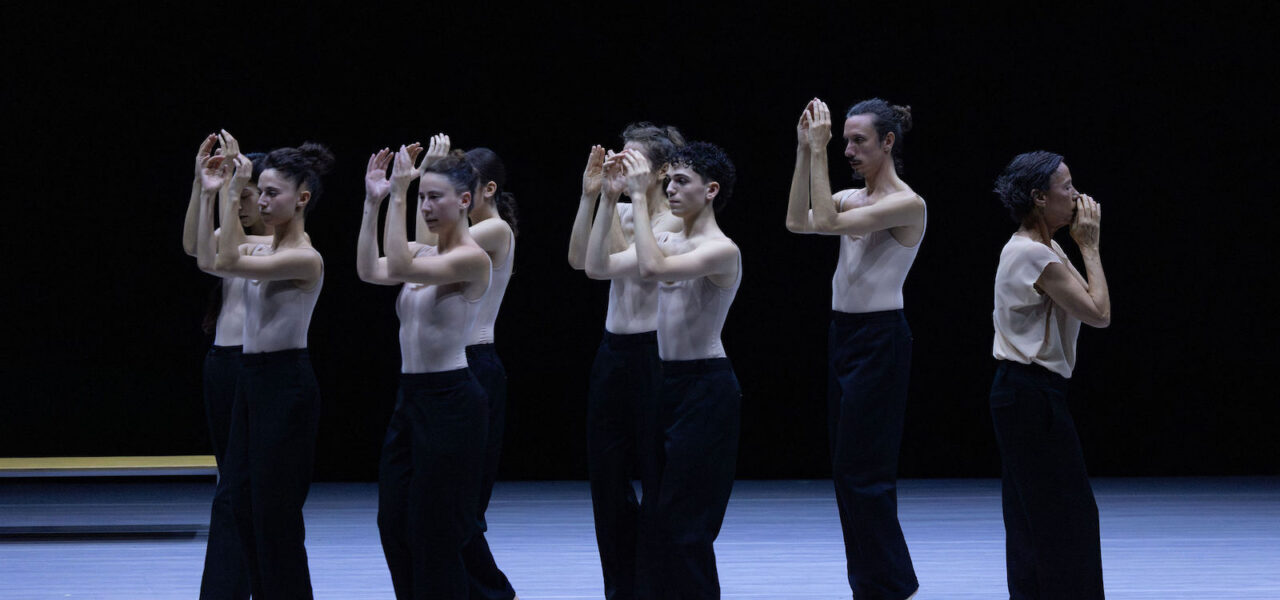
*Photo by Asya Skorik
Youth grabs our attention effortlessly. The beautifully strange movements of babies, the pure faces of children. In Noa Zuk’s new work, Destinies, from the moment a youthful dancer and her boyish partner step on stage, she captivates. Only after the show, going through the cast name by name, do I realize that the young female dancer with a willowy back reminiscent of Zuk’s distinct posture is Kima Zuk Fishof, daughter of Zuk and Ohad Fishof (soundtrack design and dramaturgy). During the performance I had thought, what perfect casting. But now I understand, this role was cast by a higher power.
Described as a “dance creation for eight dancers from four generations, aged 16-70 . . . explor[ing] the fate of our ever-changing bodies,” Destinies (Goralot in Hebrew) starts slowly with elder dancer Galia Lever striking carefully aesthetic, almost dutiful positions. The piece gains momentum with cascading scenes of dancers cast to represent periods of life, and in the life of a dancer. They take the stage in duets, trios, sometimes overlapping, other times the entire ensemble, and not in any particular progression or order—a snapshot here, a home video there, of an inter-generational human family.
The groupings display distinct character and energy: the pair of youths mix gentle exploration of discovering themselves and each other with moments of playfulness; the young adults form a powerful, energetic female trio; the middle-aged pair are so sure in their technique they can be quirky; and the elder dancer is careful and precise. Zuk is a keen observer, and in Destinies she successfully brings qualities of movement symbolic of stages of life, as dancers and simply as human beings.
Zuk and Andrea Constanzo Martini, representing adulthood, enter with an untamed, groovy, cares-to-the-wind attitude. They could be male-female counterparts of one another. Together they form a strange sort of machine, asynchronous yet attuned, bringing to mind the jerky movements of Miyazaki’s Howl’s Moving Castle. A knee bent here, an elbow there. Together and yet not. Moving separately and somehow a unit. Nothing careful or dutiful here.
Three female dancers, Chen Agron, Atalya Ben Dova, and Noa Gronich, comprise the young adult phase. Together, they offer a trio of technique and willingness to put it all out there that intensifies every time they take the stage. Agron shines with her muscled back, uncompromising precision, and feeling of teetering on the edge yet in total command, her years as a Batsheva dancer embedded in her body. Straddling abandon and technique, all three are terrific representatives of Israel’s fearless dance scene.
Kima Zuk Fishof and Oraya Nir represent the youngest among us. Exploring, discovering, tender with each other, and yes, captivating. Their acting too innocent to be affected or self-conscious, their bodies youthful with not yet fully developed musculature or core. Her sloping shoulders and flexible spine exhibiting softness and, in surprising flashes, sharpness. Even when sharing the stage with the Zuk-Martini generation, all eyes are on them. I imagine the work of imprinting the complex choreography on their young bodies. I can picture them rehearsing in front of the bathroom sink, walk-dancing down the street, or sitting on the bus marking movement with their hands. Whatever their process, they worked hard enough for it not to look like work at all, natural and unaffected.
In one memorable vignette, the entire cast of four generations is on stage at once, costumed by Eri Nakamura in uniform, off-white skin-hugging tanks (the elder matriarch in chiffon) and black work pants, a color reversal of the black sleeveless leotards and white tights that emphasized dancers’ bodies and purity of movement in George Balanchine’s compositions known as “leotard ballets.” The dancers lie on their backs to form a chain. They break off one by one, crawling like hatched larvae over the chain of their own bodies, then gently lying down at the end, and in this way slowly snaking across the stage. It is fascinating to observe how each dancer makes their way over the others, dangerously close yet not touching. But at some point, the repetition brings me to a place where I silently wish they would break the tension of the chain into its parts once and for all.
Later, the entire ensemble again takes the stage, interacting and shaking hands with each other in ever-changing configurations and combinations that never play themselves out. Something in the build up of the classical score combined with repetitive gestures and dashes of chaos calls to mind another animated scene: the crazed buckets of the Sorcerer’s Apprentice in Fantasia. The association makes me wish for the choreography to get crazier and more chaotic—as if four curly-tendriled Zuk-Martini pairs were up there shaking hands and mixing it up.
In the final scene, the ensemble takes the stage. Seven squeeze onto a long bench with the eighth plopping down on the floor beside it, as if quickly arranging themselves for a family portrait. Music blares and they switch places and rowdily yell out lyrics. It’s a playful, cathartic snapshot of a multigenerational family of dancers. Each one on their own timeline of bodily destiny, each in their own prime.
Noa Zuk presented ‘Destinies’ on August 18, 2025 at the Suzanne Dellal Centre.
Photo by Efrat Mazor
Lisa Kremer is a lifelong dancer and lover of dance performance but not a performer. She grew up in NYC taking the subway to class at Joffrey and Martha Graham. She moved to Israel in 1995 and is a teacher and practitioner of Vijnana yoga, studying with Orit Sen Gupta since 1997 when she was looking for dance, tried yoga, and got hooked upon realizing that the quiet mind of intense concentration—an experience she had called “just dancing” as a young dancer—was the purpose of yoga. She completed a three-year teacher training at Wingate, later assisting there. Yoga took the place of dance for Lisa, until in a bomb shelter during a 2012 conflagration she realized that the one thing she longed for in life was ballet. Two days later she was at the barre in Nira Paz z”l’s beloved class at Bikurei Haitim. She now studies with Lee Arbel. Lisa has a BA in English from University of Virginia and is an editor, writer, and Hebrew–English translator and has edited and translated books on yoga. She has traveled and photographed widely in Asia, walking 1,000 kilometers in the Himalaya of India, Nepal, and Tibet. In recent years she has begun guiding students on yoga journeys to India. She lives in Tel Aviv with her husband and two daughters.