
פועל של הריקוד רוקד את הזיכרונות של המקום: מחשבות על היצירה ‘קמרה אובסקורה’ מאת עדי בוטרוס
*צילום אסיה סקוריק
*English Follows
מאת ג’וי ברנרד
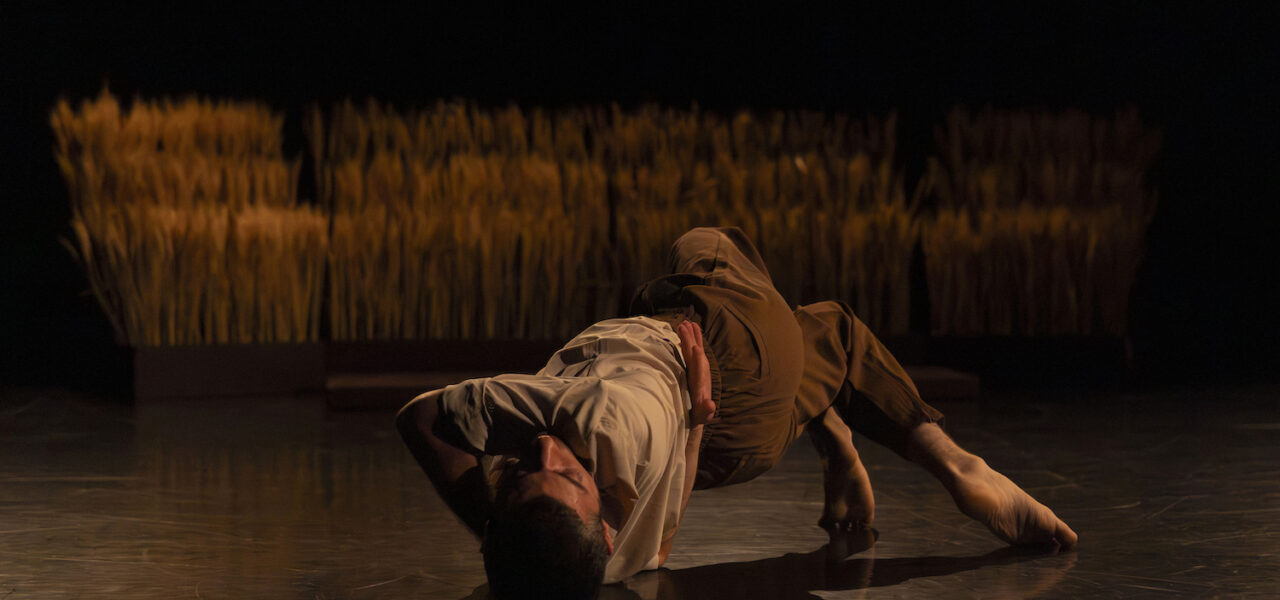
רגעים לפני שהרקדן והכוריאוגרף עדי בוטרוס נכנס לסטודיו זהבה ומתמקם בירכתיו, הקהל עדיין נוהר פנימה. קולגות מקהילת המחול מברכים זה את זה בטפיחות עליזות על השכם, צופים שכבר הספיקו להימלט מהחום המהביל ששורר בחוץ אל הסטודיו הממוזג מזיזים את הכיסאות עליהם הם ישובים בקולות חריקה שצורמים על גבי רצפת הלינוליאום, מתלחששים, נרגשים. אישה מבוגרת שיושבת במושב שמאחורי לוחשת לחברתה: “הוא בטח מאוד מתרגש. הרי אין איתו אף אחד”. היא מתכוונת לכך ש”קאמרה אובסקורה” היא יצירת סולו, ובוטרוס מתעתד לעלות לבמה בגפו, ללא ליווי של רקדנים מבצעים נוספים. זו אכן התפתחות מעניינת בקריירה של היוצר, שנוהג ליצור עבודות קבוצתיות המתמקדות בעבודת קונטקט, פרטנרינג ותנועתיות דחוסה, עוצמתית, כמו “השתקפויות” שעלתה בבכורה באותו הפסטיבל לפני שנתיים. אני תוהה אם אותה אישה היא קרובת משפחה של בוטרוס, ולכן רגישה במיוחד למצבו הנפשי טרם יעלה לבמה, או שמא היא פרפורמרית לשעבר ולכן מסוגלת להבחין בין סוגי ההתרגשות השונים שמפעמים בלב רגע לפני שהכל מתחיל. לפני שאני מספיקה להפליג בעוד הרהורים מסוג זה האולם מחשיך, ואז כמה ספוטים כתמתמים מאירים את הבמה, ובוטרוס מתגלה בתנוחה עוברית בתוך קונסטרוקציה שעשויה ממוט עץ ארוך וכמה מבני עץ חומים שלתוכם דחוסים עשרות רבות של ענפי שיבולים.
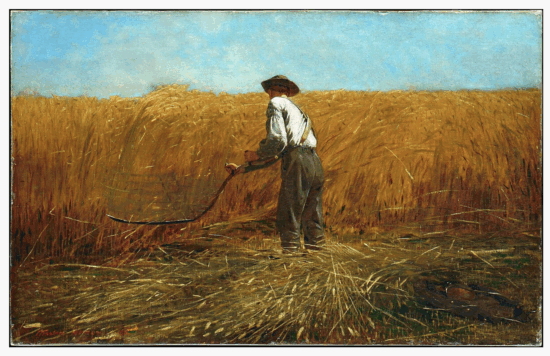
Veteran in a New Field by Winslow Homer
קריאה זריזה בתוכנייה עוד טרם התחיל המופע גילתה לי שבוטרוס יצר את שדה החיטה בהשראת הציור The Veteran in a New Field של הצייר האמריקאי וינסלו הומר, שבו נראית דמותו של לוחם-חקלאי אמריקאי אחרי מלחמת האזרחים בארה”ב. בוטרוס אמנם שאב את השראתו מיוצר אמריקאי שפעל בשלהי המאה ה-19, אבל שדות חיטה וענפי שיבולים מוכרים לנו היטב מהנופים, הספרות והשירה המקומיים בני זמננו, ולכן זה דימוי עם פוטנציאל מבטיח, שכן הוא טעון במארג תרבותי וגיאוגרפי שלם של פסטורליה ישראלית נוסטלגית שעתה היא רק זיכרון נוגה של חיים שהיו ונמוגו, אולי לבלי שוב. כמעט בניגוד לרצוני מתנגן בראשי הלחן של השיר “ים השיבולים” של להקת הגבעטרון, ואני צריכה לכבוש את החיוך שלי כשאני מהרהרת במתק המילים והלחן, שנדמים לי לפתע אירוניים נוכח המציאות העכשווית שלנו.
בינתיים בוטרוס פשוט נוכח שם בשדה התפאורה שלו, ללא ניע, ואני מצליחה לשחרר את האוויר שהיה דחוס בבטן שלי ולנשום נשימה עמוקה. את מה שהגוף שלי מבין לוקח למוח עוד כמה רגעים לקלוט עד שמערכת העצבים שלי משגרת אליו את המסר: הנה אדם נח. גם את יכולה להתרווח, לעצור, לשכוח מהטרדות הקיומיות הלאומיות והאישיות, לנכוח בכאן ובעכשיו. המחשבה הבאה שחולפת בראשי היא: “כמה נדיר לראות דימוי של גבר נח בזמנים הללו, שרווחים בהם דימויים של גברים שנלחמים, מתאמצים, כורעים תחת העול”. אבל המנוחה של בוטרוס היא רגעית בלבד, לדאבוני, והדימוי שובה הלב של גופו המעורסל במבנה השיבולים הכה-ישראלי, שמשווה לו מראה של חקלאי שתפס תנומה בשדה בעיצומו של יום עבודה בעונת הקציר, מתפרק בזריזות לטובת התמונה הבאה (תופעה שתחזור על עצמה לאורך היצירה הזו, ולא בהכרח לטובתה).
משכיבה על הצד בוטרוס עובר להשתרעות על הגב. הוא זוחל לאחור, מזיז את מבני העץ על הבמה, מצופף אותם יחדיו בשורה בצידו השני של הסטודיו כך שהם יוצרים מבנה ארכיטקטוני חדש, מתקדם הלוך ושוב על גבו בלבד בפעולה סיזיפית ממושכת. המגבלה שהוא הטיל על עצמו מרתקת, שכן היא מאלצת אותו לנסח פרטיטורות יצירתיות של התקדמות ונסיגה באמצעות הכוח של גפיו, ובעיקר שרירי הגב והבטן שלו. העבודה עם מגבלה היא טקטיקה מעניינת שלעיתים קרובות משרתת מחקרים כוריאוגרפיים. נהוג לומר ש”צורך הוא אבי ההמצאה”, ומנסיוני האישי אני סבורה שמגבלה היא האמא שלה – דווקא כאשר רקדנים לא מניחים לגופם האקספרסיבי לנוע בחלל לכל עבר ולהציג לראווה את כל היכולות הפיזיות המשוכללות שלהם, עולה מתוכם תנועה חשופה, פגיעה, אותנטית וממוקדת יותר. קביעה זו נכונה לגבי בוטרוס, שנוטש את ההתקדמות על הגב לטובת זחילה עמלנית, מתישה, על הגחון. הראש שלי שוב שולח אותי למחוזות המלחמה כשאני צופה בו מתקדם כך בעיקשות. כמו מאליו עולה דימוי של חייל מסתתר בשוחות, מתקדם בזחילה אל עבר התעמתות מסוכנת. הפסקול המינימליסטי השקט, ההולך וגובר, שמורכב מצלילים צורמניים המזכירים צרצרים או ציקדות המשמיעות את קריאתן בשדה, מחזק את הדימוי הקרבי שהולך ומתגבש לנגד עיני דווקא מפני שהוא עומד בסתירה מוחלטת אליו – קולות הטבע שמתקיים בהרמוניה יחסית מנכיחים את העובדה שבפנינו ניצב גבר בעיצומו של מאבק.
מאבק לקראת, או לשם מה? השאלה הזו שולחת אותי לדון בסוגייה המרכזית העולה מעבודתו של בוטרוס: זיהוי המטרה שעומדת מאחורי המטלה שהטיל על עצמו. ב”קאמרה אובסקורה”, בוטרוס מצטרף, בין אם ביודעין או שלאו, לשורה ארוכה של יוצרי מחול שהעמידו יצירות המשתייכות לסוגת ה-Task Dances (“ריקודי משימות/מטלות”). ב”ריקודי משימות”, הרקדן לא בהכרח נענה לאינסטינקטים הגופניים שלו לחולל במרחב, אלא מנסה לבצע משימה פיזית מורכבת יותר או פחות, בריכוז מוחלט, ומארגן את גופו כך שישרת בצורה המיטיבית ביותר את ביצוע המשימה. הז’אנר הזה נולד בניו יורק, ארה”ב בשנות ה-60 של המאה ה-20, בקרב חברי קבוצת תיאטרון מחול ג’דסון. כמה דוגמאות בולטות הן Man Walking Down the Side of a Building מ-1969 ו-Walking on the Wall מ-1970 מאת טרישה בראון, שתי יצירות שבהן רקדן וכמה רקדנים (בהתאמה), קשורים לרתמות, התקדמו במורד חזית של בניין ובמורד קיר של מוזיאון הויטני; Parts of Some Sextexts מאת איבון ריינר (1965), עבודה שבה רקדנים הזיזו ממקום למקום והערימו זה על גבי זה מזרנים כבדים; או Running Out of Breath, יצירה של קאת’י דאנקן שעלתה כמה פעמים במהלך שנות ה-70 שבה הרקדנית רצה תוך שדיברה והסבירה לקהל מה היא עושה, עד שאיבדה את נשימתה.
ככל שיצירתו מתקדמת, הזחילה של בוטרוס על הגחון מתפתחת לכדי סדרה של גלגולים אקרובטיים בהם הוא מקפיד לשמור על כף יד אחת מקופלת ונעוצה בגבו, כאילו נשכחה מאחור. בוטרוס הוא רקדן שניחן באינטליגנציה גופנית עצומה, ולכן מרהיב לראות אותו מתבוסס במאמץ הזה ומתמסר לתכליתיות שקבע לעצמו, הופך ל-Task Dancer במלוא מובן המילה, פועל של הריקוד. המטלה שלו בתחילת היצירה, סידורם המחודש של זרי השיבולים, מתחלפת בהתעמתות עם מוט העץ הארוך, שהופך לפרטנר החדש שלו: גם אותו הוא גורר, מעמיד, מציב מחדש שוב ושוב ברחבי החלל כפסל הבודק אפשרויות הצבה שונות של המיצב שלו בחלל תערוכה. הרגעים הלופתים ביותר ביצירה מזהירים במלוא עוצמתם כשבוטרוס מתחיל להתעמת עם המוט, נשען עליו ואז משליך אותו וממהר לתפסו או להסתתר תחתיו תוך שברי שניות שבמהלכם נעתקת נשימתי ואני חוששת שהוא לא יספיק לנוע בזמן ויכרע תחת המשקל הרב, ושוב רואה לנגד עיני חייל שמציב שכפ”ץ בינו לבין העולם, כאילו ממהר להסתתר ממטחי ירי. אבל הדימוי הזה הוא תולדה של הדמיון הפעיל שלי, ולא בהכרח מוצע על ידי בוטרוס בצורה מפורשת. כמובן שיש מקום ליצירת מחול שמעדיפה להישאר אבסטרקטית, אך השימוש באובייקטים גדולים והפנייה לטקטיקת ה-Task dance הן החלטות דרמטורגיות שמתבקש לצקת מתוכן יותר דימויים קריאים וחד-משמעיים, כאלו שיסבירו איזו דמות או חוויה גברית בוטרוס מנסה לגלם, לבקר או לחקור.
ברגעים הללו אני חושבת שאולי אני מחמירה מדי בהתעקשות שלי למצוא אלמנט נרטיבי או צורני מאחד, ושהמשימה האמיתית של העבודה היא הניסיון המתמיד של הגוף להתמודד עם הסכנה שהוא משית על עצמו או עם המוטיבציה הבלתי אפשרית לארגן את המציאות סביבו ולמצוא בה מנוחה נכונה. אולי בוטרוס מציע לנו אלגוריה פיזית לחיים עצמם, שבהם לעיתים קרובות המצבים הפריכים ביותר שאנחנו חווים נובעים כתוצאה מהחלטות שהחלטנו או קשרים שקשרנו עם אחרים. אבל גם המאבק עם המוט חולף, ונמהל בלהטוטים (אמנם מרשימים) של בוטרוס, מפגן יכולות זריז וקופצני שמושתת על סדרה של עמידות ידיים ועמידות ראש על המוט.
ברגע מסוים ומכונן בוטרוס משתחרר מהמוט ומתחיל לרקוד, בלי אף אובייקט. התנועות שלו זריזות, סיבוביות, מתפתלות, אבל הזרועות עדיין נשלחות אל הגב ואל הצדדים, כמו מגששות אחר המוט, משחזרות את זיכרון הריקוד עם הפרטנר-אובייקט הדומם. אני נפעמת מהזרימה הטוטאלית של בוטרוס, שסוף סוף מזכיר לנו איזה רקדן מופלא הוא כאשר הוא נע בין תנועה רצונית, כזו שבה הוא מוביל את איבריו בחלל, להתמסרות לכוח הכובד ולסחף האנרגטי שחולף בגופו. אני רוצה עוד מזה, אך הסולו שבתוך הסולו חולף ובוטרוס שב לרצפה, לגלגולים, למאבק. המעבר הזה הוא חד, ולא לגמרי קוהרנטי, וכך בוטרוס מוביל אותנו בבת אחת אל הסיום, ללא התרה או אמירה חד משמעית. העבודה נחתמת בתמונת מראה של תחילתה: בוטרוס מייצר ערימה זהה לזו שקידמה את פנינו בראשית העבודה, מטפס עליה בזהירות ומתכרבל בתוכה.
ההיסטוריון הצרפתי פייר נורה טבע במאמרו המכונן “בין זיכרון להיסטוריה – הבעיה של המקום” (1993) את המונח “מחוזות זיכרון”. הוא ביסס את הרעיון שאותם מחוזות הם לא בהכרח מקומות פיזיים אלא גם אובייקטים או אירועים שקבוצת אנשים זוכרת ומקשרת עם הזהות שלהם. הטיעון המרכזי של נורה הוא שבחברות הפוסט-מודרניות, בשל קצב החיים המהיר, מלחמות ואסונות, אנשים נתלים יותר ויותר באותם “מחוזות זיכרון” כדי לבסס את תחושת העבר שלהם, ואפילו מתבונן על דמות החקלאי/איכר שבוטרוס מגפין בעבודתו כדוגמה לתרבות שפסה מן העולם ואנחנו עדיין מתעקשים לזכור: “ההתעניינות במקומות, שמתגבש בהם הזיכרון ומוצא בהם מקלט, קשורה לרגע מיוחד זה בתולדותינו. זהו רגע-תפנית, שבו תודעת ההינתקות מן העבר מעורבת בתחושה של זיכרון קרוע; אבל רגע שבו הקרע מעורר עדיין די זיכרון כדי שתעלה שאלת גלגולו של הזיכרון בחומר. קיימים מחוזות-זיכרון מפני שאין עוד סביבות-זיכרון. נתבונן בסופם של האיכרים, בקטיעה שאין-ממנה-חזרה…” (נורה, עמ’ 6, “זמנים – רבעון להיסטוריה”, גיליון 45). אני חושבת על שדה השיבולים של בוטרוס כעל אתר זיכרון שכזה, אובייקט שהוא הניח כמו אקדח שהופיע במערכה הראשונה כדי להזכיר לעצמו ולנו את המקום שממנו באנו. האקדח הזה אכן שב גם במערכה האחרונה של היצירה, אך אף פעם לא נורה. הבחירה האמנותית להציב אובייקט גדול על הבמה לא יכולה להיוותר רק בגדר הצהרה, ולעניות דעתי בוטרוס יכול היה להציע לנו התפתחות הדרגתית של היחסים שלו עם שדה החיטה, כזו שלא מסתכמת רק בהזזה של האובייקטים. בתום הצפייה מתעוררת בי כמיהה שבוטרוס ימשיך לפתח את העבודה ויתמקד ביחסים עם השיבולים, יבדוק עד כמה רחוק הוא יכול להרחיק לכת במניפולציה הפרפורמטיבית שלו על אותו אובייקט.
כשהאורות כבים, אני מבחינה שאחת מערימות השיבולים רועדת, ורואה את בוטרוס שולח זרוע זהירה כדי לייצב אותה. זה לא רגע מתוכנן, שהרי ההופעה כבר נגמרה, אבל זה הרגע שייחלתי לו לכל אורכה: פסק זמן של שהייה ארוכה בתוך הדימוי הפיסולי שנוצר במלאכת מחשבת, של פגיעות, של ניסיון לא לקרוס בתוך המבנה הארעי שבנה – שהוא מטאפורה לארעיות המחול, ההווה ואולי החיים עצמם במקום ההולך וחרב הזה שאנחנו קוראים לו בית, על סף התהום.
עדי בוטרוס הציג את הבכורה של ׳קמרה אובסקורה׳ ב10.8.2025 ו11.8.2025 כחלק בפסטיבל תל אביב דאנס של מרכז סוזן דלל.
A Task Dancer Dancing the Memories of a Place: Thoughts on Adi Boutrous’s Work, “Camera Obscura”
By Joy Bernard
Moments before dancer and choreographer Adi Boutrous entered Zehava Studio and settled into his spot downstage, festival-goers were still swarming in. Colleagues from the dance community greeted each other with merry slaps on the back, and viewers who had already managed to escape the sweltering heat outside into the air-conditioned studio moved the chairs they were seated on, scraping them across the linoleum floor in grating noises while whispering in excitement. An elderly woman in the chair behind me was whispering to her companion: “He must be very excited. There’s no one else with him.” What she meant was that “Camera Obscura” is a solo show, and that Boutrous was expected to alight the stage by himself, without the accompaniment of other performers.
This is indeed an interesting development in his career, as Boutrous usually creates group works that focus on contact, partnering and a dense and powerful movement language (a good example that comes to mind is “Reflections,” which premiered at the Tel Aviv Dance Festival two years ago). I wonder whether the woman I overheard is a relative of the choreographer and therefore especially attuned to his mental stage prior to performing, or whether she might be a former dancer and can therefore differentiate between the different kinds of excitement one feels a moment before starting to perform. Before I manage to dive deeper into my ruminations the studio falls into darkness, and then orange-hued spotlights shed light on the stage. Boutrous is revealed to us in a fetal position, tucked into a construction made up of long wooden sticks and several brown, wooden structures into which many branches of wheatstalk are stuffed densely.
Veteran in a New Field by Winslow Homer
A brief perusal of the program before the show began revealed to me that Boutrous was inspired to create this field of wheat after seeing the painting The Veteran in a New Field by American painter Winslow Homer. The painting depicts a soldier-farmer in the post-Civil War era. Boutrous may have been inspired by an American artist who was active in the late 19th century, but wheat fields and stalk branches are familiar to us from the local views, literature and poetry of our time, and therefore I find this to be an image that carries a promising potential — being charged as it is with a whole cultural and geographical tapestry woven with Israeli nostalgia for a life that was and is now gone, perhaps for good. Almost despite myself I can hear in my head the familiar song “Yam Hashibolim” (literally translated into “Sea of wheatstalk”) by the Givatron band, and I have to stop myself from smiling when I ponder the sweet melody and lyrics, which suddenly seem ironic considering our current reality.
While all this goes through my head Boutrous is simply present there in his wheat field, lying motionless, and I am finally able to release the air that was trapped in my stomach, as a long exhalation is released from my mouth. What my body instinctively understands takes my brain a few more moments to grasp until my nervous system finally sends my mind the message: “Here is a man resting. You, too, can rest, pause, forget about the existential, national and personal concerns and simply be in the here and now.” The next thought to pass through my mind is: “How rare it has become to witness an image of a man resting these days, when it is more prevalent to see men fighting, struggling with their burdens.” To my dismay, Boutrous’s rest is only momentary, and the heart-wrenching image of his body nestled in the all-Israeli wheat field (which makes him look like a farmer catching a nap in the field in the midst of a work day during harvest season) disintegrates into a different image (a phenomenon that will repeat itself throughout this work, and not necessarily in its service).
Boutrous shifts from laying on his side to spreading on his back. He crawls backwards, moves the wooden constructions on stage, places them narrowly together in a row on the other side of the studio and thereby creates a new structure, and then proceeds to advance back and forth on his back in a continuous, Sisyphic action. The restraint he imposed on himself is fascinating, because it forces him to come up with creative ways to move forward and retreat, relying on the strength of his arms and legs, and mostly on the muscles of his upper back and stomach. Working with a limitation is an interesting tactic that often serves choreographic research. There is a popular aphorism claiming that “necessity is the mother of invention,” but my personal experience has been that limitation is actually the mother of many inventions, at least in our field.
When dancers don’t allow their expressive bodies to move freely through space and refrain from putting on display their myriad, evolved physical abilities, this abstinence of sorts gives rise to a more vulnerable, exposed, authentic and focused type of motion. This appears to apply well in Boutrous’s case, who now abandons his advancement on his back and instead starts crawling on his stomach in an exhausting and laborious movement. My mind sends me yet again to war-time symbolism when I watch him persevere in this fashion. Quite naturally I imagine him to be a soldier lurking in the trenches, crawling toward a dangerous encounter.
The quiet and minimalistic soundtrack, which grows louder as the piece progresses and consists of squeaky sounds reminiscent of crickets or cicadas calling in the wild, strengthens the militant imagery because it stands in stark contrast to it. The sounds of nature, which exist in relative harmony, only serve to remind us that before our eyes we are witnessing a man carrying on in his struggle.
A struggle with, or for, what? This question leads me to discuss the main issue arising from Boutrous’s work: Trying to decode what task he really took on. In “Camera Obscura” Boutrous is joining, whether knowingly or not, a long lineage of dance makers who created works that belong to the “Task Dances” genre. In task dances, dancers don’t necessarily adhere to their physical instincts and instead of moving through the space, they try to carry out a physical task — be it more or less complicated — while organizing their bodies to best serve the execution of their task. This type of task-oriented choreography was born in New York in the 1960s through the research and work of the Judson Church Theater group members. Several pioneering examples of task dances they made are Man Walking Down the Side of a Building (1696) and Walking on the Wall (1970) by Trisha Brown, two works in which a dancer and several dancers (respectively) were hooked to harnesses and advanced slowly down the front of a building on a pedestrian street and down a wall at the Whitney Museum of Art; Parts of Some Sextexts (1965) by Yvonne Rainer, a piece in which dancers moved about and piled up heavy mattresses; or Running Out of Breath by Kathy Duncan, a work she performed on several occasions in the 70s in which she ran while talking and describing to the audience her actions until she quite literally ran out of breath.
As his piece progresses, Boutrous’s crawl develops into a series of acrobatic rolling motions on the floor in which he insists on keeping one arm folded and lodged against his back, as though forgotten behind. Boutrous is a dancer possessed of immense physical intelligence, so it is striking to watch him wallow in this effort and give himself over entirely to the pragmatism dictating his motion, until he becomes a task dancer in the full sense of the term.
His task in the beginning of the piece — the rearrangement of the wheat bouquets — is replaced with a duet with the long wooden stick, which becomes his new dance partner. Boutrous now drags, positions and repositions the stick all over the studio as though he was a sculptor checking various installation options in a gallery space. The most gripping moments in the work take place in their full, titillating strength when Boutrous begins fighting against the stick, first leaning on it and then tossing it away and rushing to catch it midair or seek cover under it within split seconds, during which time my breath catches as I pray he will make it on time and won’t get squashed under the immense weight. Once more, I envision a soldier setting up a flak jacket between himself and the rest of the world, as though trying to seek cover from live fire. It’s important to note that this image is the result of my imagination, which is almost always on over-drive when I watch a live performance; Boutrous never explicitly offers it to us. It is a legitimate choice to create an abstract dance piece, but once he opted for the use of large objects and a task-dance tactic, Boutrous made specific dramaturgical decisions. These decisions require that he develop clearer and more readable images, ones that would help bring to life the male character or experience that Boutrous attempts to portray, criticize or explore.
At this point I start to think that maybe I’m being too harsh when I insist on finding one unifying narrative or stylistic element in the piece. Perhaps the true task at hand here is the body’s ongoing attempt to deal with the danger it inflicts on itself, or with the impossible motivation to arrange reality around it and find a proper place of rest. Maybe Boutrous is offering us a physical allegory for life itself, where we often find ourselves in the most fragile situations because of decisions we ourselves made or relationships we struck with others. But as I think this Boutrous’s duel against the stick ends, and is replaced by (admittedly impressive) juggles, a quick and rambunctious showoff based on a series of handstands and headstands in which Boutrous uses the stick as his ground.
At a certain pivotal moment Boutrous lets go of the stick and starts dancing, finally object-free. His movements are quick, circular, curvy, yet his arms keep splaying to the sides and reaching for his back, as though looking after the stick and reviving the lost memory of his silent partner-object. I’m thrilled by his unique flow, which finally reminds us what a terrific dancer he is as he shifts between active movement in which he leads his limbs assertively and between a total devotion to gravity and to the energetic tide moving through his body. I want more of this, but the solo-within-the-solo ends and Boutrous returns once more to the floor, to acrobatic rolling, to his struggle. This transition is sharp and not entirely coherent, and on this note Boutrous suddenly leads us to the end of his piece, offering in the interim no resolution, climax or clear statement. The work is sealed with a mirror image of its beginning: He creates a pile similar to the one that greeted us at the start, climbs into it carefully and cradles himself within.
French historian Pierre Nora coined the term “lieux de mémoire” (sites of memory) in his canonical essay “Between Memory and History: Lieux de Mémoire.” In this text, he theorized that sites of memory are not necessarily physical places but can also be events or objects that a group of people remembers and links to its identity. Nora claimed that in post-modern societies, due to the rapid pace of life, wars and disasters, people cling more and more to those so-called “sites of memory” in order to hold on to their sense of a past. He even analyzes the gradual disappearance of the role of farmers in our society, the very same role Boutrous embodies in his dance as an example of a bygone world we still insist to grasp lest it slip away from us: “Our interest in lieux de mémoire where memory crystallizes and secretes itself has occurred at a particular historical moment, a turning point where consciousness of a break with the past is bound up with the sense that memory has been torn — but torn in such a way as to pose the problem of the embodiment of memory… consider, for example, the irrevocable break marked by the disappearance of peasant culture…” (Nora, pg. 7, Representations, vol. 26).
I think of Boutrous’s wheat field as a particular site of memory, an object that is like the gun that appears in the first act to remind both the performer and ourselves of the place we come from. This gun site reappears in the last act, but it is never fired. The artistic decision to set a dominant object on stage cannot remain a mere declaration, and I believe that Boutrous could have offered us a gradual development of his relationship with the wheat field, one that doesn’t merely consist of moving the objects across the stage. When the work is over I am left with a yearning for the artist to continue developing this work and to focus on his relationship with the wheat piles, to test how far he can go as he carries out a performative manipulation on his object of choice.
When the lights go off, I notice that one of the stalk piles is shaking, and I catch Boutrous sending out a careful arm to balance it. This is an unplanned moment, as the show has already ended, but this is the moment I was yearning for throughout the work: A break, a reprieve in the movements, a lingering within one of the carefully-construed sculptural images, a moment of vulnerability, an attempt not to collapse inside the temporary structure that Boutrous built — which might be a metaphor for the transient nature of dance itself, the present moment, or perhaps even life in this slowly extinguishing place we call our home, a country on the brink of the abyss.
Adi Boutrous presented the premiere of ‘Camera Obscura’ on August 10 and 11, 2025 as part of the Suzanne Dellal Centre’s Tel Aviv Dance Festival.
 ג׳וי ברנרד היא כותבת, כוריאוגרפית, רקדנית, שחקנית ואמנית רב-תחומית אשר חיה ויוצרת בין ירושלים לתל אביב. ג׳וי היא בעלת תואר ראשון במחול מטעם האקדמיה למוסיקה ולמחול בירושלים, שם היא לומדת בימים אלה לקראת תואר שני במחול, עם התמחות בכוריאוגרפיה. היא למדה משחק בסטודיו מיה מכר, ולימודים לקראת תואר ראשון בתולדות האמנות באוניברסיטת תל אביב.
Joy holds a B. Dance from the Jerusalem Academy of Music and Dance, where she is currently attaining her M. Dance, with a specialization in choreography. She also learned acting at the Maya Behar Studio and studied toward a B.A in Art History at Tel Aviv University.
In her works, Joy explores the connections between spoken language, written language and the language of the body. She creates in dance, physical theater, experimental cinema, sound and writing. She has been commissioned to perform and exhibit her works in various dance and film festivals, as well as galleries and museums, including the Ramat Gan Museum of Art, ZUMU Museum, Machol Shalem Dance House, Alfred Gallery, Hanut Theater, the Athens International Film Festival, Kyoto Film Festival, the Brooklyn Art Film Festival, Jerusalem Fringe Festival and others.
Joy’s writing as a journalist and critic is regularly published by Haaretz, The Jerusalem Post, Erev Rav, Portfolio Magazine, Flash Art, Collectors Agenda, Granta literary magazine and other publications.