
רשמים של ג׳ני בירגר בעקבות צפייה ב”חשוף בסטודיו” – ערב משותף של ניר וידן ותמר סופיה קיש
*English Follows
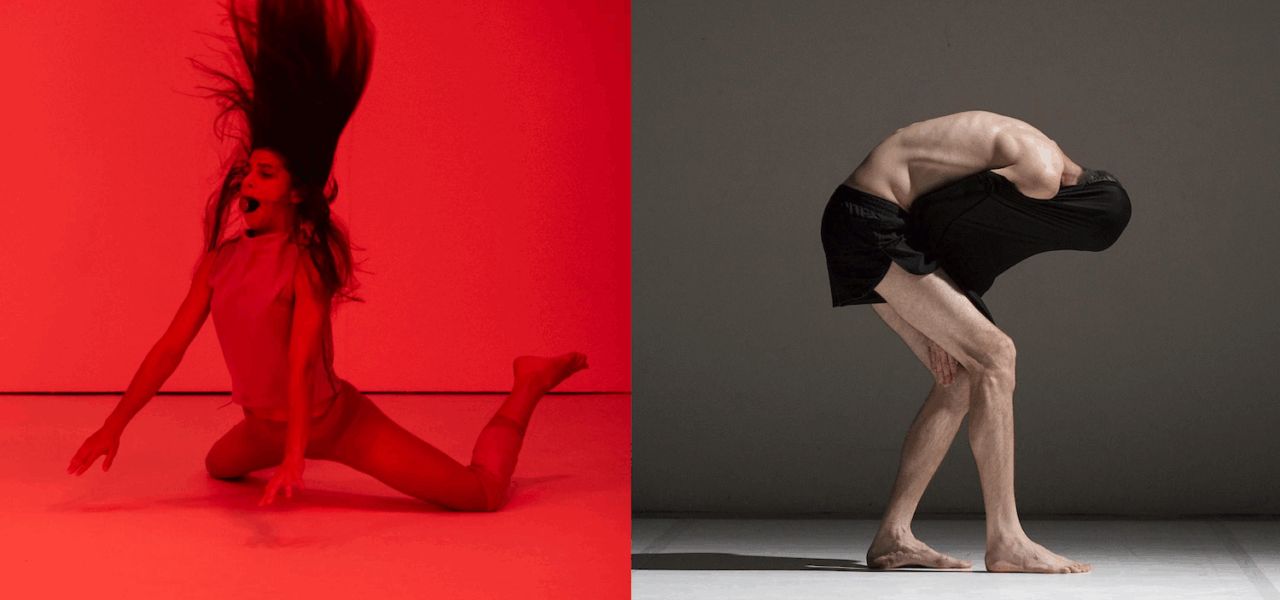
אקדים ואומר שאני מאד אוהבת לצפות ביצירות בסטודיו. העיניים שלי מתענגות על גולמיות רכה של יצירה המוצגת בביתה, ללא עטיפה של הפקה גדולה ומתוחכמת. דלות האמצעים מאפשרת לאיכויות אחרות לבלוט ולגעת באופן יותר אינטימי וישיר בצופים. “חשוף בסטודיו” הוא דוגמא מופלאה לערב שכולל שתי יצירות שונות מאד שמדברות זו עם זו ומתחברות בצורה מופלאה: “הוראות הרכבה” של ניר וידן ו”שתיקת הסירנות” של תמר סופיה קיש. זהו ערב מסקרן ועשיר, שפועל על כל החושים ומראה מנעד רחב של יצירה מחולית עכשווית דרך שני סולואים מאת ובביצוע האמנים.
הוראות הרכבה / ניר וידן
ניר עומד עם הגב אלינו, לבוש בחולצה ומכנס קצר שחורים. הוא מסובב את ראשו מימין לשמאל במהירות הולכת ומתגברת; מה שנראה בהתחלה כפעולת קריאה של מילים בלתי נראות הופך במהרה לאקט עוצמתי של סירוב. תנועתו לעיתים מסונכרנת עם קצב מוסיקת הטכנו שמתנגנת ברקע, ולעיתים חורגת ממנה במכוון. התחלה חזקה ואמיצה – ה”כן” של קיום היצירה מתחיל בלצעוק את המילה “לא”. אני מרגישה שזה משקף באופן מדויק את הלך הרוח של חיינו כאן בשנים האחרונות. הסירוב הנחוש וטלטול הראש מצד לצד אינם הכחשה עיוורת אלא התנגדות פיזית איתנה, כשה”לא” משמש כמנוע מנוע רב עוצמה.
הטלטול מתגבר ומהירותו כבר מזמן חורגת מגבולות ה-bpm של הטראק. העיניים שלי לא מספיקות לפרש את הדימוי שמולי ונוצר קסם – אני רואה את אוזן ימין ואוזן שמאל של ניר בו זמנית בפרופיל. העיניים שלי מתעתעות בי, ומשקפות דימויים משונים ביותר – כאלה שאפשר למצוא בציוריו של פיקאסו ובייקון, המשלבים פרספקטיבות שונות בקנווס אחד, רק שכאן זה קורה מולי בזמן אמת. הטלטול ממשיך ומשתלט על כל גופו של ניר, מוריד אותו אל הריצפה, מסובב אותו, מוליך אותו במרחב כמעט בכניעה. טראנס או גירוש שדים, אם תרצו, שממשיך ליצור אשליות אופטיות ולאתגר את התפיסה שלי. השם “הוראות הרכבה” מניח שיש משהו מפורק אותו נרצה להרכיב – והנה כאן מולי, כבר בדקות הראשונות, אני רואה את ניר על סך חלקיו המופרדים והמובדלים, ללא היכולת לתפוס את השלם.
השקשוק דועך, ניר נעמד שוב עם הגב אלינו על רגליו הדקות והאיתנות באופן מפליא. אני מדמיינת את עצמי אחרי מהלך דומה, ומבינה שהסחרחורת הייתה מושכת אותי במהרה אל הריצפה, ולא בדרך חיננית. בתוך גופו השלדי והשברירי למראה יש עוצמה פנימית ומרכז יציב שמקבלים במה ברגע זה. ידיו של ניר מצטלבות מול גופו ופולשות אחת לתוך המרחב של השניה – יד שמאל למרחב מימין ויד ימין למרחב משמאל. הידיים מתגנבות למרחב הגבי, כאילו היו ידיים זרות, ומתחילות למשוך את החולצה כלפי מעלה ולחשוף את העור. עוד אשלייה אופטית שמציבה את שאלת הבעלות – של מי הידיים? איפה ניר, והאם הוא מסכים למהלך? וכיצד יתנגד אם לא? הידיים ממשיכות להרים את החולצה, חושפות את הגב ומכסות את הראש, שיישאר מכוסה עד סוף המופע (אחזור לזה בהמשך). תחושת אי-הנוחות מול הסצינה הולכת ומתעצמת כשאותן הידיים הזרות יורדות אל קו המותן ומורידות את גומי המכנס אל מתחת לגובה הישבן. לראות או לא לראות, להתבונן או להסיט מבט – אבל לאן? הבמה ריקה ולא מספקת פתחי מילוט. ניר לוכד אותנו במבוכה המשולבת בסקרנות, כשאותן הידיים מתחילות להניע את הישבנים והעיניים שלי שוב מתחילות להתבלבל, כשמה שמולי מאבד ממשמעותו הרגילה והופך לדבר-מה אחר, חדש. הישבן הערום נהיה חומר בידי היוצר, תרתי משמע, וממשיך לפרק את היכולת שלי לתפוס את מה שאני רואה באופן מלא וקוהרנטי.
אותן ידיים זרות פולשות לתוך המרחב שבין הרגליים, ומתחילות להניע את ניר בצעדים מדודים לאחור, תוך כדי קימור גבו. רגע שברירי, ארוטי ומטריד, ושוב אני תוהה – איפה ניר בתמונה והאם ידיו מקשיבות לו או בעלות עמדה משל עצמן? דימויי המלחמה והפלישה הגופנית לא מקלים על הצפייה במה שמשתקף מולי עיני. זהו רצף חזק ומטלטל ושוב אין לאן לברוח. אולי רק לעצום עיניים או לשים את החולצה על הראש בהזדהות עם האמן.
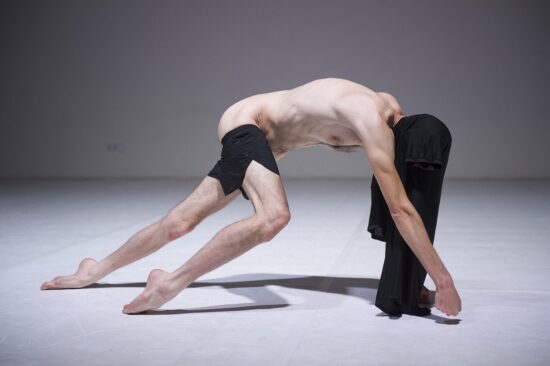
Photo Dieter Hartwig
דרך מחקר תנועתי-ויזואלי ניר לוקח אותנו למסע אל הדרכים השונות לפרק את הצורה של גופו לצורות זרות, משונות, דימויים מוכרים וניתנים לשיום, כמו גם דימויים חדשים בעלי חוקים משל עצמם. התאורה הקרירה והסאונדטראק שיצרה תומר דמסקי מייצרים אווירה טעונה. דרכי ההזרה הן רבות ומגוונות, והן עובדות – אין כמעט רגע בו אני מרגישה שמה שאני רואה מולי זה אדם במובן המוכר של המילה. המחקר של ניר הוא בו-זמנית ארכיאולוגי ופוליטי, והוא עשוי ביד מיומנת ביותר.
תנועת הראש בתחילת המופע, הבחירה בבגדים השחורים כמו גם העיסוק בפירוק-העצמי – כל אלה לוקחים אותי בליל ברירה ליצירה הקאנונית של קסבייה לה רואה בשם Self Unfinished. קסבייה משתמש בבגדים השחורים כדי ליצור ריבוי משמעויות המשתנות במהירות מסחררת, וניתנות לזיהוי ולפרשנות באופן מיידי כפי שניתן לראות בקטע המצורף. ביצירה של ניר, למעט סצינות בודדות בהן זיהיתי שימוש בבגדים השחורים ככלי ליצירת משמעות, התחושה שלי היא שהם משמשים יותר ככלי למחוק מידע לא נחוץ, להסתיר ולהחביא את מה שלא צריך להיות בחזית.
היות והבגדים נשארים עליו למשך כל המופע, כשברובו החולצה נמצאת מעל הראש והמכנס מתחת לקו הישבן, שאלה שהתגנבה לראשי בתחילת הדרך הלכה והתעצמה ככל שהזמן עבר – למה בעצם הבגדים שם? האם יש כאן רצון להיחשף או שמא להתחבא, או אולי גם וגם? דמיוני הפורה מתחיל לצייר מולי מופע מקביל המתרחש בזמן המופע האמיתי, עם ההבדל הקטן שהיצירה מבוצעת כעת בעירום מלא. אולי זה נשמע כמו חלום מציצני מצד הכותבת, אך היא מצידה מרגישה שזה הדבר המתבקש ונובע מהיצירה עצמה. אם הגוף הוא חומר גלם נקי ופשוט, בעל מסה, מרקם, צבע, ומשקל, אין הבדל בין הישבן החשוף לעין המוסתרת – כולם שווים.
לפני כעשור, מצאתי ערימת עיתוני אופנה זרוקים באחד הרחובות לידי בתל אביב. אחד מהם היה המגזין ACNE PAPER, כשאותו הגיליון הוקדש כל כולו למחקר של הגוף האנושי בצילום אמנות ואופנה. כתבה מרכזית בגיליון שמה זרקור על צלם אמריקאי בשם ביל דארג’ין, שצילומיו מזכירים את יצירתו של ניר באורח מפליא. גם הוא חוקר את אפשרויות הפירוק של הגוף האנושי, בשימוש מתוחכם בזוויות צילום ומנחי גוף מיוחדים של הדוגמנים. העירום של הגוף המצולם מתבקש וטבעי, כמעט הכרחי, כמו בפיסול וציור קלאסי.
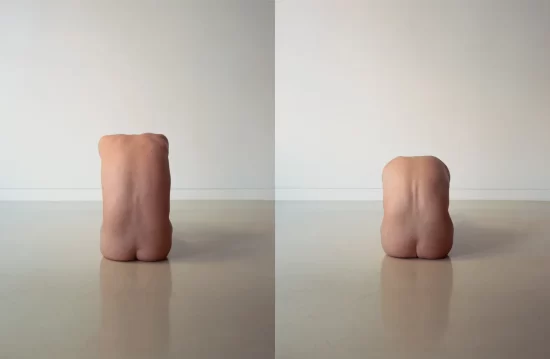
Figure Studies, Bill Durgin
היצירה המקבילה בראשי המשיכה להירקם מול עיני ואפשרה לי גם ליצור קשר עין עם האמן ולהרגיש. להרגיש את המבוכה, הבושה, הגאווה, ההסתרה והחשיפה האמיצה. המשכתי לצפות בשתי יצירות, אחת ממשית ואחת בדיונית. החומר התנועתי המוקפד והמדויק של ניר מרשים ביופיו, ומותאם ככפפה למידות גופו. כל עצם מביעה עולם שלם, וכל תנועה קטנה בעלת חשיבות. ועדיין, אם אני חושבת על השם – הוראות הרכבה – היה חסר לי הדבק לחבר את כל החלקים יחדיו. בשבילי כצופה הדבק הוא האנושי, הרגשי, הרך והמשותף, כמו האפשרות ליצור קשר עין גם אם זה לרגעים בודדים. אולי “הוראות הפירוק” הוא שם שתואם את חוויתי מהמופע – כיצירה מרתקת, שונה ועשויה ממיטב חומרי הגלם.
*
שתיקת הסירנות / תמר סופיה קיש
כל נסיון שלי לכתוב על העבודה באופן לינארי, דרך מילים שמצטרפות למילים ויוצרות משפטים ופסקאות, כשל; הכישלון בעיני הוא עדות להצלחה של היוצרת המעוניינת לעסוק במתח בין הגוף החולף ותנועתו הלא-ניתנת-להגדרה לדימויו המוגדרים והמקובעים באמצעות פעולת הצילום והתיעוד. המילים רצו להתארגן בהיררכיה שונה הפעם, ואני נותנת להן דרור.
*
אדוות
כריות האצבעות פוגשות את המים, שפוגשות קרני האור, שפוגשות העיניים שלי
כמו שיר הייקו
מעט מילים הרבה רגש
תנועת האצבעות מניעה את הקיר שמולי, מפסלת בחומר הקשה מבלי להזיז לבנה
מבלי להזיע
כמעט.
גיגית המים השקופה מלאה למחצה, ואני תוהה אם תמר תצלול לתוכה בשלב כלשהו במופע
ואם יהיה כאן קסם או אשלייה אופטית לכל הפחות
נחכה ונראה.
*
המצלמה מוכנה, העדשה מכוונת, היא מתחילה לפלס את הזמן האינסופי למקטעים-מקטעים
כמו פצצה מתקתקת לוכדת רגעים בודדים מתוך הבליל
הכאוס
צלילייה – מטרונום אכזרי
בוררת מה נשאר בזיכרון
ומה הולך לאיבוד
בעולם האינסופי של רגעים שלא שמנו לב אליהם.
העולם האינסופי שמתקיים במקביל לחיים האמיתיים
אך אין אליו שביל גישה.
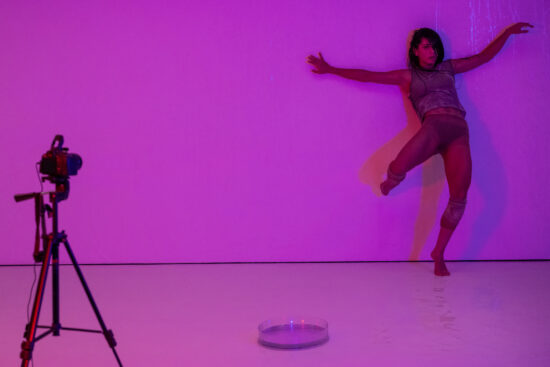
Photo Carole Parodi
תמר בתנועה אימפולסיבית ורפטטיבית לצלילי המצלמה
הגוף שלה פוגש את הקרקע ברכות הנדרשת כדי להמשיך אך גם בעוצמה המהדהדת בעצמותיי
ואת זה אני בטוחה שהמצלמה פספסה.
איך נראית רכות?
*
אני רוצה לדעת איך ייראו הסטילס
אבל תראי, זה מולך, אומר לי קול פנימי
זה קורה כאן מולך, מה עוד את צריכה?
אבל אני מתה לדעת, האם בסוף המופע תהיה הקרנה? אולי נקבל מזכרות פולארויד? מרצ’נדייס עם רגעים נבחרים מתוך המופע?
האם הזיכרון שלי נופל מזה של המצלמה, או שאולי
אין לה זיכרון
כלל
*
תנועת הרקדנית בולעת את המרחב מסביבה, מונעת ממנוע פנימי בעוצמות גבוהות,
הדימויים היפים מתחלפים בקצב גבוה.
קערת מים הופכת להריון קצר-מאד
מתועד כמובן.
היא חוזרת לגיגית ואני תוהה אם זה לא מסוכן
המפגש של תנועתה שהיא חשמל טהור ומים
אבל זה בסדר.
השיער הרטוב והכבד מוביל תנועה גדולה
הפה הפעור עם הספיקר, רגע בעצם זה היה לפני, או שלא? המצלמה בטוח זוכרת.
הפה הפעור לרווחה, ומשמיע קול שאיננו שלה (לרוב), לעיתים נבלע מתוך תנועת גופה
דימוי מבריק ומרתק
קשת רחבה של הבעת פנים וגוף:
שילוב של הפתעה עם צעקה שקטה וכאב בלתי ניתן לתיאור
אני מצדיעה ללסתות שלה על התמדה להחזיק את הספיקר לאורך זמן
לא לפלוט בטעות
איזה מילה שלא במקום.
*
היא צוללת לתוך הגיגית
לא כמו שדמיינתי
כמו שהיא דמיינה
שערה הרטוב מוביל את התנועה במרחב
מושך אל הקיר
אדוות המים ניתזים לכל עבר,
הקיר הלבן משנה צבעיו
מתרכך
נכנע לכוח הזרימה
שאי אפשר לעצור.
*
“חשוף בסטודיו” – ערב משותף של ניר וידן ותמר סופיה קיש (שניהם התארחו כאמני רזידנסי בשנה החולפת בסטודיו של להקת יסמין גודר) התרחש ב25.9 ו26.9 בסטודיו של להקת יסמין גודר.
Jenny Birger’s Impressions Following “Exposed in the Studio”- A Joint Evening by Nir Vidan and Tamar Sofia Kisch
I’ll start by saying that I love watching works presented in a studio. My eyes delight in the soft rawness of a piece shown in its home, without the wrapping of a large, sophisticated production. The scarcity of means allows other qualities to surface and to touch the audience in a more intimate and direct way. “Exposed in the Studio” is a wonderful example of an evening featuring two very different works that speak to one another and connect beautifully: “Assembly Instructions” by Nir Vidan, and “The Silence of the Sirens” by Tamar Sofia Kisch. It’s an intriguing, rich evening that addresses all of the senses and reveals a broad range of contemporary dance creation through two solos, choreographed and performed by the artists themselves.
Assembly Instructions / Nir Vidan
Nir stands with his back to us, wearing a black shirt and short black pants. He turns his head from right to left with increasing speed; what looks like reading lines of invisible words quickly becomes a powerful act of refusal. At times his movement syncs with the techno beat playing in the background, and at others he deliberately breaks away from it. A strong and courageous opening, the “yes” of creation begins with shouting the word “no.” I feel that this opening accurately reflects our lives here in Israel in recent years. The firm refusal and the shaking of the head from side to side are not blind denial but a grounded, physical resistance, the “no” serving as a potent engine.
The shaking intensifies, surpassing the BPM limits of the track. My eyes can’t keep up with the image before me, and magic occurs in front of me: I see Nir’s right and left ears simultaneously in profile. My eyes deceive me, conjuring strange, distorted images, like those in the paintings of Picasso or Bacon, blending multiple perspectives on a single canvas. The shaking continues, overtakes Nir’s whole body, brings him to the floor, twists him, leads him through the space almost in surrender. A trance, or perhaps an exorcism, that keeps generating optical illusions and challenging my perception. The title “Assembly Instructions” implies there’s something disassembled that one wishes to reassemble, and indeed, already in these first minutes, I see Nir as the sum of separated parts, unable to perceive the whole.
The tremor subsides. Nir stands again, his back to us, on surprisingly firm and thin legs. I imagine myself attempting something similar, I’d be flat on the floor in seconds, dizzy and graceless. In his fragile-looking, skeletal body there is inner power, a stable core now fully on display.
His arms cross in front of his body and invade one another’s space, the left arm reaching right, the right reaching left. The hands sneak behind his back, as if they were foreign hands, and start pulling his shirt upward, revealing his skin. Another optical illusion that brings with it a question of ownership: whose hands are these? Where is Nir, and is he consenting? And, if not, how could he resist?
The hands keep lifting the shirt, uncovering his back and then covering his head, which will remain covered until the end of the performance (I’ll return to this later). The discomfort grows as those same foreign hands slide to the waistline and lower the elastic of his shorts below his buttocks. To look or not to look, to gaze or avert, but where to? The empty stage offers no escape. Nir traps us in that mix of embarrassment and curiosity, as the hands start moving the buttocks, and again my eyes get confused, what I see loses its usual meaning and becomes something else, something new. The bare bottom becomes material in the hands of the creator, literally, continuing to dismantle my ability to perceive fully and coherently what I see.
The foreign hands invade the space between the legs and begin to move Nir backward in deliberate steps, curving his back. A fragile, erotic, and unsettling moment, and again I wonder: where is Nir in this picture? Are his hands listening to him, or do they have a will of their own? Images of war and bodily invasion make watching even harder. It’s a powerful and disturbing sequence, and again, there’s nowhere to run. Maybe just to close one’s eyes, or pull a shirt over one’s head, in solidarity with the performer.
Photo Dieter Hartwig
Visual and somatic, Nir’s research takes us on a journey into the many ways of dismantling his body’s form into foreign, strange shapes, into both recognizable images and new ones with laws of their own. The cool lighting and soundtrack by Tomer Damsky create a charged atmosphere. The methods of estrangement are many and they are extremely effective; there’s hardly a moment when I feel I’m seeing “a person” in the usual sense of the word. Nir’s research is at once archaeological and political, and it’s executed with impressive skill.
The head movement at the start, the choice of black clothing, and the exploration of self-disassembly all inevitably bring me to the canonical work Self Unfinished by Xavier Le Roy. Le Roy uses black clothing to create a multiplicity of meanings that shift at dizzying speed, immediately recognizable and interpretable, as can be seen in the excerpt linked below. In Nir’s work, aside from a few moments where the black clothes serve as meaning-generating tools, I sense they function more as a way to erase unnecessary information, to hide and obscure what need not be at the forefront.
Since the clothes remain on him throughout, the shirt mostly above his head and the shorts below the buttocks, a question that crept into my mind early on grew stronger as time passed: Why are the clothes there at all? Is there a desire to expose or to hide, or perhaps both? My imagination begins to paint a parallel performance, happening simultaneously, identical except that it’s performed in full nudity. It might sound like a voyeuristic fantasy, but to me it feels like a natural conclusion drawn from the work itself. If the body is a pure, simple raw material, with mass, texture, color, and weight, there’s no difference between the bare buttocks and the eyelid masked by the shirt; they are equals.
About a decade ago, I found a pile of fashion magazines discarded on a Tel Aviv street. One of them was ACNE PAPER, and that issue was devoted entirely to exploring the human body in art and fashion photography. A central article focused on American photographer Bill Durgin, whose works strikingly resemble Nir’s. He too investigates the possibilities of dismantling the human body using clever angles and unusual poses. The nudity in his photographs feels necessary and natural, almost inevitable, as in classical sculpture or painting.
Figure Studies, Bill Durgin
The imagined piece in my mind continued to unfold alongside the real one, allowing me to make eye contact with the artist, to feel: the embarrassment, shame, pride, concealment, and brave exposure. I continued watching the two works simultaneously, one real and one imagined. Nir’s meticulous, precise movement material is beautifully crafted, perfectly tailored to his body. Every bone expresses a whole world; every small motion has weight. And yet, when I think of the title “Assembly Instructions”, I feel the glue that connects the parts is missing. For me as a viewer, that glue is the human, emotional, soft, shared element, the possibility of eye contact, even if only for brief moments. Perhaps “Disassembly Instructions” would be a more fitting name for my experience – which was a fascinating, different and skillfully crafted work made of the finest raw materials.
The Silence of the Sirens / Tamar Sofia Kish
Every attempt I made to write about this work linearly, through words that form sentences and paragraphs, failed. This failure, to me, testifies to the success of the artist, who seeks to explore the tension between the fleeting, undefinable movement of the living body and its fixed, defined image through photography and documentation. This time, the words wanted to arrange themselves differently, so I let them.
*
Ripples
Fingertips meet the water.
Water meets the light.
Light meets my eyes.
A chain of quiet encounters.
Like a haiku,
a flood of emotion contained in only a few words.
The fingers stir the wall before me,
sculpting in hard matter
without moving a single brick.
Almost without sweat.
*
A half-full, transparent tub of water.
I wonder if Tamar will dive into it.
And whether something will happen,
a small miracle, or just an optical illusion.
We’ll wait and see.
*
The camera stands ready,
its lens fixed.
It begins to carve the infinite stream of time into fragments.
Each click is a small explosion.
A ticking bomb collecting moments
from the blur,
from the chaos.
Its rhythm, cruel and mechanical,
decides what will remain in memory
and what will fade
into the endless world of unnoticed things.
A world that exists beside real life,
but has no path leading back to it.
*
Photo Carole Parodi
Tamar moves impulsively and repetitively.
Her rhythm answers the camera’s.
Her body meets the ground with the gentleness needed to go on,
yet the force reverberates through my bones.
The camera misses it, of course.
What does softness look like?
*
I want to know how the still images will look.
But look, it’s here,
a voice inside me whispers.
It’s happening right now, before your eyes.
What more do you need?
Still, I can’t help wondering.
Will there be a projection at the end?
Polaroid souvenirs?
Merchandise of selected moments?
Will my memory fall short of the camera’s,
or perhaps
the camera remembers
nothing at all?
*
The dancer’s movement devours the space around her,
driven by an inner voltage,
a current you can almost hear.
The images change too quickly.
A bowl of water becomes
a very short pregnancy,
documented, of course.
*
She returns to the tub,
and I wonder if it’s dangerous,
this meeting of water
and electricity.
But it’s fine.
*
Her wet, heavy hair drives the movement through space.
Her open mouth with the speaker, or was that before?
Perhaps not. The camera will know.
Her mouth wide open, releasing a voice not her own,
sometimes swallowed by the movement of her body.
A brilliant, mesmerizing image.
A wide arc of expression
face and body intertwined
surprise tangled with a silent scream
and a pain beyond description.
I salute her jaws for their devotion,
holding the speaker for so long,
never letting slip
by accident
a single misplaced word.
She dives into the tub,
not as I imagined,
but as she imagined.
Her wet, heavy hair pulls her toward the wall.
Ripples scatter in every direction.
The white wall changes color.
Softens.
Surrenders
to the unstoppable flow.
Exposed in the Studio- a joint evening by Nir Vidan and Tamar Sofia Kisch (both of whom have been artists in residency at the studio of Yasmeen Godder Company in the passing year) took place on September 25 and 26, 2025.
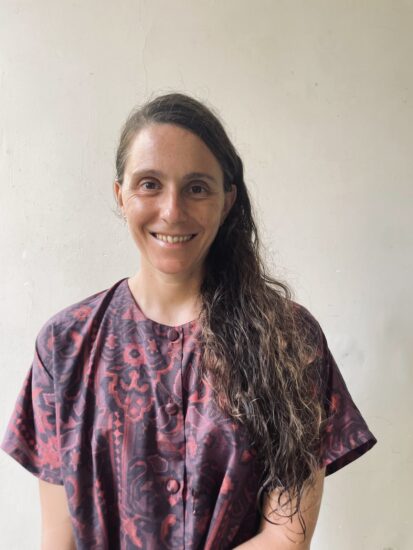 ג’ני בירגר
נולדה ב-1984 בקייב, אוקראינה, כיום חיה ופועלת בתל אביב.
יוצרת וחוקרת גוף רב-תחומית, פרפורמרית ומורה. יצירות הוידיאו-דאנס שלה הוקרנו במבחר פסטיבלים בארץ ובעולם (ביניהם Cinedans, Cyprus Film Festival, Burgundy Video Dance Festival, בית הנסן). בעלת קשת רחבה של הכשרה פיזית ואקדמית, ומחפשת ליצור חיבורים וקשרים חדשים בין גופי ידע שמדברים מטבעם בשפות שונות. בשנים האחרונות חוקרת את הממשק בין תנועה ומילים; דרכים ליצור חומר כוריאוגרפי בזמן אמת; תנועה בתוך מים ומחולות ממערב אפריקה. מלמדת שנים רבות בפרויקט “קהילה בתנועה” המקיימת שיעורי מחול עבור א.נשים החיים עם מחלת הפרקינסון (סטודיו יסמין גודר), כמו גם יוגה ופילאטיס באופן פרטי.
Jenny Birger
Born in 1984 in Kyiv, Ukraine, currently lives and works in Tel Aviv.
A multidisciplinary artist and researcher, performer, and teacher. Her video-dance works have been screened at selected festivals in Israel and abroad (including Cinedans, Cyprus Film Festival, Burgundy Video Dance Festival, Hansen House). She holds a wide range of physical and academic training and seeks to create new connections and links between bodies of knowledge that naturally speak different languages.
In recent years, she has been researching the interface between movement and words; ways of creating choreographic material in real time; movement in water; and dances from West Africa. She has been teaching for many years in the project Movement Communities, which holds dance classes for people living with Parkinson’s disease (Yasmeen Godder Studio), as well as teaching yoga and Pilates privately.