
ארבעה יוצרים רוקדים את הרוח הנוודית של הפלמנקו
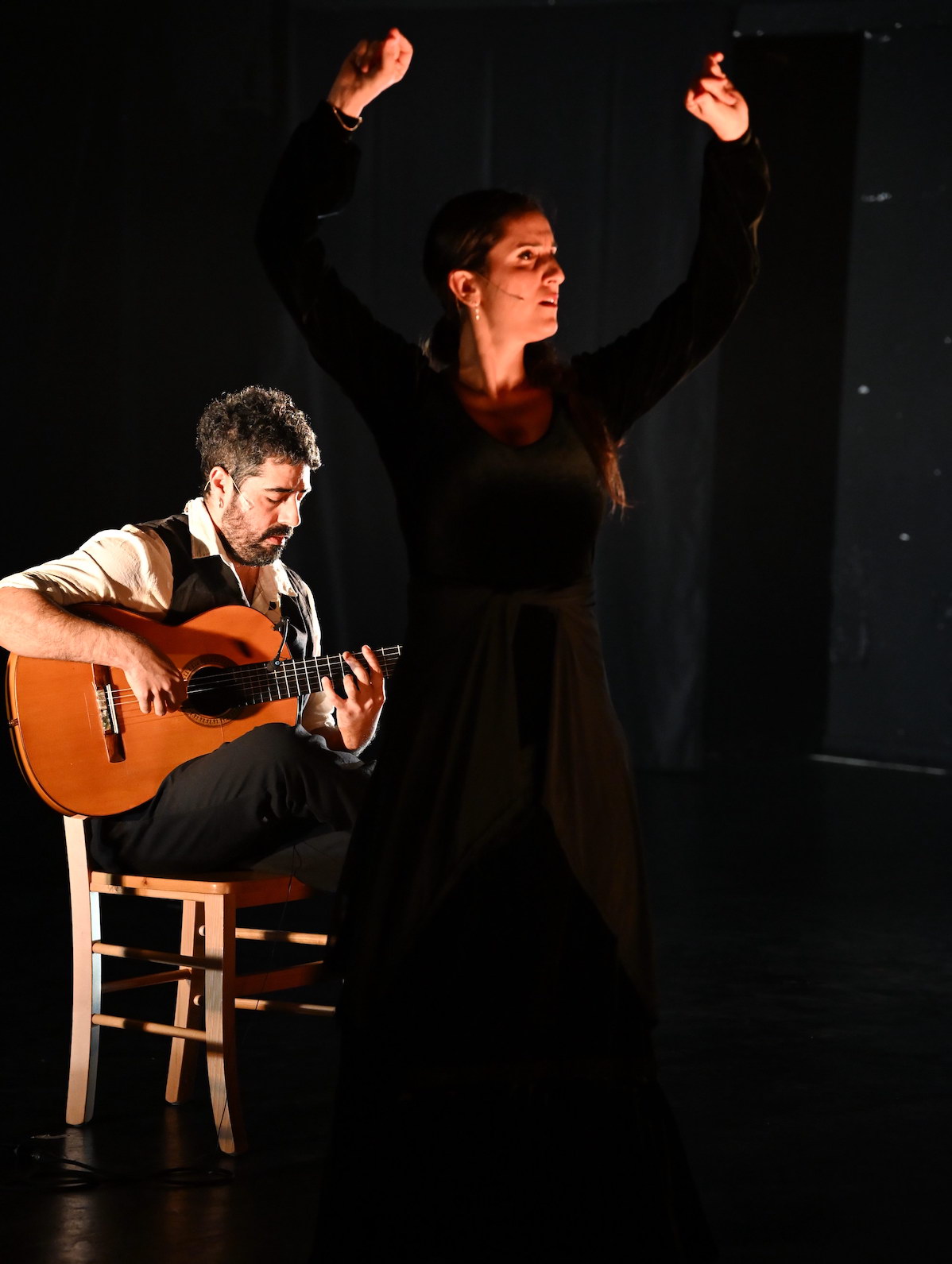
In Photo- Yael Tuchfeld Sayag in ‘In First Person’
Photos by Mark Stranger
*English follows
כמה מחשבות בעקבות המופע Cuartos בפסטיבל Fex
מאת ג’וי ברנרד
במובנים רבים, פלמנקו הוא אמנות ההגירה האולטימטיבית. עמוד השדרה של סוגת המחול הזו, שמזוהה עם אנדלוסיה שטופת השמש אשר בדרום ספרד, הוא התרבות הצוענית. בני שבט הרומה (הצוענים) ככל הנראה החלו להגר מאזור צפון-מערב הודו סביב המאה ה-11, נדדו דרך פרס, המזרח התיכון והבלקן, וספגו השפעות מוזיקליות שונות לאורך הדרך עד שהגיעו לאנדלוסיה במאה ה-15. הפלמנקו עוצב בקרב קבוצות שוליים, שלעיתים קרובות היו במנוסה או נאלצו לחיות במסתור בתקופת האינקוויזיציה הספרדית (אחרי 1492): צוענים, מורים (מוסלמים), יהודים ספרדים ואיכרים אנדלוסיים.
יש אפילו קטגוריה שלמה של שירי פלמנקו שנקראת Cantes de Ida y Vuelta (“שירים של יציאה וחזרה”). זהו סגנון שנולד כתוצאה מהגירה ספרדית לאמריקה הלטינית וחזרה; מהגרים שנסעו במאות ה-18 וה-19 למקומות כמו קובה וארגנטינה שילבו בפלמנקו מקצבים שלמדו, וכאשר חזרו לספרד הביאו איתם את הגרסאות הללו, שנספגו מחדש בקאנון של הפלמנקו. אפשר לומר שהפלמנקו נישא על פני יבשות, לוטש דרך מפגשים בין עמים עקורים והפך במידה רבה למחול של הנוכריים.
לכן לא מפתיע לגלות שקיימת דווקא בישראל קהילה משגשגת של אמני פלמנקו, שאחד מאירועי השיא שלה הוא פסטיבל Fex לפלמנקו אקספרימנטלי – פסטיבל שנערך זו השנה השלישית ברציפות. בשבוע שעבר, הגעתי אחר הצהריים לתיאטרון הבית ביפו כדי לצפות בסדרה של ארבעה מופעים קצרים שנוצרו עבור הפסטיבל על ידי עדי מודבט, הגר שחל, הלל קוגן ויעל טוכפלד סייג. אחר הצהריים שחלקו ארבעת היוצרים נקרא Cuartos (בספרדית: “רבעים”), ונדמה שיחד הארבעה גילמו בגופם ובתנועתם את הרוח הנוודית, ההיברידית שכה מאפיינת את ההיסטוריה של הפלמנקו, דווקא משום שהארבעה התעקשו לשלב, לצד המחוות, התנועות והצלילים הספרדיים הטיפוסיים, שפות תנועתיות ודימויים שחיצוניים לפלמנקו – בין אם מדובר בשימוש בשפה העברית, באובייקטים פלסטיים או ברפרנסים למחול המודרני.
 ראשונה עלתה לבמה הרקדנית והכוריאוגרפית עדי מובדט. אולי דקה או שתיים לתוך המופע שלה, הקהל החל לפרוץ בשאגות Olé נמרצות. על אף שאינני שייכת לקהילת הפלמנקו, מצאתי את עצמי מחייכת מאוזן לאוזן למשמע הקריאות המדבקות של כל הצופים.ות שישבו סביבי. אולי משום שברוב המופעים המערביים הקהל נוטה להתנהג באיפוק מנומס, להיענות לקודים התרבותיים הממשטרים שמנהלים את חיינו, למחוא כפיים רק בסוף המופע, בקצב אחיד. לא כאן. כאן לקריאות ולמחיאות הכפיים יש תפקיד אחר. הן מסמנות של תשוקה – הקהל מודע לתשוקה שעכשיו אוחזת בגופה של הרקדנית, ובאמצעות קריאת ה-Olé מהדהד לה שהתשוקה הזו ממגנטת אותו, עוברת גם אליו. הצופים מריעים לא מתוך ריחוק אלא מתוך הזדהות, תחושת השתייכות. בשעה שמובדט הסתחררה והסתובבה שוב ושוב ושוב ובכל זאת הצליחה, באורח פלאי, למצוא את הפוקוס שלה, אני הרהרתי לעצמי שהייתי רוצה לאמץ את הרוח הנדיבה, השיתופית, של הפלמנקו. מצאתי את עצמי תוהה: מתי בפעם האחרונה בחיים שאגתי ככה משמחה? מתי בפעם האחרונה חשתי שאני שייכת לקהילה שמתאגדת כך בעוצמה ומניחה לעצמה להביע את ההתלהבות הסוחפת שלה?
מעבר לשליטה המכשפת של מובדט בגופה, לא יכולתי להתעלם מהתלבושת שהיא עטתה. שכבת הבסיס לגופה הייתה שמלה ארוכה ושחורה שחצאיתה המתנפנפת הגיחה מפעם לפעם כשתנועות רגליה הבטוחות של מובדט נשאו אותה מצד לצד, אך מעל השמלה היא לבשה שקיות זבל לבנות, שנערמו על גופה כעור שני, שמלה נוספת. לאורך היצירה, דואט עם המתופף דניאל דור אותה כינתה “תשליך”, היא משכה את השקיות, כמו מנסה לתלוש אותן מגופה, ולעיתים אפילו הרימה אותן מעלה יחד עם הנפות הזרוע החגיגיות שלה, כבשה בהן את פניה האקספרסיביות עד שהיא נעלמה ונעשתה כולה, ובכן… שקית זבל. זו הייתה הצהרה בוטה, ברורה, עוצמתית. אולי מובדט ניסתה לומר לנו משהו על המקום שממנו היא מגיעה, על תפקיד שהיא חשה שהיא נושאת איתה (ובמידה רבה, תפקיד שנושאות עימן נשים באשר הן).
נזכרתי לפתע בעבודת וידאו מוקדמת של האמנית ורד ניסים, “אם אספר לכם קורות חיי, דמעות יוצאות לי מעיניי” (2015). ביצירה הזו ניסים מופיעה לצד אמה כאשר היא לבושה בשמלת כלה מהודרת ומקושטת, בעוד שהאם לובשת שמלה קצרה וצמודה שעשויה מסמרטוטי רצפה. אמה של ניסים נראית משפשפת נמרצות עשרות רבות של כפפות ניקוי צהובות המסודרות בעיגול גדול המדמה שמש, תוך שהיא שרה שירים שמחים, המנוגדים לסיפור הביוגרפי העצוב שהיא מספרת ולכך שמדי פעם, הסיפור עצמו והמלאכה הפיזית המתישה, הסיזיפית וחסרת התוחלת גורמת לה לפרוץ בבכי. בשעה שמובדט הסתחררה, הצבע השחור של השמלה שלה והצבע הלבן של שקיות הזבל התמזגו זה בזו, באופן שגרם לי לחשוב שהאסטרגיה בה היא נוקטת, המזכירה את החומרים החזותיים שהעמידה ניסים, מצביעה על כך שמהניגודים הללו בנויים חומרי החיים: נמוך וגבוה, טוהר ולכלוך, חשיפה והסתרה.

עוד יוצרת שלבשה שכבה נוספת על עורה היא הרקדנית הגר שחל. בעבודתה PIEL (מילה שמשמעה “עור” בספרדית, כך על פי התוכנייה), שחל הגיחה לבמה כשהיא עוטה מעין צעיף גדול ולבן שאליו קשור חוט, המחובר לשק גדול. שחל החל מתקדמת לאורך הבמה שפופה, מתאמצת לשאת את משקל השק. אלא שבניגוד למובדט, שחל ביקשה להיפרד מהשכבה הנוספת שהיא נושאת עליה, ובשלב מוקדם מאוד של היצירה היא השתחררה מהכבלים שהיו כרוכים סביב מותניה ופצחה בסולו אוורירי, קליל ויפהפה לצלילי מוזיקה שנשמעה צוענית, אך שכל שפתו התנועתית צעקה מחול עכשווי. מפעם לפעם מפרקי כף היד שלה התעקלו, מציירים ספירלות בכיוון התקרה, והאגן שלה חיקה אותם, ממשיך את העיגול, נע בצורה של הספרה 8. היצירה הקצרה הסתיימה כפי שהחלה: שחל האלגנטית, האנרגטית, בכל זאת התחברה חזרה לחבל שנשאה וגררה איתו מחוץ לבמה. אולי זו הדרך שלה להזכיר לנו שהמשקל של הייסורים או הגעגועים הפנימיים שאנו נושאים אף פעם לא ניתק מאיתנו.
היצירה השלישית בערב היתה “בגוף ראשון” מאת הכוריאוגרפית והרקדנית יעל טוכפלד סייג. זוהי העבודה היחידה מהרצף שהייתי עדה לו שלא בהכרח חרגה מהקונבנציות של הפלמנקו באמצעות עזרים תיאטרליים חיצוניים, אלא דרך שימוש בשפה. לאורך כל העבודה, טוכפלד סייג שילבה בחינניות את המחול שלה עם שירה מלאת נשמה בעברית, שיצרה דיאלוג רגיש ומעניין עם הגיטריסט שהופיע עימה. הבחירה של טוכפלד סייג להחדיר את שפת האם שלה לפרפורמנס שמושתת על התרבות הספרדית הייתה מקורית ונוגעת ללב, במיוחד כשאירעה תקלה טכנית שפגמה במיקרופונים שעל הבמה. תגובתה של טוכפלד סייג הייתה לא פחות מרשימה מתנועותיה מלאות הביטחון, שהיה בהן שילוב של יכולת מבע נרטיבית ושימת לב מעודנת לפרטים – היא לא הפסיקה לשיר. אמנם זה היה היבט לא מתוכנן של ההופעה, אך ראוי להתייחס אליו ולשבח את היוצרת על הנאמנות הסוחפת שלה למופע ועל הנוכחות הבימתית הטוטאלית והכריזמטית שלה, שעוררה ובצדק עוד סבב נרגש במיוחד של קריאות Olé.
היצירה שחתמה את הערב היא העבודה “תנועה מגונה” מאת הכוריאוגרף והרקדן הלל קוגן, שהציג ורסיה בהשראת הפלמנקו של העבודה האיקונית שהעלה לראשונה בפסטיבל “הרמת מסך” ב-2011 ומאז עברה כמה וכמה גלגולים. קוגן נכנס בשערי עולם הפלמנקו ב-2022 עם היצירה THISISPAIN, דואט מסחרר שיצר בשיתוף עם הכוריאוגרפית והרקדנית מיכל נתן, שבו הוא מעלה שאלות על ניכוס תרבותי וגופני תוך עבודת רגליים מופתית וקצבית, ועבודה פרפורמטיבית-טקסטואלית שנעה סביב מושגים שהחברה המערבית תחמה בתוך קווי מתאר מוגדרים ונוקשים, כמו למשל ‘מגדר’, ‘מיניות’, ‘כיבוש’, ‘גבריות’, ‘נשיות’, ‘כאב’. תנועת המטוטלת שקוגן מקיים ביצירה הזו בין שפות האם שלו (עברית, מחול עכשווי) לשפות זרות (ספרדית, פלמנקו) מאפשרת לנו, הצופים, לנוע מתוך כלא “המובן מאליו” אל החופש שבהטלת הספק, שבשאילת השאלות, כמו למשל: מי אמר שככה הדברים צריכים להיות? למה אנחנו כל כך נואשים להגדרות?
 ב”תנועה מגונה”, קוגן שידוע בכתב היד הסאטירי שלו, בוחן את המושג “מגונה” במובן הפוליטי והמוסרי. דרך שילוב של טקסט, הומור עצמי ופירוק של קלישאות מחוליות (כמו ה”דיוק” האירופאי לעומת ה”חספוס” המקומי), נדמה שהוא מבקש לשאול ביצירה זו האם העיסוק באסתטיקה ובמחול יפה בתוך מציאות של קונפליקט וכיבוש הוא כשלעצמו סוג של תנועה מגונה. לפסטיבל Fex קוגן יצר תמצית מהעבודה המקורית, הנשענת על רגע שיא מהעבודה – מונולוג הומוריסטי המגולל חלום שבו גופו מתפרק, איבר מינו נפרד ממנו והוא נאלץ לשתול אותו על כף ידו, מה שהופך אותו לישות עצמאית ומגונה. למשמע צליל דפיקות בדלת, קוגן מתלבט אם לפתוח אותה או לאו, בשל הפוטנציאל המביך של המפגש עם מי שיגלה מהעבר השני. עד מהרה, בחלומו מתברר לו שמי שהתדפקה על דלתו היא לא אחרת מהכוריאוגרפית המיתולוגית פינה באוש, ושהוא למעשה נמצא בוופרטאל, גרמניה, לב המקדש של המחול המודרני. גם 14 שנים אחרי שראיתי את היצירה הזו לראשונה, אני עדיין מתפעמת מהטקסט המבריק של קוגן, מהתזמון הקומי שלו, מהיכולת שלו לנכס את המלבושים של באוש ואת תנועותיה – כותונת בסגנון המלבושים שכיכבו ביצירה Café Müller וזרועות פשוטות לפנים במחווה שכה מזוהה עם באוש – כדי לנסח אמירה עצמאית על האופן שבו אנחנו מגדירים את עצמנו דרך גבולות, לאומיות וכוח, שהפעם עוברת דרך המסננת התנועתית של הפלמנקו.
אם מובדט הביאה אל הבמה את שקיות הזבל, אובייקט שמרפרר לפעולת הניקוי שבהכרח מסמלת התנהגות מעמדית מסוימת, קוגן מביא לבמה את באוש ואת העיסוק באיבר המין, איבר שמייצג את היצר והבושה. שניהם מעמתים דימויים נמוכים עם “תרבות גבוהה”, מה שמעורר את השאלה: מה באמת “מגונה” – הפעולה הפיזית הקשה, או הצורך שלנו להסתיר אותה?
אם הפלמנקו צמח מתוך צורך של קהילה מודרת ונודדת לבטא את עצמה, קוגן (שוב) לוקח את המחול הממסדי והשבע ומכריח אותו להסתכל על הלכלוך שמתחת לפני השטח. אחד המושגים המרכזיים בפלמנקו הוא Duende – מילה שמתארת התפרצות גולמית של רגש, לעיתים אפלה, שמשתלטת על האמן ועל הקהל. הדואנדה מגיע מתוך מאבק ודורש מגע עם הסבל, עם הידיעה שאנחנו בני תמותה. כמו הדואנדה, שבו הכאב והשמחה משמשים בערבובייה, גם אצל קוגן אני מוצאת את עצמי צוחקת, אבל כמו ברבות מעבודותיו, זה צחוק שנובע מאי-נוחות ומעורר אותה, צחוק שגורם לי לחשוב מחדש על המציאות שבה כולנו מתחוללים ומחוללים, על הבמה ומחוצה לה.
Cuartos הוצג ב12.12.2025 בתאטרון הבית במסגרת Fex Festival.
Four creators dance the nomadic spirit of flamenco: Reflections on the performance Cuartos at the Fex Festival
By Joy Bernard
In many ways, flamenco is the ultimate art of migration. The backbone of this dance genre, identified with sun-drenched Andalusia in southern Spain, is Romani culture. The Roma people likely began migrating from northwestern India around the 11th century, wandering through Persia, the Middle East, and the Balkans and absorbing various musical influences along the way until they reached Andalusia in the 15th century. Flamenco was shaped among marginalized groups who were often on the run or forced into hiding during the Spanish Inquisition (after 1492): Roma, Moors (Muslims), Sephardic Jews, and Andalusian peasants.
There is even an entire category of flamenco songs called Cantes de Ida y Vuelta (“Songs of Departure and Return”). This musical style was born from Spanish migration to Latin America and back; migrants who traveled in the 18th and 19th centuries to places like Cuba integrated rhythms they learned there. Upon returning to Spain, they brought these versions back, and they were re-absorbed into the flamenco canon. One could say that flamenco was carried across continents, polished through encounters between displaced peoples, and became, to a large extent, the dance of the outsiders.
It is, therefore, not surprising to discover a thriving community of flamenco artists in Israel of all places. One of the highlights of this community’s activities is the Fex Flamenco Festival— which recently took place for the third consecutive year. Last week, I arrived at Habait Theater in Jaffa to watch a series of four short performances created for the festival by Adi Movdat, Hagar Shachal, Hillel Kogan, and Yael Tuchfeld Sayag. The afternoon shared by these four creators was titled Cuartos (“Quarters” in Spanish), and it seemed that together, the four embodied in their bodies and movements the nomadic, hybrid spirit so characteristic of flamenco’s history. This was precisely because the four insisted on integrating — alongside typical Spanish gestures and sounds —movement languages and imagery external to flamenco, whether through the use of Hebrew, plastic objects, or references to modern dance.
Adi Movdat was the first to take the stage. Perhaps a minute or two into her performance, the audience began to erupt in vigorous shouts of Olé. Although I do not belong to the flamenco community, I found myself smiling from ear to ear at the infectious calls of the spectators around me. Perhaps it is because in most Western performances, the audience tends to behave with polite restraint, adhering to the policing cultural codes that govern our lives — clapping only at the end of performances, usually in a uniform rhythm. Not here. Here, the shouts and clapping serve a different purpose. They are markers of passion —the audience is aware of the passion currently gripping the dancer’s body, and through the Olé, they echo back that this passion is magnetic, transferring to them as well. The spectators cheer not from a distance, but out of identification and a sense of belonging. As Movdat spun and turned repeatedly, miraculously maintaining her focus, I thought that I would like to adopt this generous, communal spirit of flamenco. I found myself wondering: When was the last time in my life I roared with such joy? When was the last time I felt that I belonged to a community that unites so powerfully and allows itself to express such sweeping enthusiasm?
Beyond Movdat’s mesmerizing control over her body, I could not ignore the costume she wore. The base layer was a long and flowing black dress whose fluttering skirt emerged occasionally as her confident leg movements carried her from side to side. But over the dress, she wore white trash bags, piled on her body like a second skin. Throughout the piece, a duet with drummer Daniel Dor titled “Tashlich,” she pulled at the bags as if trying to tear them from her body, sometimes even lifting them high with her celebratory arm flourishes, burying her expressive face in them until she disappeared and became entirely… a trash bag. It was a blunt, clear, and powerful statement. Perhaps Movdat was trying to tell us something about the place she comes from, about a certain ambivalence she feels toward a role she and all women are expected to fulfill (and to a large extent, a role that women carry with them wherever they are).
I was suddenly reminded of an early video work by the artist Vered Nissim, “If I Told You My Life Story, Tears Would Come Out of My Eyes” (2015). In this work, Nissim appears alongside her mother, dressed in an ornate wedding gown, while her mother wears a short, tight dress made of floor rags. Nissim’s mother is seen vigorously scrubbing dozens of yellow cleaning gloves arranged in a large circle simulating a sun, while singing happy songs that contrast with the sad biographical story she tells and the fact that occasionally, the story itself and the exhausting, Sisyphean, and futile physical labor cause her to burst into tears. As Movdat spun, the black of her dress and the white of the trash bags merged, leading me to think that the strategy she employs — reminiscent of the visual materials Nissim presented — points to the fact that life is made up exactly from these contradictions: Lows and highs, purity and filth, revelations and and concealments.
Another creator who wore an additional layer over her skin was dancer Hagar Shachal. In her work PIEL (“Skin” in Spanish), Shachal emerged on stage wearing a large, white linen scarf tied to a long rope, which was connected to a big sack. Shachal began moving across the stage hunched over, struggling to carry the weight of the sack. Yet, unlike Movdat, Shachal sought to part with the extra layer she was carrying; very early in the piece, she broke free from the bonds wound around her waist and launched into an airy, light, and beautiful solo set to music that sounded Romani, but whose entire movement language screamed contemporary dance. From time to time, her wrists curled, drawing spirals toward the ceiling, and her pelvis mimicked them, continuing the circle in the shape of the figure 8. The short piece ended as it began: the elegant, energetic Shachal reconnected to the rope she carried and dragged it off the stage. Perhaps this is her way of reminding us that the cord of suffering or inner longings we carry is never truly severed from us.
The third work presented in the evening was In First Person by choreographer and dancer Yael Tuchfeld Sayag. This was the only piece in the sequence I witnessed that didn’t necessarily deviate from flamenco conventions through external theatrical aids, but rather through the use of language. Throughout the work, Tuchfeld Sayag gracefully integrated her dance with soulful singing in Hebrew, creating a sensitive and intriguing dialogue with the guitarist who performed alongside her. Tuchfeld Sayag’s choice to infuse her mother tongue into a performance rooted in Spanish culture was original and moving, especially when a technical malfunction disrupted the microphones on stage. Tuchfeld Sayag’s response was no less impressive than her confident movements, which combined narrative, expressive power with a refined attention to detail — she simply did not stop singing. While this was an unplanned aspect of the performance, it deserves recognition, and the creator should be commended for her sweeping loyalty to the show and her total, charismatic stage presence, which — rightly so — ignited an especially emotional round of ‘Olé’ cries.
The piece that closed the evening was Obscene Gesture by choreographer and dancer Hillel Kogan, who presented a flamenco-inspired version of the iconic work he first staged at the Curtain Up Festival in 2011. Kogan entered the world of flamenco in 2022 with the work THISISPAIN, a dizzying duet created in collaboration with flamenco choreographer and dancer Michal Nathan, in which he questions cultural and bodily appropriation through masterful, rhythmic footwork and a performative-textual exploration of concepts defined by Western society within rigid outlines, such as ‘gender’, ‘sexuality’, ‘occupation’, ‘masculinity’, ‘femininity’, and ‘pain’. The pendulum motion Kogan maintains between his mother tongues (Hebrew, contemporary dance) and foreign languages (Spanish, Flamenco) allows us, the viewers, to break free from our mental prisons of preconceived notions and into the freedom of doubt and questioning.
In Obscene Gesture, Kogan — known for his idiosyncratic satirical style — examines the concept of obscenity or indecency in a political and moral sense. Through a combination of text, self-deprecating humor, and the deconstruction of dance clichés (such as European “precision” versus local “ruggedness”), he seems to ask whether the preoccupation with aesthetics and beautiful dance within a reality of conflict and occupation is itself a kind of “obscene gesture.” For the Fex Festival, Kogan created a distillation of the original work, centering on a peak moment—a humorous monologue recounting a dream in which his body falls apart, his genitals separate from him, and he is forced to plant his penis on the palm of his hand, thereby rendering it into an independent and “obscene” entity. At the sound of a knock on the door, Kogan hesitates whether to open it or not, due to the embarrassing potential of the encounter. Soon, in his dream, it turns out that the person knocking is none other than the legendary choreographer Pina Bausch, and that he is actually in Wuppertal, Germany — the very historical heart of modern dance.
Even 14 years after seeing this work for the first time, I am still amazed by Kogan’s brilliant text, his comic timing, and his ability to appropriate Bausch’s garments and movements — a nightgown in the style of those featured in Café Müller and arms stretched forward in a gesture so identified with her — to articulate an independent statement on how we define ourselves through boundaries, nationality, and power. This time, his unique statement is articulated through the filter of flamenco.
If Movdat brought trash bags to the stage— an object referencing the act of cleaning that is necessarily associated with menial labour and perhaps even the struggling working class — Kogan brings Bausch and the preoccupation with genitals, an organ representing both desire and shame. Both choreographers confront “low” imagery with “high culture,” raising the question: What is truly “obscene”—the difficult physical action/reality, or our need to hide it?
If Flamenco grew out of the need of a marginalized and wandering community to express itself, Kogan (once again) takes institutional dance and forces it to look at the dirt it has gathered beneath its own glamorous surface. One of the central concepts in flamenco is Duende — a word describing a raw eruption of emotion, often dark, that takes over both the artist and the audience. Duende comes from struggle and demands contact with suffering, with the knowledge that we are mortal. Like the Duende, where pain and joy are mixed together, I find myself laughing at Kogan’s work — but as in many of his pieces, it is a laugh that stems from and awakens discomfort; a laugh that makes me rethink the reality in which we all move and are being moved, both on and off the stage.
Cuartos was presented on December 12, 2025 at Habait Theater as part of Fex Festival.
Joy Bernard is a choreographer, dancer, actress, multidisciplinary artist and writer. She creates in dance, physical and visual theater, writing, video and sound. She has been commissioned to create and perform her works in various museums, galleries, dance and film festivals across Israel, Europe and Asia.
For the past decade, in addition to her artistic practice Joy has been working as a journalist and critic, specializing in visual arts and dance. Her writing has been published in numerous newspapers and journals, such as: Haaretz, The Jerusalem Post, Flash Art, Collectors Agenda, The Art Newspaper, Portfolio Magazine, Erev Rav, literary magazine Granta and others. She has been a member of the Creative Writing team since 2024.
Joy holds a B.Dance from the Jerusalem Academy of Music and Dance, where she is currently attaining her M. Dance. She is presently training to become a Feldenkrais teacher and therapist.