
Planting the Seeds of Art: Heather DeAtley’s Response to the Israeli Opera’s Dido and Aeneas

*Photo by Yossi Zwecker
Opening note with invitation at end to follow: Take your kids to the opera. Make it a ritual, even if only once a year. Get dressed up. Make it an occasion. Wear red lipstick. Share stories from your life resonant with the tale on stage. Plant seeds in the arts. They will nourish the children in your life. Arm our young generations with art and watch the world transform.
For a brief, magic time, I lived in the Arava Desert of southern Israel. Steeped in mystery and an ancient remembrance, I coveted my time living on the land once walked by Nabateans, Romans, Arabs, and Judeans alike. In the days after seeing the stunning production of Stefan Poda’s Dido and Aeneas by the Israeli Opera, I was reminded of this poem I had written while living in the Arava.
I saw peace today.
Written on the backs and Arms
Of 3 Israelis and 3 Palestinians
As they off-loaded a piano from the back of a truck
Approaching their destination,
The Israeli played little melodies absently
Dancing fingers on untuned keys
I saw peace today.
Six men working together
To bring a piano to its new home.
Could it be that simple?
These hidden tattoos of brotherhood shared
Through moving bodies
In pursuit of offering
This Gift Of Music.
——
When art meets life, life becomes art. Observing this simple, seemingly insignificant moment catalysed something in me. It planted a seed. Something similar was catalysed in me by this incredible production—an invisible thread amplifying connection through beauty and artistry. Humanity working together to create versus destroy. An act of courage and vulnerability in beholding our power to build beauty in the face of aridity and disenchantment. This was my deeply felt sense in the invisible thread linking these experiences: One: a passing moment woven into my life. Life as art. Another: Art reflecting life so profoundly, it awakens something. Amidst it all, we have the power to create—Therein lies the antidote to futility.
הבל הבלים הכל הבל
“Vanity of Vanities, all is Vanity.” —Book of Ecclesiastes
As the curtain opens, a woman clad in black sits alone on the stage. She is positioned between large letters spelling out the above in what looks like snow but is revealed to be sand. This is our epically beautiful introduction to Dido, the true heart and center of the opera. What unfolds is a glimpse into her internal world and its vast array of characters, each representing elements and archetypes of her psychic dissonance. She is all of us and what we grapple with in this wild experience of being human.
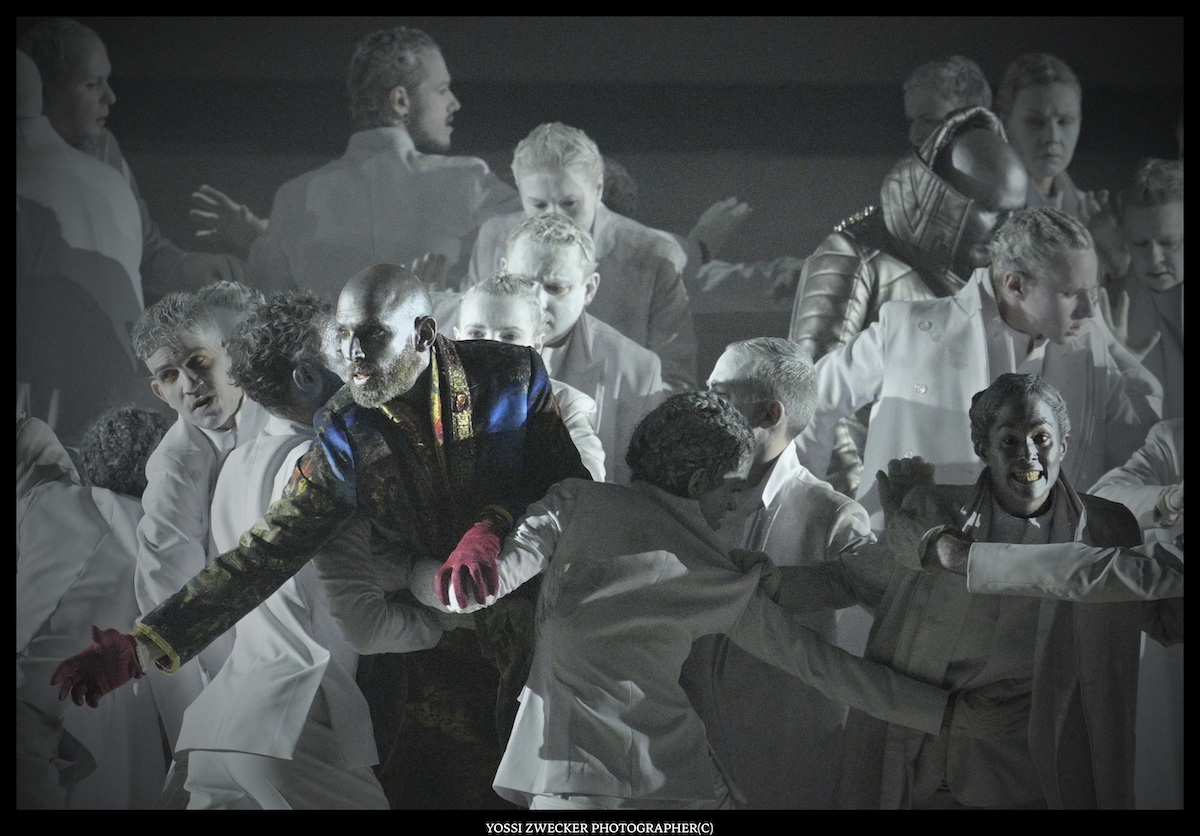
The large, heavy walls behind her foreboding, overbearing and overwhelming. These are walls designed to limit and control versus simply shelter and protect. There is a glimmer of calm waters in the backdrop as viewed through an open portal in the wall. We have stepped into a stunningly designed world created by the visionary Italian director Stefan Poda.
As the first aria of Henry Purcell’s “Dido and Aeneas” unfolds. Dido, the Queen of Carthage, sings hauntingly of the depths and torrents of her torment, her abysmal grief (“grief increases by concealing”) in the wake of losing her husband. “Peace and I are strangers grown,” she laments. As dancers emerge from the overbearing walls, having been camouflaged, they are revealed as nearly nude and covered from head to toe in metallic body paint. They stand in stark contrast to the chorus heavily clad in white robes entering from stage right. Robes designed to stifle thought, movement, and compassion—they embody the stiffness of authority, tradition and societal expectation. Their heads and faces are covered in white, haunting specters of the past, while the nude dancers invite remembrance of life before these filters, deeply rooted in feeling, sensing, and moving through primal instincts. We see the contrast and collision of these forces throughout the hour-and-twenty-minute opera.
Everything about this production was thoughtfully designed and executed by Poda.
A true Renaissance man. Accompanied by my 6 year old daughter, I felt so fortunate that this was her introduction to the magic realm of opera. I was charmed by her questions throughout the piece, especially “Ima, when will they stop singing?!” Poda made this ancient world of Carthage, shipwrecks, Gods and witches so sumptuous, the aesthetics alone could hold the attention of a young art lover.
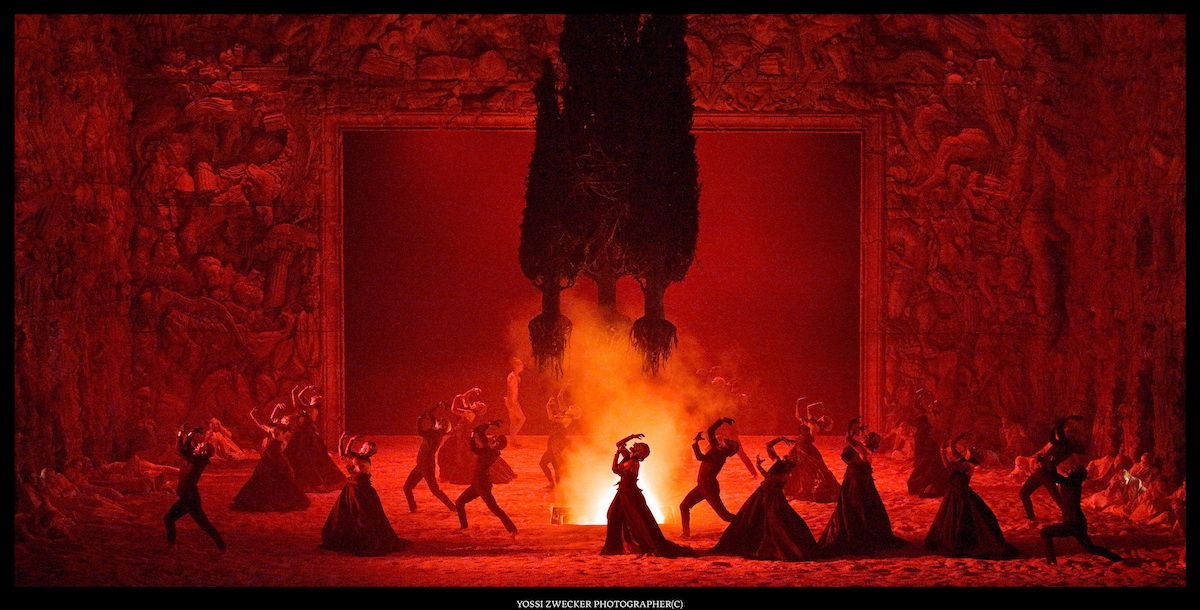
One of the most visually striking scenes was the emergence of the witches from the base of the stage. Crimson lighting accompanied their entry and made for dramatic effect after having been swimming in a sea of primarily white lighting. The contrast was potent and instantly engaging. My daughter was mesmerized. As the dance of the witches unfolded, the movements of the dancers and chorus cast a spell. The choreography perfectly embodied the reveling in destruction and disruption the witches represented. An interesting side note: Inbal Sigler, one of the dancers, shared with me that the witches were not in Henry Purcell’s original 1689 opera. They were added later. An intriguing historical inquiry uncovering a bit of post-witch trial frenzy misogyny, perhaps? Or classic archetypes to flush out the interior world of Dido more fully?
The love that unfolds between Dido and Aeneas is ill-fated and short-lived. She was reluctant to fall for the man who would go on to found Rome, but she eventually yielded to the attraction. Tragically, she lost herself in the process—the choreography, utilized by Poda more for universal expression and to drive the story than anything else, captured the internal torment unfolding within Dido. Each movement is a tribute to the dissonance within her—reaching for what she desires only to fall to the ground. The sequence of reaching with one arm, and then the other, followed by a fall or some other kind of turn or collapse offered a recurring and compelling movement motif. The dancers carried their role as engjnes of storytelling seamlessly.
As the internal journey into the psyche of Dido reaches its tragic end, the opera closes with the chorus and dancers having written in the sand the same words that opened this beautiful opera. Aeneas is left to embrace his destiny of founding Rome while Dido commits suicide (tastefully and age appropriate for a 6 year old of course). We are left to dance with the futility of life, but through the lens of creating and appreciating its beauty as a measure against futility.
The hidden tattoos have been revealed. Or perhaps danced into existence…only to rise and fall as the fleeting art it all is. That all breath is. And I got to behold it all with my daughter.
That in and of itself feels like a revolutionary act against futility—inviting your child to join in the ephemeral act of witnessing art. Just as that brotherhood on the back of the truck all those years ago had done. Perhaps peace can be woven simply by engaging, by playing with the art that we all are. Playing the piano is reminding the Universe it loves itself. And we just keep playing.
My invitation—I will offer two complimentary tickets to the first reader to respond to this post. With the intention of their selecting an Israeli opera production for kids from the 2025-2026 season line up. My only requests are to tag Creative Writing on a post highlighting the experience with the hashtag: #armwiththearts and #paytheartsforward. And to pay it forward to another parent-child duo to enjoy an artistic experience (not limited to opera).
Let’s keep planting the seeds of art. And watch the world transform.
The Israeli Opera presented Henry Purcell’s ‘Dido and Aeneas’ in November of 2025.
Heather DeAtley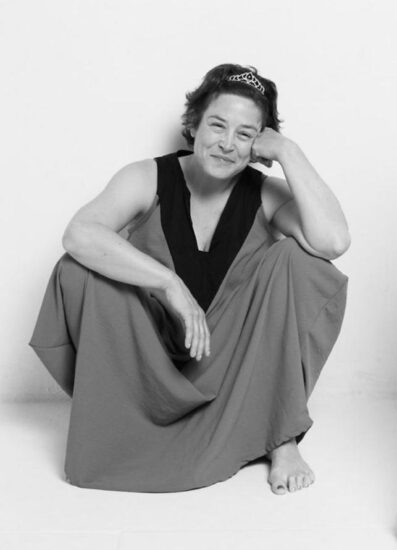
Born in the United States, Heather arrived to Israel in 2011 to dive into the rich movement and dance culture here. Suzanne Dellal became her sanctuary as she immersed herself in the rich worlds of Gaga and the Ilan Lev Method. As a former Division I collegiate gymnast and dancer, movement was always at the center of her life but everything shifted dramatically following a herniated disc that required surgery at the tender age of 19 her sophomore year at the University of Iowa. Her journey into the healing powers of movement had thus begun.
Heather pulls from her long history of movement practice to create synesthetic experiences through her words, event production, poetry, tipulim and intuitive movement journeys. Creatrix of Wombyn in the Water and Wombmynt, alongside Body Poetry (Ilan Lev Method tipulim), Heather blends her fascination with somatics, neuroscience, embodiment practices, pregnancy, birth, embryology, and so much more into all she does. A love of all things dance has always underscored these other passions.
Prior to becoming an ima nearly 6 years ago, Heather had helped in coordinating Suzanne Dellal’s International Exposure festival, graduating to positions of international development and promotion with individual choreographers: Galit Liss, Sally Anne Friedland, and Adva Yermiyahu. These experiences served as the inspiration behind creating/curating the Salon Series in which she hosts female choreographers in her living room of Sde Yitzhak (including fellow Creative Writing contributors Yulia Frydin and Ella Greenbaum!). Movement and poetry are at the core of all she does.
Heather looks forward to launching her body-sourced “Poetry of” workshops later this year.