
ב”טעמים”, הכוריאוגרפית אילנה בלסן מזמינה אותנו לשהות איתה בתוך קרע בזמן
*English follows
*Photos by Asya Skorik
מאת ג’וי ברנרד
היצירה “טעמים”, עבודת הפרפורמנס החדשה של הכוריאוגרפית והרקדנית אילנה שרה קלייר בלסן, פותחת פרק חדש ומסקרן במחקרה של היוצרת על המפגש שבין מזון, אמנות פלסטית ומחול, אשר החל ביצירה “ארוחה ערוכה”, שהוצגה לראשונה בפסטיבל אינטימדאנס בשנת 2023.
“טעמים”, שעלתה בבכורה במסגרת פסטיבל “תל אביב דאנס” של מרכז סוזן דלל, נפתחת בתמונה סוריאליסטית-אירוטית: שלוש נשים מוצגות לראווה בתוך מבנים שהן לכודות בהם. ואולי הן דווקא בחרו להילכד; הכל תלוי באופן שבו תבחרו לקרוא את הדימויים הנפרשים לעיניכן. בחזית השמאלית של הבמה ניצבה המוזיקאית ים אשכנזי בתוך עמדת די-ג’יי עתידנית, מעין קונסטרוקציית מתכת דמוית סולם שנבנתה במיוחד עבורה. עטויה בשמלת נצנצים שחורה בסגנון שנות העשרים, שפתיה משוחות בליפסטיק אדום מנצנץ וגבה מופנה אל הקהל, היא השתופפה מעל עמדת הבקרה שממנה הפעילה את עולם הסאונד הצורמני והעתידני של היצירה.
במרכז הבמה ישבה בלסן עצמה. היא ישבה על שרפרף שקוף, לבושה בשמלת ערב לבנה ונועלת מוקסינים שחורים מצוחצחים. בידיה אחזה תיק שחור אלגנטי, משקפי שמש כהים הסתירו את עיניה, ועל פניה הייתה נסוכה ארשת חתומה ובלתי חדירה. מפעם לפעם החלה לנוע על השרפרף בקצב כה אטי, עד שהזכירה לי בובת ראווה המתעוררת לתחייה בחלון תצוגה. לצידה הופיעה הרקדנית רוני מילטין, לבושה במחוך ובגרבונים צהבהבים. אף ששפת גופה הידהדה את זו של בלסן, כבר מהרגע הראשון היא נראתה כמו גרסה חיה, משוחררת וגמישה יותר של הדמות האסופה והמחושבת שיצרה בלסן.
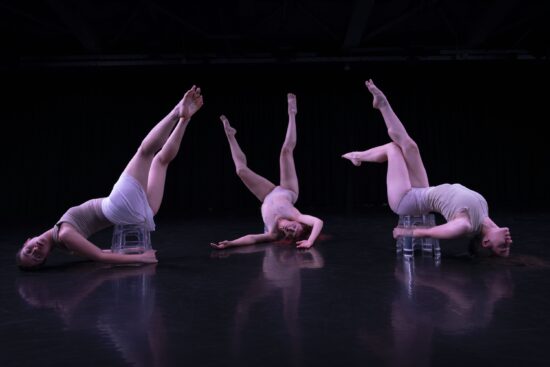
אט-אט הפשירו השתיים מן הקיפאון הראשוני אל תנועה בקאנון על גבי השרפרפים. הן הקשיתו את הגב, זלגו אל הרצפה, ראשיהן מטאטאים את האדמה ורגליהן מתרוממות אל האוויר, כמו מדוושות בקרוסליהן המפוסלים על אופניים בלתי נראים. בבת אחת, תוך הישענות על כוח בטנן וזרועותיהן, התנדנדו בחזרה אל נקודת המוצא, מתיישבות בשיכול רגליים בובתי.
 הרצף התנועתי הזה, שהתפתח באיטיות ונפרש על פני דקות ארוכות, תבע מהקהל התמסרות מלאה למקצב החריג שבלסן מתווה. בראיונות שקדמו לבכורה סיפרה היוצרת כי היא שואבת השראה ממחול הבוטו, זרם שהתפתח ביפן בשנות השישים ומתבסס על איכויות תנועה ועל דימויים חזותיים-פיוטיים. סוד קסמה של “טעמים” טמון בראש ובראשונה בעושרה החזותי, מן התאורה המחמיאה של מתן פרמינגר ועד התלבושות ואביזרי הבמה שעוצבו על ידי רוסלו שמריה, אך ההשפעה של הבוטו ניכרת בעיקר במשך הארוך של כל סצינה, העומד בניגוד חריף לקצב החיים הזריז ורווי המסכים שמאפיין את חיינו מחוץ לאולמות המחול.
ההאטה הקיצונית היא בחירה כוריאוגרפית מעניינת ותובענית. מאחר שבלסן והפרפורמריות שלה התמסרו להחלטה הזו בטוטאליות פיזית ופרפורמטיבית מהפנטת, מצאתי את עצמי נרגעת אט-אט בכיסאי ונכנסת מרצון לקרע בזמן שהיצירה יצרה.
לפתע הגיחה אל העולם המדיטטיבי הזה דמות רביעית: הרקדנית מילה לוי, שנכנסה עטופה בתכריכים שחורים והתקדמה כפופה לעבר עמדת הדי-ג’יי. שם, מתפתלת ומפרכסת בין עמודי המתכת, החלה לפלוט מגופה עשרות כדורי מסטיק צבעוניים שהתגלגלו ברחבי החלל בצליל מספק. בהדרגה הסירה מעליה את המעטפת השחורה, אך זמן רב חלף עד שנחשפה כדמות אנושית. שערה הארוך כיסה את פניה, וגופה נע בעוויתות מבעד לבגד גוף אפרפר, כאילו אחז בו דיבוק. נוכחותה של לוי שברה את הקיפאון המוזיאלי שאפיין את היצירה עד לאותו רגע והחדירה אליה חיות נחוצה. מכאן ואילך העבודה צברה תנופה, כאשר כל אחת מהפרפורמריות יצאה למסע משלה.
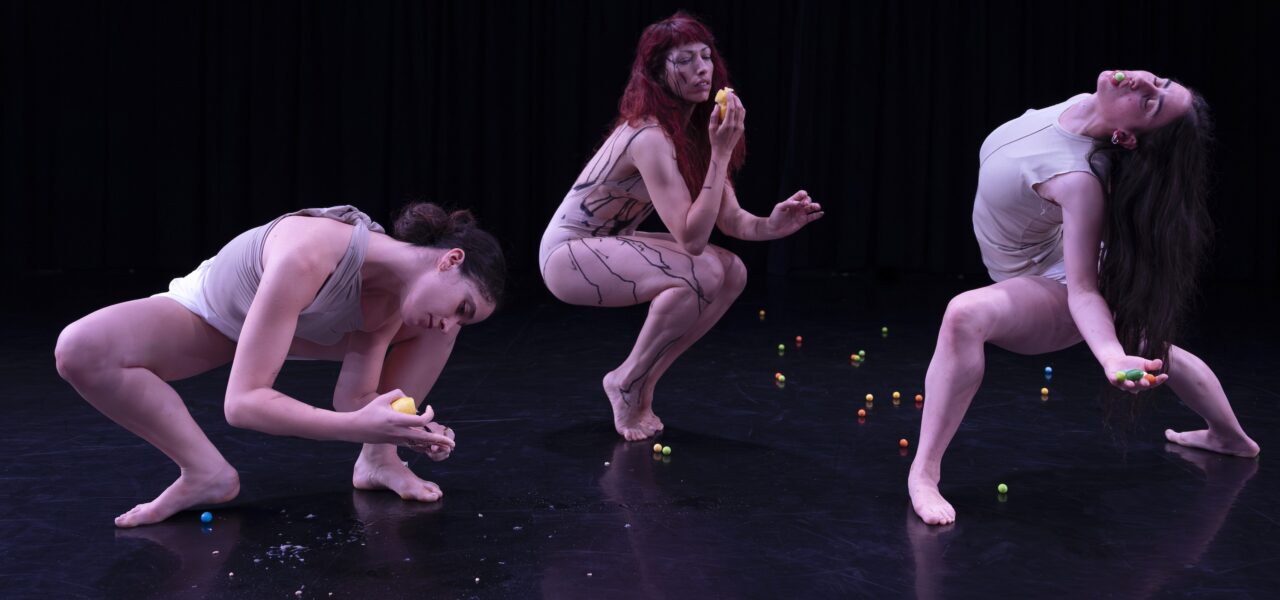
לוי המשיכה לרקוד בתזזיתיות, גופה מתקשת, מתעוות, מתגלגל, מרפה ושוב מתפתל. גם לאחר שאספה אל פיה חתיכת מסטיק ולעסה אותה בפתיינות, גופה לא מצא מנוח. מאחר שנקודת המוצא של היצירה היא טעמים, אותה דמיינתי כפלפל חריף: כזה שאינו מחליק בקלות בגרון, אך מתפשט במהירות בגוף כולו. מילטין, לעומתה, ייצגה את הטעם החמצמץ. היא חתכה לימונים, רקדה עמם ונגסה בהם, בעוד פניה מתעוותות לנוכח החמיצות.
לאורך כל הזמן הזה קיימה בלסן טקס פרפורמטיבי מקביל, שקשה היה להתיק ממנו את המבט. דווקא משום שהיא מוכרת כרקדנית וירטואוזית – כיום כחלק מלהקת יסמין גודר ובעבר כסולנית בלהקת המחול הקיבוצית – הבחירה שלה למעט בתנועה הייתה מעניינת. היא בלטה בדיוק, בהחלטיות ובטקסיות שבה ביצעה את פעולותיה: תחילה התפלשה בצבע לבן שנראה כחלב, ובהמשך בצבע שחור. אחת הסצינות היפות ביותר התרחשה כאשר הסירה את שמלתה, חשפה בגד גוף בצבע עור, אספה את שערה הארוך, שפכה על עצמה את הצבע השחור והחלה לזמזם שיר ערש נטול מילים. היה זה רגע שבו הגוף הפרפורמטיבי הפך ממש לקנבס.
הסצינה הזו שפכה אור חדש על היצירה כולה. לפתע ראיתי בה מסע קינה של בלסן עצמה, בעוד שלוש הפרפורמריות סביבה מגלמות מופעים שונים של אבל. קשה היה להשתחרר מהמחשבה הזאת, במיוחד בסיום, כאשר אשכנזי ירדה מן הסולם, רכסה על גופה גיטרה חשמלית אדומה ושרה ברכות אל תוך מיקרופון שיר המבטיח ללכת בעקבות האהבה. בהקשר זה, ראוי לציין את נוכחותה של אשכנזי ואת העולם הסונארי שיצרה כאחת מנקודות החוזקה של העבודה. בשירתה ובנגינתה, היא יצקה לתוך “טעמים” משמעויות רגשיות קונקרטיות שהפכו תנועות אבסטרקטיות למופעים של כמיהה או אפילו שבר רוחני.
צופים שמבקשים למצוא עקרונות מארגנים, נרטיביים או פסיכולוגיים, לא ימצאו מענה לנטיית לבם ביצירתה של בלסן. כבר בטקסט התוכנייה היא מבהירה כי “כל אחת מהן איננה דמות פסיכולוגית, אלא תדר גופני אחר: מצב של טעם”. ואכן, העבודה אינה מתפתחת לכדי סיפור, אלא מתעקשת להישאר רצף של מצבים ודימויים.
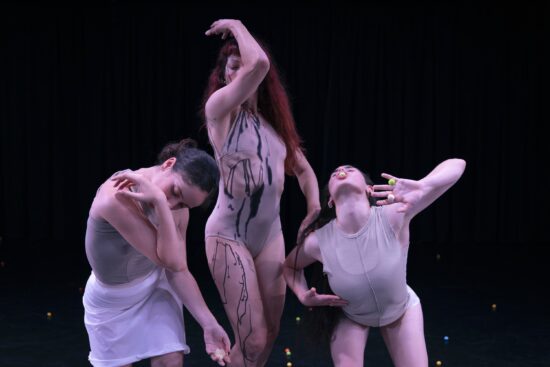 אך מי שתסכים להיפרד מהצורך בהתרה סיפורית תזכה בעולם חזותי מרהיב, גם אם פרגמנטרי ועמום. הרקע של בלסן כציירת אבסטרקטית ניכר היטב באופן שבו היא בונה את המתח שבין תמונות קפואות לבין תנועה נשית הנעה בין אקסטזה מתפרצת לבין טונוס גבוה וריקוד מכונס. ברגעיה היפים ביותר הזכירה לי העבודה את מסורת ה־Tableaux Vivants, ששילבה לאורך ההיסטוריה בין תיאטרון לאמנות חזותית באמצעות קומפוזיציות אנושיות קפואות.
רובד מרכזי נוסף נע על הציר שבין חשיפה להסתרה ומעורר מחשבות על האופן שבו הגוף הנשי תופס בעלות על המבט המופנה אליו. מחד גיסא, הנשים מוצגות לראווה בתוך מבנים; מאידך גיסא, הן מכתיבות לחלוטין את תנאי התצוגה. הגוף הנשי אצל בלסן אינו מתמסר למבט. הוא מתכסה, מסתתר, מסווה את עצמו באמצעות בדים, צבעים ומשקפי שמש. זהו גוף שבוחר להיראות, אך מסרב להפוך לשקוף או למפוענח עד תום. חשיפתו החלקית נראתה לי לא רק בחירה אסתטית, אלא עמדה כוריאוגרפית שמבקשת לשמור על אוטונומיה.
העיסוק של בלסן בטעם דרך חומר, צבע וסאונד מוכיח כי מדובר ביוצרת רב-תחומית בעלת חזון אסתטי מובהק. במקום לתרגם טעמים לאילוסטרציה בימתית, היא מייצרת חוויה סינאסתטית שבה הגבולות בין החושים מיטשטשים: הצליל מקבל מרקם, הצבע מקבל טעם והתנועה הופכת לתחושה.
במובן זה, עבודתה הזכירה לי את ספרה של הסופרת והמתרגמת הבריטית פולי בארטון, Fifty Sounds. בארטון, שהיגרה ליפן בצעירותה, כותבת על חווית התלישות שלה דרך מחקר אודות השפה היפנית. היא צוללת לנבכי השפה באמצעות חמישים מילים אונומטופאיות, מילות חיקוי שאינן מחקות רק צליל, אלא גם מרקם, קצב ותחושה, ומציעה לקרוא אותן לא כייצוגים מופשטים, אלא כחוויות סומטיות וסינסתטיות לחלוטין: Jin-jin כתחושת העקצוץ של מגע ראשון בעור, Bō כצלילה של ספינה המתרחקת מן הרציף, או Basari כצלילו של ה”לעולם לא עוד” הנוחת דווקא כשלא ציפית לו.
כפי שכותבת בארטון, הצלילים הללו אינם מתארים את המציאות, אלא הם “דרך לחוות את העולם ישירות מתחת לעור”. נדמה שגם בלסן אינה מבקשת לייצג טעמים או רגשות, אלא לעורר אותם. היא מפרקת את המחול מכל מבנה נרטיבי אל התדר הפיזי הגולמי שלו, כך שהחמוץ, החריף והמר אינם דמויות או עלילה, אלא מנגנונים תחושתיים שנחרתים בגוף הצופה. במיזוג המרשים הזה שבין אמנות חזותית, סאונד ומחול, בלסן מוכיחה כי השפה הפרפורמטיבית שפיתחה אינה זקוקה למילים כדי להותיר אחריה אדוות.
אילנה שרה קלייר בלסן הציגה את הבכורה של ׳טעמים׳ ב1.8.2026 בפסטיבל תל אביב דאנס של מרכז סוזן דלל.
In Ta’amim, choreographer Ilana Bellashen invites us into a rupture in time
By Joy Bernard
Ta’amim (Hebrew for “flavors”) by choreographer and dancer Ilana Sarah Claire Bellashen marks a compelling new chapter in the artist’s ongoing exploration of the intersection between food, visual art, and dance; a line of inquiry she first introduced in Etiquette, which premiered at the Intimadance Festival in 2023.
Bellashen’s new performance work, premiering as part of the Tel Aviv Dance Festival at the Suzanne Dellal Centre, opened with a surreal, erotic image: three women are displayed inside sculptural structures that seem to confine them. Or perhaps they have chosen confinement themselves; it depends on the lens through which one chooses to read the images unfolding before one’s eyes.
At one end of the stage, musician Yam Ashkenazi stood inside a futuristic DJ booth, a custom-built metal structure functioning as a ladder of sorts. Dressed in a black sequined dress reminiscent of the 1920s, with glittering red lipstick and her back turned toward the audience, she bent over the control panel from which she activated the work’s abrasive, futuristic soundscape.
Taking up center stage was Bellashen herself. Perched on a transparent stool, she wore a white evening gown and polished black loafers. An elegant black handbag rested in her hands, dark sunglasses concealed her eyes, and her face carried a sealed, unreadable expression. From time to time, she began to move on the stool at such a slow pace that she brought to mind a mannequin awakening to life in a shop window. Beside her appeared dancer Roni Milatin, dressed in a corset and pale yellow stockings. Although her physical language echoed Bellashen’s, from the very beginning she appeared as a more alive, liberated, and fluid version of the composed, controlled figure Bellashen embodied.
Gradually, the two women thawed from their initial frozen poses into movement, performing in canon a simple movement sequence on their stools. They arched their backs and spilled toward the floor, their heads sweeping across the ground while their sculptural legs rose into the air, pedalling invisible bicycles with precision. Suddenly, relying on the strength of their abdomens and arms, they rocked themselves back into their original positions, returning to their doll-like seated postures.
This movement sequence, which developed slowly while extending across a rather long stretch of time, demanded complete surrender from the audience to the unusual rhythm Bellashen establishes. In interviews preceding the premiere, the choreographer spoke of drawing inspiration from Butoh, a dance-theater movement that emerged in Japan during the 1960s and is rooted in physical qualities, poetic imagery, and visual states rather than conventional narrative.
The enchantment of Ta’amim lies first and foremost in its visual richness, from the flattering lighting designed by Matan Preminger to the meticulously crafted costumes and stage objects designed by Rossello Shmaria that reveal themselves throughout the work. Yet the influence of Butoh is perhaps most evident in the extended duration of each scene, which stands in stark contrast to the rapid, screen-saturated pace that characterizes contemporary life outside the theater.
This radical deceleration is an intriguing and demanding choreographic choice. Because Bellashen and her performers committed to this decision with such total physical and performative conviction I gradually found myself relaxing in my seat and willingly entering the temporal rupture the work creates.
Suddenly, a fourth figure emerged into this meditative world: dancer Mila Levy, who entered completely wrapped in black shrouds and moved in a hunched position toward the DJ booth. There, twisting and convulsing among the metal beams, she began to expel dozens of brightly colored bouncing gum balls from her body, sending them rolling across the studio floor with a strangely satisfying sound.
Gradually, she removed the black veil surrounding her, yet a considerable amount of time passed before she revealed herself as a recognizably human figure. Her long hair stretched across her face, while the contours of her body, moving in spasms as though possessed, remained only partially visible beneath the long grey bodysuit she wore.
Levy’s presence disrupted the museum-like stillness that had characterized the work up to that moment, introducing a welcome sense of vitality. From that point onward, the piece gained momentum as each of the performers embarked on her own distinct trajectory.
Levy continued dancing with relentless intensity. Her body stiffened, contorted, rolled, released, and coiled back into itself, never finding rest, not even after slipping a piece of chewing gum into her mouth and chewing it with quiet sensuality. Since Ta’amim was organized around sensations of taste, I found myself imagining her as chilli pepper: a taste that doesn’t slide down one’s throat easily, but once it does it spreads quickly, igniting the body from within. Milatin, by contrast, embodied acidity. She sliced lemons, danced with them, bit into them, and allowed her face to contort in response to their sour taste.
Throughout this time, Bellahsen performed a parallel ritual of her own, one that proved almost impossible to look away from. Precisely because she is widely recognised as a virtuoso dancer, currently through her work with the Yasmeen Godder Dance Group and previously with the Kibbutz Contemporary Dance Company, her decision to embrace restraint here felt especially compelling. Rather than commanding attention through movement itself, she did so through precision, deliberateness, and an almost ceremonial sense of purpose.
Her ritual unfolded in carefully measured stages. She first covered herself in white paint that resembled milk before immersing herself in black pigment. One of the performance’s most arresting moments came when she removed her white dress, revealing a flesh-colored bodysuit beneath. Gathering her long hair, she slowly poured the black liquid over herself and began humming a wordless lullaby. In that instant, the performative body became a canvas.
The scene cast the entire work in a different light. Suddenly, I began reading it as Bellahsen’s own ritual of mourning, while the three performers surrounding her came to embody different manifestations of grief. Once this association had taken hold, it became difficult to let go of it, particularly during the closing moments of the performance, when Ashkenazi descended from her elevated structure, strapped a red electric guitar across her body and softly sang into a suspended microphone a song promising to follow love wherever it might lead.
Ashkenazi’s musical presence became crucial in this moment. The sonic landscape she created was among the work’s greatest strengths. Through her singing and live performance, she infused Ta’amim with an emotional concreteness that transformed abstract movement into gestures of longing and even spiritual fracture.
Viewers hoping to find a coherent narrative or psychological framework are unlikely to have those expectations fulfilled by Bellahsen’s work. As she herself wrote in the program notes, “the women are not different psychological characters, but bodily frequencies: a state of taste.” True to this statement, Ta’amim resisted developing into a narrative, insisting instead on remaining a succession of embodied states and visual images.
Those willing to relinquish the desire for narrative resolution were rewarded with a striking visual world, albeit a fragmentary and elusive one. Bellahsen’s practice as an abstract painter was evident throughout the performance, particularly in the way she constructed a tension between sculptural stillness and feminine movement oscillating between ecstatic release, explosive energy, and a tightly contained physicality. At its most compelling, the work recalled the tradition of the tableau vivant, the “living picture”, which historically occupied the fertile ground between theater and the visual arts.
Another of the work’s most compelling dimensions unfolded through the interplay between concealment and revelation, giving rise to contemplation about the ways in which the female body reclaims authority over the gaze directed at it. On the one hand, the women were displayed inside sculptural structures, seemingly offered up to be looked at. On the other hand, they dictated the terms of that display entirely. Bellahsen presented a female body that refused easy access: it concealed itself beneath shrouds, hid behind dark sunglasses, disappeared beneath grey bodysuits and repeatedly obscured itself with black and white liquids. This was a body that chose to make itself visible while resisting complete legibility. Its partial exposure seemed to function not merely as an aesthetic gesture but as a choreographic proposition, insisting on the body’s autonomy and refusing to surrender itself fully to the spectator’s gaze.
Bellahsen’s exploration of taste through material, color, and sound ultimately revealed her as a distinctly interdisciplinary artist with a remarkably coherent aesthetic vision. Rather than translating taste into theatrical illustration, Ta’amim created a profoundly synaesthetic experience in which the boundaries between the senses dissolved: sound acquired texture, color became something to taste, and movement seemed to carry feeling.
In this sense, the performance brought to my mind Polly Barton’s book Fifty Sounds. In this oeuvre, the author and translator approaches the Japanese language through fifty onomatopoeic words, expressions that evoke not only sound but also texture, rhythm, and sensation, and invites the reader to experience them not as abstract linguistic signs but as fully embodied, synaesthetic events. For example, she interprets jin-jin, the tingling of first contact against the skin; bō, the sound of a ship drifting away from the harbor; or basari, the heavy thud of a “never again” arriving at the precise moment one least expects it.
As Barton writes, these sounds are not descriptions of reality but “a way of experiencing the world directly beneath the skin.” Bellahsen seemed to pursue a remarkably similar ambition. Rather than representing taste, or even emotion, she sought to produce it. She stripped dance of narrative scaffolding until what remained was its raw sensory frequency, where bitterness, acidity, and heat no longer functioned as metaphors or characters but as embodied intensities that settled beneath the spectator’s skin. In this striking convergence of visual art, sound, and choreography, Bellahsen demonstrated that the performative language she has developed requires neither words nor narrative to leave a lasting trace.
Ilana Sarah Claire Bellahsen presented the premiere of ‘Ta’amim’ on August 1, 2026 as part of the Suzanne Dellal Centre’s Tel Aviv Dance Festival.
ג’וי ברנרד היא אמנית רב־תחומית, כוריאוגרפית, פרפורמרית וכותבת. עבודתה נעה בין מחול, קולנוע, תיאטרון ואמנות חזותית, וכתיבתה מתפרסמת בעיתונות ובמגזיני תרבות בישראל ובעולם. ב־Creative Writing היא כותבת בעברית ובאנגלית.
Joy Bernard is a multidisciplinary artist, choreographer, performer, and writer whose work spans dance, film, theater, and visual art. Her writing has appeared in Haaretz, Portfolio, The Jerusalem Post, Flash Art, and other Israeli and international publications. At Creative Writing, Joy writes in both Hebrew and English.