
בואי: אוריין מיכאלי הופכת את כישלונה של שותפות אומנותית ישראלית־פלסטינית ליצירת מחול מטלטלת – מאת ג’וי ברנרד
*English follows
*Photos by Asya Skorik

“בואי”. מילה פשוטה כל כך. ובכל זאת, בעברית היא כמעט תמיד טעונה באינטימיות. “בואי”, הפנייה הנשית של המילה “בוא”, נושאת עמה הבטחה של קרבה. היא הזמנה להצטרף, להיכנס אל תוך בית, אל תוך לב, אל תוך דיאלוג.

“רציתי לכתוב לך עוד דבר. איני יודעת מתי תבואי ובינתיים הכל בסדר הדשא מצהיב / והקיפול לא נשלם אני לא מוצאת / את הספר על החולם, החלון פחות נקי יש עליו / סימני געגוע באמת־באמת מינוריים / אבל אני מדמיינת שאת פה ויודעת מה פירוש גאולה באה לעולם” (חיה לוי, “מתי תבואי”, מתוך: אכלתי פרחים).

כמעט שעה לתוך בואי, יצירתה החדשה של הכוריאוגרפית והפרפורמרית אוריין מיכאלי, שעלתה בשבוע שעבר במרכז סוזן דלל במסגרת פסטיבל “תל אביב דאנס”, אני חושבת על השיר מפלח הלב הזה של חיה לוי. במשך שנים קראתי אותו כתפילה לבואה של ילדה שממאנת להיוולד. אבל המופע של מיכאלי מציע אפשרות אחרת: ה”את” שהדוברת מדמיינת בשירה של לוי, “שאת פה”, יכולה להיות גם שותפה ליצירה, פרטנרית לדיאלוג אמנותי, ואולי אפילו בת ברית בפרויקט פוליטי המבוסס על ההתעקשות שגם מציאות אחרת אפשרית.

הרעיון שרקדנית יהודייה ורקדנית פלסטינית יוכלו לבנות שותפות אמנותית שוויונית, כזו שתשפיע ולו במעט על המציאות שסביבן, עשוי להיראות היום כמו פנטזיה אוטופית. דווקא משום כך, ההתעקשות של מיכאלי להמשיך ולנסות לכונן אפשרות כזאת בישראל של 2026 היא מעשה של אומץ.

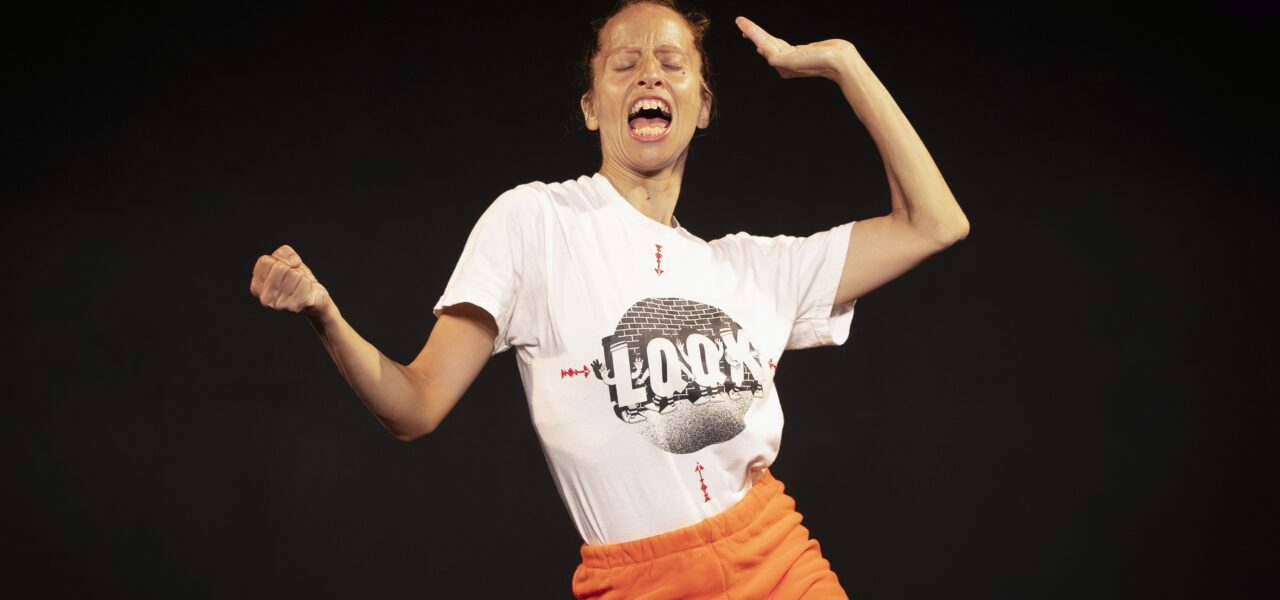
בבואי היא הופכת את ההתעקשות הזאת ליצירת תיאטרון־מחול מקורית, מטלטלת, נוקבת ואינטליגנטית. זו עבודה רגשית מאוד, אך כזו שאינה גולשת לסנטימנטליות; ביקורתית מאוד, אך גם לא מהססת להפנות את הביקורת כלפי עצמה. מעל הכל, היא מזכירה אמת פשוטה: הגוף הרוקד הוא תמיד גם גוף פוליטי.

היצירה נולדה מתוך שש שנים של ניסיונות ליצור שותפות עם לא פחות משש־עשרה אמניות במה פלסטיניות, ניסיונות שהתפרקו פעם אחר פעם עוד לפני שהפכו לשיתוף פעולה של ממש. במקום להסתיר את הכישלונות האלה, בואי הופכת אותם לחומר שממנו היא בנויה.

ההיעדר כחומר בימתי


כדי לספר את הסיפור הזה, מיכאלי בוחרת במבנה ההיברידי של הרצאת־פרפורמנס, המשלב מחול, וידאו־ארט, טקסט ושירה. כבר בכניסתה לבמה היא מסמנת את המרחב הלא יציב שבו יתרחש הערב. היא מתיישבת על כיסא באי־נחת, קמה, שוכבת על הרצפה ושוב מתיישבת. לצידה ערימות של דפים וחומרי עבודה, שרידים גלויים של תהליך אמנותי, ולגופה בגדי עבודה, מכנסי טרנינג וטי-שרט, כאילו זה עתה נכנסה לסטודיו לעוד חזרה. אך סצינת הפתיחה הזאת, כמו המופע כולו, מרגישה פחות כמו התחלה דרמטית ויותר כמו הכנה ממושכת לרגע שאינו מגיע, מעין “מחכים לגודו” בגרסת סולו נשית ופמיניסטית. 

עד מהרה מתברר שההרצאה של מיכאלי מסרבת להישאר בתוך גבולות הז’אנר המוכרים. הגוף כל הזמן פורץ מתוכה. היא מפעילה בעצמה את התאורה, מכוונת את המקרן, מפעילה את חומרי הווידאו, רצה ברחבי האולם, מנתרת על הבמה ושוב ושוב חוצה את הגבול שבין מי שמופיעה לבין מי שמפעילה את מנגנון ההופעה.

הבחירה לקחת על עצמה את כל התפקידים הבימתיים אינה רק פתרון מעשי. היא חושפת את הסתירה המרכזית של הפרויקט: הרצון העמוק להגיע אל אישה אחרת, לצד ההכרה שכל ניסיון לספר את סיפורה, לייצג תרבות אחרת או מאבק פוליטי שאינו רק שלך, ישאר תמיד חלקי.

לאורך המופע מיכאלי פונה אל אישה אחת, אבל זהותה משתנה ללא הרף. היא ס’. אחר כך פ’. אחר כך מ’. שם אחד מחליף שם אחר, עד שהחיפוש אחר נמענת יחידה מתגלה כבלתי אפשרי. אולי כאן נמצא הקשר העמוק ביותר בין המופע לבין שמו. “בואי” היא קריאה שמופנית לכאורה אל אישה מסוימת, אבל זו שמוזמנת להגיע נשארת תמיד מעבר להישג יד.

בהדרגה מתברר שהיעדרה של אישה אחת מסוימת אינו רק תולדה של בחירה אמנותית אלא תוצאה ישירה של המציאות שהמופע מתעד. מיכאלי משחזרת סדרה של מפגשים שלא התממשו: פגישה בבית קפה שלאחריה הגיעה שתיקה; מענקים שהתקבלו, הופעות שתוכננו ותוכניות שנרקמו, ואז התפרקו; טלפונים שלא נענו; שותפות שבחרו בדיעבד שלא יוזכר שמן.

במקום להתייחס להיעדר הזה כמכשול, מיכאלי הופכת אותו לחומר הכוריאוגרפי של היצירה. באחת הסצינות החזקות במופע היא מקריאה רצף ארוך של מיילים שנותרו ללא מענה. הקצב הולך וגובר, עד שקולה נשבר ומשתנק, והיא נותרת ללא אוויר. ברגע אחר היא הופכת מילים קשות שנאמרו לה מצד שותפות לשעבר למעין שיר ראפ שהיא מפנה כלפי עצמה. כך היא מחזיקה בו־זמנית את כל העמדות: את זו שנפגעה, את זו שחוששת שפגעה, ואת זו שממשיכה לשאול מדוע המפגש שכל כך ביקשה לכונן שוב ושוב חמק ממנה.

חיים בתוך קונפליקט מתמשך


הבחירה של מיכאלי לשאת את המופע כולו על כתפיה, מטאפורית וליטרלית, מייצרת רגעים של וירטואוזיות יוצאת דופן. קשה שלא להתפעל משפע היצירתיות שלה ומיכולתה לנוע בין אינספור תפקידים ומצבים. אבל מעל לכל התפקידים שהיא לוקחת על עצמה, היא נשארת בראש ובראשונה רקדנית מצוינת. הגוף שלה — עם המפרקים הפתוחים והאווריריים שלו והשליטה הברורה שלה בעקרונות הריליס, מזכיר לנו שלפני שהיא מרצה, מתעדת או הוגה פוליטית, היא כוריאוגרפית שהשפה הראשונה שלה היא תנועה. לכל מחווה שלה יש בהירות ואלגנטיות, אבל גם דחיפות כמעט בלתי נשלטת לדבר.

את הדחיפות הזאת חוויתי גם כנקודת תורפה של העבודה. לעיתים העודפות של המופע הותירה אותי ללא אוויר. טקסט מצטבר על גבי טקסט, דימוי על גבי דימוי, תנועה על גבי תנועה. לפרקים השילוב בין החומר המדובר לבין המוזיקה מקשה לשמוע את מיכאלי. גם המעברים המתמידים בין פרפורמרית, מרצה, כוריאוגרפית וחוקרת העוסקת בתיעוד דוקומנטרי יכולים להשאיר את הצופה לרגע בלי נקודת אחיזה.

אני מציינת את הביקורת הזאת בהיסוס מסוים, משום שיתכן שהעודפות היא לא אלמנט שהעבודה אינה מצליחה לשלוט בו; יתכן שהיא דווקא האמצעי הנכון להעביר את המסר. בואי מסרבת להרמוניה. היא אינה מנסה ליצור עולם תיאטרלי נקי שבו כל החלקים מסתדרים, שהרי מיכאלי מביימת את הסתירה עצמה. במובן הזה, גם תחושת המחנק שהמופע מייצר הופכת לחלק מהחוויה. היא משקפת חיים בתוך קונפליקט מתמשך, כזה שהוא בו־זמנית פוליטי ואישי.

למצוא מישהי להניח עליה את הראש


אם לעיתים המופע מאיים לגלוש מעבר לגבולותיו, הווידאו־ארט הופך את העודפות הזאת לאחת החוזקות הגדולות שלו. מיכאלי יוצרת קולאז’ צפוף וכמעט כאוטי מתוך בקשות תמיכה שנדחו, מיילים שנותרו ללא מענה, קטעים מחזרות יחידניות בסטודיו ושיחות מצולמות עם השחקנית, המייסדת של תיאטרון עכו והמלווה האמנותית של היצירה, סמדר יערון. בשיחות האלה יערון מציבה מול מיכאלי שאלות קשות על עצם הפרויקט שהיא מנסה להגשים. מיכאלי מגיבה לה בזמן אמת מן הבמה — וכך המרחק בין תיעוד לבין פעולה חיה הולך ומיטשטש.

לצד החומרים האלה מופיעות גם עבודת וידאו שנוצרה עם השחקנית והמחזאית הפלסטינית פדאא זידאן, ובה קטע ספוקן־וורד שהופך לאחד מהעוגנים הרגשיים של המופע. דווקא דרך הנוכחות של זידאן, ואולי ביתר שאת דרך היעדרותה, מתגלה המורכבות האתית של הפרויקט.

באחד הרגעים הלופתים ביצירה מיכאלי מניחה על רצפת הבמה את הבגדים שלבשה זידאן בעבודת הווידאו, והתלבושת הופכת תחליף עצוב לגוף שאיננו. היא מספרת על הרגע שבו, במהלך הצילומים, זידאן פנתה אל הצלם וביקשה ממנו להפסיק לצלם. בתחילה נדמה שהרגע הזה הוא מחווה של התנגדות, התרחקות מתוך המרחב המשותף שמיכאלי מנסה ליצור, אך בהמשך המופע משנה לחלוטין את הקריאה הזאת.

(ספוילר קצר לפניכם)

בווידאו אחר מיכאלי נזכרת כיצד סיפרה לזידאן שההיריון שכל כך קיוותה לו התרחש. היא ביקשה ממנה שלא תספר לאיש, אבל גם שתשמור עליה במהלך החזרות, משום שיש תנועות שכבר אינה יכולה לבצע. כשהיא מעלה באוב את הזיכרון הזה, היא מתנצלת על בקשתה. הרגע הזה משנה את האופן שבו אנו מבינים את הסצינה הקודמת. מה שנראה בתחילה כמו סירוב מתגלה כאקט של סולידריות: זידאן לא עצרה את הצילום כדי לדחות את העבודה המשותפת, אלא כדי להגן על מיכאלי — שהייתה כבר בהיריון, ושעבורה הדרישות הפיזיות של העבודה החלו לגבות מחיר.

המופע מבקש מאיתנו שוב ושוב לשנות את האופן שבו אנו קוראים את היחסים שהוא מתחקה אחריהם. יחסים שנדמים בתחילה כיחסים של דחייה והתרחקות מתגלים בהדרגה כמרחב מורכב הרבה יותר: של תלות, אחריות, פגיעוּת, אכזבה ואכפתיות. אולי כאן המילה “בואי” מקבלת את המשמעות האינטימית ביותר שלה. מעבר לשאלות הפוליטיות הגדולות, היא מבטאת כמיהה פרטית מאוד: למצוא בחיים האלה אחות. אישה שאפשר להניח עליה את הראש; מישהי שתגן עלייך ברגע שבו הגוף שלך כבר אינו יכול לשאת את משקל הקיום לבדו.

ייתכן כי הפרדוקס של המופע, ושל החיים עצמם, הוא שכאשר האישה שאליה מופנית הקריאה אינה מגיעה, מיכאלי נאלצת להפוך לאישה הזאת בעצמה. היא זו שמחזיקה את כל הקצוות, שמפעילה את האורות, שנושאת את הדפים, שמספרת את הסיפור, שממשיכה לרקוד גם בתוך ההיעדר. “בואי” הופכת מקריאה לאחרת גם לקריאה פנימה, אל האפשרות להיות עבור עצמך, ולו לרגע, מי שחיכית שתגיע.

האהבה מעולם לא הייתה תנועה פופולרית’


המהלך האחרון של המופע מוסיף רובד נוסף למערכת היחסים המורכבת שמיכאלי בונה לאורך הערב. היא מחלקת לכל אחת ואחד מהצופים עותק מודפס של מייל שכתבה לה אחת השותפות לשעבר, סיואר עואד. משפטים מסוימים מסומנים במרקר זוהר, כמעט כאילו מיכאלי מבקשת לוודא שלא נחמיץ את הביקורת הקשה שמופנית כלפיה. עצם הבחירה להציג את המייל הזה על הבמה היא מחווה פוליטית. כאן אמנית פלסטינית פונה לאמנית יהודייה בעברית, לא כדי להציע פיוס או סגירה, אלא כדי לבטא אכזבה, כעס, פגיעוּת ורצון להישמע. המכתב מתעד את כישלונה של שותפות, ובו בזמן, הוא גם עדות לכך שמפגש אכן התרחש.

העיסוק של המופע בקרע ממשיך מעבר לשפה כטקסט, אל השפה כפעולה פרפורמטיבית-גופנית. מוקדם יותר בערב, כשהיא מבצעת בוידאו קטע ספוקן-וורד עוצמתי ומהפנט, זידאן מדברת עברית שוטפת, אך הערבית ממשיכה להופיע בתוכה: במילים בודדות, בקצב, במצלול, באופן שבו שתי השפות מתקיימות זו לצד זו בתוך הקול שלה. בהמשך מיכאלי מבצעת קטע ספוקן־וורד בערבית תוך כדי ריקוד. הערבית שלה לא שוטפת, וכך נחשף המאמץ לדבר בשפה שאינה לגמרי שלה. דווקא במאמץ הזה נעוץ הכוח האתי של הרגע.

לימוד ערבית אינו יכול למחוק את הפערים ההיסטוריים והפוליטיים שבתוכם מתקיימים מפגשים בין יהודים לפלסטינים בישראל. הדיבור בערבית אינו מעשה של ניכוס במקרה זה מפני שברור שאינו נועד לאפשר למיכאלי לתפוס את מקומה של האחרת. להפך. הבחירה של מיכאלי לדבר בערבית הופכת את המרחק לנראה; היא מכירה בפער במקום להעמיד פנים שנעלם. זהו פער שנוצר מתוך דורות של היררכיות פוליטיות, היסטוריות וקולוניאליות, שהפכו את הערבית בישראל לשפה שנדחקה לשוליים.

העיסוק של מיכאלי בשפה מחזיר אותי אל המילה שבה התחיל הערב: “בואי”. מי מזמינה את מי? באיזו שפה? ומי נדרשת לעבור מרחק גדול יותר כדי להגיע אל האחרת? למופע אין תשובות פשוטות לשאלות האלה. במקום זאת, הוא מציע את הנדיבות שבהתעקשות להמשיך ולשאול. 

כשאני יוצאת מהתיאטרון, עדיין אוחזת במייל המודפס של עואד, אני חושבת על דימוי שחוזר לאורך המופע: מיכאלי מרימה שוב ושוב את אגרופה אל האוויר. זוהי מחווה שמצטטת את האיקונוגרפיה המוכרת של מחאה פוליטית. אך אצל מיכאלי האגרוף המורם אינו הופך לסיסמה אלא מזכיר יותר תחינה נואשת, נוכח הפרויקט הפוליטי והאישי שלה שכישלונו נדמה היה טמון בו כבר מראשיתו. 

אני נזכרת בג’יימס בולדווין, הסופר, ההוגה ופעיל זכויות האדם האפרו־אמריקאי, שאמר: “Love has never been a popular movement, and nobody ever wanted to be free.” בולדווין הבין את האהבה לא רק כרגש פרטי, אלא כעמדה מוסרית ופוליטית תובענית: הנכונות להמשיך לראות את האנושיות של אדם אחר בעולם שמספק שוב ושוב סיבות שלא לעשות זאת.

מנקודת מבט זו אפשר להבין גם את הנשים שבחרו בסופו של דבר שלא להיענות לקריאה של מיכאלי. אחרי שנים של יחסי כוח, פחד, אכזבה וחוסר אמון, הבחירה שלא להיכנס שוב אל מרחב שבו הן עשויות להידרש להסביר את עצמן, או לייצג עם שלם, היא בחירה מובנת. גם מי שמושיטה יד, בכנות הגדולה ביותר, אינה יכולה לדרוש ממישהי אחרת לקחת אותה.

“בואי” אינו מופע המבטיח פיוס. הוא אינו מבטיח שותפות. הוא אינו מבטיח את הגאולה שאליה התאוותה חיה לוי בשירה שעימו פתחתי את דבריי. התקווה שלו נמצאת במקום אחר: בסירוב של מיכאלי לוותר על עצם פעולת הקריאה. בהתעקשות שגם אחרי כל הדלתות שנסגרו, כל ההודעות שלא נענו וכל הניסיונות שלא הצליחו — עדיין אפשר לפנות אל אישה אחרת ולקרוא בפשטות: “בואי”.


אוריין מיכאלי הציגה את ׳בואי׳ ב1.8.2026 כחלק מפסטיבל תל אביב דאנס של מרכז סוזן דלל.

Come Along: Orian Michaeli Turns the Failure of an Israeli-Palestinian Artistic Partnership into a Powerful Dance Work

By Joy Bernard

“Come.” Such a simple word. And yet, in Hebrew, it is almost always charged with intimacy. Bo’i, the feminine form of the verb “to come,” carries with it the promise of closeness. It is an invitation to join, to enter a home, a heart, a dialogue.

“I wanted to write you one more thing. I don’t know when you’ll come, and meanwhile everything is fine. The grass is turning yellow / the folding remains unfinished. I can’t find / the book about the dreamer. The window is less clean; it bears / truly, truly tiny traces of longing / but I imagine that you’re here and know what it means for redemption to come.”

— Chaya Levy, When Will You Come, from I Ate Flowers

Nearly an hour into Come Along, choreographer and performer Orian Michaeli’s new work, which premiered last week at the Suzanne Dellal Centre as part of the Tel Aviv Dance Festival, I find myself thinking about this heart-rending poem by Chaya Levy. For years, I read it as a prayer for the arrival of a child who refuses to be born. Michaeli’s performance, however, offers another possibility. The “you” whom the speaker imagines in Levy’s poem, “that you’re here,” could also be a creative partner, a collaborator in an artistic dialogue, perhaps even an ally in a political project rooted in the insistence that another reality is still possible.

The idea that a Jewish dancer and a Palestinian dancer might build an equal artistic partnership, one capable of influencing, however modestly, the reality around them, can seem today like a utopian fantasy. Precisely for that reason, Michaeli’s determination to continue pursuing such a possibility in Israel in 2026 is an act of courage.

In Come Along, she transforms that determination into an original, piercing, intelligent work of dance theatre. It is deeply emotional without slipping into sentimentality, fiercely critical while never hesitating to turn that critical gaze upon itself. Above all, it reminds us of a simple truth: the dancing body is always a political body.

The work emerged from six years of attempts to build artistic partnerships with no fewer than sixteen Palestinian performance artists, attempts that fell apart again and again before becoming genuine collaborations. Rather than concealing those failures, Come makes them the very material from which it is built.

Absence as choreographic material

To tell this story, Michaeli adopts the hybrid form of a lecture performance, weaving together dance, video art, text, and song. From the moment she steps onto the stage, she establishes the unstable terrain on which the evening will unfold. She sits uneasily on a chair, stands up, lies down on the floor, then sits again. Beside her are piles of papers and working materials, visible remnants of an artistic process. She wears rehearsal clothes, sweatpants and a T-shirt, as though she has just walked into the studio for another run-through. Yet this opening scene, like the performance as a whole, feels less like a dramatic beginning than a prolonged preparation for a moment that never arrives, a kind of Waiting for Godot reimagined as a feminist solo.

It quickly becomes clear that Michaeli’s lecture refuses to remain within the familiar boundaries of the genre. The body is constantly breaking through. She operates the lighting herself, adjusts the projector, cues the video, runs through the auditorium, leaps across the stage, and repeatedly blurs the line between performer and stage technician, between the one being watched and the one constructing the act of watching.

Her decision to take on every theatrical role is more than a practical solution. It exposes the central contradiction of the project: the profound desire to reach another woman, alongside the recognition that any attempt to tell her story, to represent another culture or a political struggle that is not solely your own, will always remain incomplete.

Throughout the performance, Michaeli addresses a single woman, yet her identity is constantly shifting. First she is S. Then P. Then M. One name replaces another until the search for a single addressee proves impossible. Perhaps this is where the deepest connection between the performance and its title resides. Come Along is, ostensibly, a call directed toward one particular woman, yet the woman being invited always remains just beyond reach.

Gradually, it becomes clear that the absence of one specific woman is not merely the result of an artistic choice, but a direct consequence of the reality the performance documents. Michaeli reconstructs a series of encounters that never came to fruition: a meeting in a café followed by silence; grants that were awarded, performances that were planned, projects that took shape only to fall apart; phone calls that went unanswered; collaborators who later asked not to be identified by name.

Rather than treating this absence as an obstacle, Michaeli transforms it into the choreographic material of the work. In one of the performance’s most powerful scenes, she reads aloud a long sequence of unanswered emails. The pace quickens until her voice cracks, she begins to choke, and she is left gasping for air. In another moment, she turns harsh words spoken to her by former collaborators into a rap directed at herself. In doing so, she holds all of these positions at once: the one who has been hurt, the one who fears she has caused hurt, and the one who continues asking why the encounter she longed to create kept slipping beyond her grasp.

Living within an ongoing conflict

Michaeli’s decision to carry the entire performance on her shoulders, both metaphorically and literally, gives rise to moments of extraordinary virtuosity. It is impossible not to admire the abundance of her creativity and her ability to move effortlessly between countless roles and modes of being. Yet above all the identities she assumes, she remains, first and foremost, an exceptional dancer. Her body, with its open, airy joints and her remarkable command of release technique, reminds us that before she is a lecturer, a documentarian, or a political thinker, she is a choreographer whose first language is movement. Every gesture she makes possesses both clarity and elegance, alongside an almost uncontrollable urgency to speak.

I also experienced that urgency as one of the work’s vulnerabilities. At times, the performance’s excess left me breathless. Text accumulates upon text, image upon image, movement upon movement. At certain moments, the combination of spoken material and music makes it difficult to hear Michaeli. Likewise, the constant shifts between performer, lecturer, choreographer, and researcher documenting her own process can leave the audience momentarily without a point of orientation.

I offer this criticism with some hesitation because it is entirely possible that this excess is not something the work fails to control, but rather the precise means through which it communicates. Come Along refuses harmony. It does not seek to create a neat theatrical world in which every element falls into place, because Michaeli is staging contradiction itself. In that sense, the feeling of suffocation the performance produces becomes part of the experience. It reflects what it means to live within an ongoing conflict, one that is simultaneously political and deeply personal.

Finding someone to rest your head on

If the performance occasionally threatens to exceed its own limits, the video art transforms that excess into one of its greatest strengths. Michaeli assembles a dense, almost chaotic collage of rejected grant applications, unanswered emails, footage from solitary studio rehearsals, and filmed conversations with actress, founder of the Akko Theater, and the work’s artistic mentor, Smadar Yaaron. In these conversations, Yaaron confronts Michaeli with difficult questions about the very project she is trying to realize. Michaeli responds to her live from the stage, gradually dissolving the boundary between documentation and live performance.

Alongside these materials is a video created with the Palestinian actress and playwright Fidaa Zidan, featuring a spoken word text that becomes one of the emotional anchors of the work. It is through Zidan’s presence, and perhaps even more through her absence, that the ethical complexity of the project comes most clearly into focus.

In one of the performance’s most gripping moments, Michaeli lays the clothes Zidan wore in the video piece across the stage floor. The costume becomes a poignant substitute for a body that is no longer there. Michaeli recalls the moment during filming when Zidan turned to the cinematographer and asked him to stop recording. At first, the gesture appears to be one of refusal, a withdrawal from the shared space Michaeli is trying to create. As the performance unfolds, however, that interpretation is completely transformed.

(A brief spoiler follows.)

In another video, Michaeli remembers telling Zidan that the pregnancy she had long hoped for had finally become a reality. She asked Zidan not to tell anyone, but also to look after her during rehearsals because there were movements she could no longer perform. As she recounts this memory, she apologizes for making such a request. Suddenly, the earlier scene takes on an entirely different meaning. What initially appeared to be rejection is revealed as an act of solidarity. Zidan did not stop the filming to reject their collaboration, but to protect Michaeli, who was already pregnant and whose body was beginning to bear the physical cost of the work.

Again and again, the performance asks us to reconsider the relationships it traces. What first appears to be a story of rejection and distance gradually reveals itself as something far more complex, a space shaped by dependence, responsibility, vulnerability, disappointment, and care. Perhaps it is here that the word Come Along acquires its most intimate meaning. Beyond the larger political questions, it expresses an intensely private longing: to find a sister in this life. A woman on whose shoulder you can rest your head. Someone who will protect you when your body can no longer carry the weight of existence alone.

Perhaps this is the paradox at the heart of the performance, and of life itself. When the woman being called never arrives, Michaeli is forced to become that woman herself. She is the one who holds all the threads together, who operates the lights, carries the papers, tells the story, and continues dancing despite the absence. Come Along becomes not only a call to another woman, but also a call inward, toward the possibility of becoming, if only for a moment, the person you yourself have been waiting for.

“Love has never been a popular movement”

The final movement of the performance adds another layer to the complex web of relationships Michaeli has been constructing throughout the evening. She hands every audience member a printed copy of an email written to her by one of her former collaborators, Siwar Awwad. Certain passages are highlighted in fluorescent marker, as though Michaeli wants to ensure that none of us overlook the difficult criticism directed at her. Presenting this email onstage is itself a political gesture. Here, a Palestinian artist addresses a Jewish artist in Hebrew, not to offer reconciliation or closure, but to express disappointment, anger, vulnerability, and the desire to be heard. The letter documents the failure of a partnership while simultaneously bearing witness to the fact that an encounter did, in fact, take place.

The performance’s engagement with rupture extends beyond language as text into language as embodied performance. Earlier in the evening, in a powerful and mesmerizing spoken word sequence on video, Zidan speaks fluent Hebrew, yet Arabic continually surfaces within it through individual words, rhythm, cadence, and the way both languages coexist within her voice. Later, Michaeli performs a spoken word piece in Arabic while dancing. Her Arabic is hesitant rather than fluent, making visible the effort required to speak a language that is not entirely her own. It is precisely within that effort that the ethical power of the moment resides.

Learning Arabic cannot erase the historical and political inequalities that shape encounters between Jews and Palestinians in Israel. In this case, speaking Arabic is not an act of appropriation because it is clearly not intended to allow Michaeli to occupy the place of the other. Quite the opposite. Her choice to speak Arabic makes the distance visible. It acknowledges the gap instead of pretending it has disappeared. It is a gap created through generations of political, historical, and colonial hierarchies that have pushed Arabic to the margins of Israeli society.

Michaeli’s engagement with language returns me to the word that opened the evening: Come Along. Who is inviting whom? In which language? And who is required to travel the greater distance to reach the other? The performance offers no simple answers. Instead, it offers the generosity of continuing to ask.

As I leave the theater, still holding Awwad’s printed email in my hands, I think about an image that recurs throughout the performance. Again and again, Michaeli raises her fist into the air. It is a gesture borrowed from the familiar iconography of political protest. Yet in Michaeli’s hands, the raised fist never becomes a slogan. It resembles a desperate plea, directed toward a political and personal project whose failure seemed embedded within it from the very beginning.

I think of the African American writer, thinker, and civil rights activist James Baldwin, who famously said, “Love has never been a popular movement, and nobody ever wanted to be free.” Baldwin understood love not merely as a private emotion, but as a demanding moral and political position, a willingness to continue recognizing another person’s humanity in a world that constantly provides reasons not to.

From this perspective, it also becomes possible to understand the women who ultimately chose not to answer Michaeli’s call. After years of unequal power relations, fear, disappointment, and mistrust, the decision not to reenter a space where they might once again be expected to explain themselves, or to represent an entire people, is entirely understandable. Even someone who extends a hand with complete sincerity cannot demand that another person take it.

Come Along is not a performance that promises reconciliation. It does not promise partnership. It does not promise the redemption that Chaya Levy longed for in the poem with which I began. Its hope lies elsewhere: in Michaeli’s refusal to relinquish the act of calling itself. In her insistence that even after every closed door, every unanswered message, and every failed attempt, it is still possible to turn toward another woman and simply say, Come.


Orian Michaeli presented ‘Come Along’ on August 1, 2026 as part of the Suzanne Dellal Centre’s Tel Aviv Dance Festival. 


ג’וי ברנרד היא אמנית רב־תחומית, כוריאוגרפית, פרפורמרית וכותבת. עבודתה נעה בין מחול, קולנוע, תיאטרון ואמנות חזותית, וכתיבתה מתפרסמת בעיתונות ובמגזיני תרבות בישראל ובעולם. ב־Creative Writing היא כותבת בעברית ובאנגלית.

Joy Bernard is a multidisciplinary artist, choreographer, performer, and writer whose work spans dance, film, theater, and visual art. Her writing has appeared in HaaretzPortfolioThe Jerusalem PostFlash Art, and other Israeli and international publications. At Creative Writing, Joy writes in both Hebrew and English.