לקרוא את ספר החוקים מאת ג׳ני בירגר
*English follows
לקרוא את ספר החוקים
מחשבות בעקבות הצפייה ב”מדריך למתעמל” של אהרונה ישראל
יש מופעים שמשאירים אותי עם דימויים. אחרים משאירים אותי עם שאלות. מדריך למתעמל השאיר אותי עם ספר חוקים שידעתי שאני נושאת איתי, רק שלא הייתי בטוחה עד כמה הוא כבד.
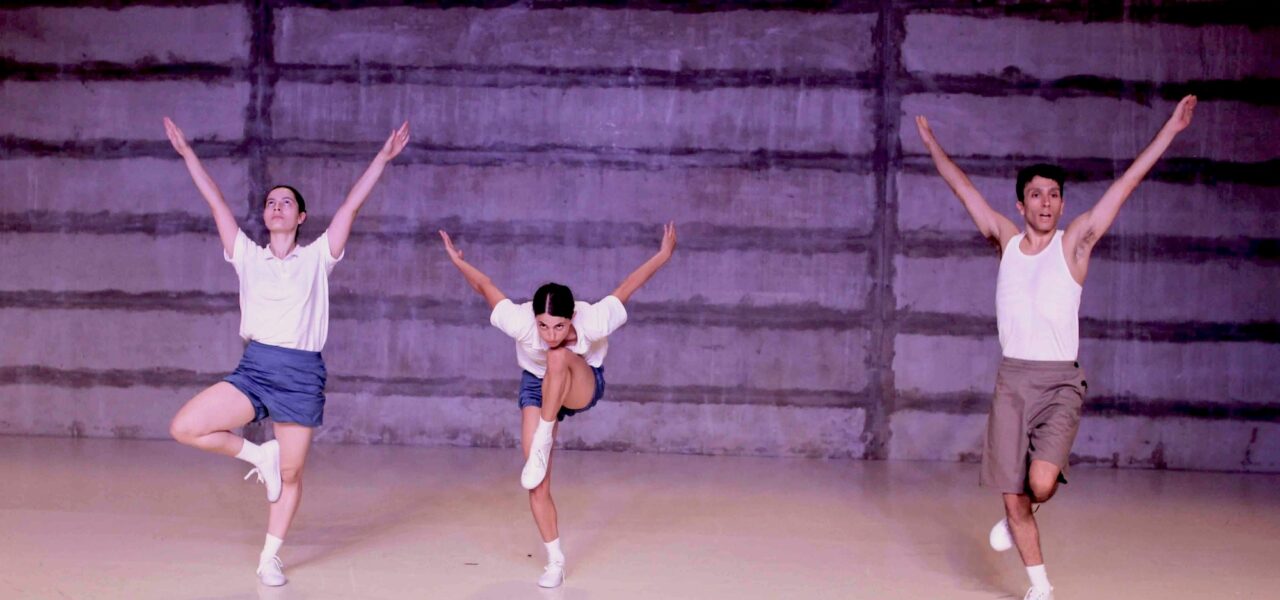
היצירה נפתחת בשלושת הרקדנים, אור ששי, גילי גבע ואופיר קונש, היושבים בגבם אל הקיר ופניהם אלינו. הם משוחחים ביניהם, ואולי אפילו מרכלים על הקהל שנכנס לאט אל אולם “אורה” בסוזן דלל. לבושים בחולצות לבנות ובמכנסיים כחולים, הם נראים כמו תלמידים טובים, בני אותו מסדר. הדמיון ביניהם גובר על ההבדלים ועל הביטוי האינדיבידואלי של כל אחד מהם, וזהו אחד המוטיבים המרכזיים ביצירה.
צילום אופירה זילברשטיין
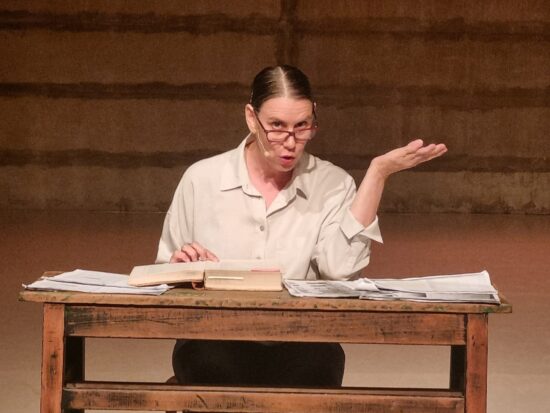
אהרונה ישראל נכנסת מן הדלת האחורית כשהיא נושאת ספר גדול. בניגוד לרקדנים, היא לבושה בבגדים רשמיים ולא ספורטיביים, מרכיבה משקפיים ונראית בדיוק כמו שמורה בבית ספר אמורה להיראות. היא מתיישבת ליד שולחן עץ לימודי, המוצב סמוך לקהל, ומתחילה להקריא הגדרות והוראות תנועה.
בהדרגה אנו מגלים שהיצירה נשענת על כתביו של צבי נשרי, ממייסדי החינוך הגופני בארץ. מתוך עבודת מחקר ארכיונית מעמיקה שוחזרו רבים מהתרגילים שפיתח ואף העניק להם שמות בעברית. במקומות שבהם התיעוד ההיסטורי לא היה ברור, או היה נתון לפרשנות, הרקדנים מרשים לעצמם לפרש את ההנחיות באופן אישי. כך הארכיון הדומם הופך לכוריאוגרפיה חיה ונושמת.
מתוך נקודת המוצא הברורה והעשירה הזאת, העבודה נפתחת לשאלות על היחסים שבין תנועה לחינוך, ובין חינוך לאידאולוגיה. מה קורה כשהחוקים הופכים למוכרים כל כך, עד שכבר אי אפשר לראות אותם? מצאתי את עצמי חושבת על ספרי החוקים הבלתי נראים שכל אחת ואחד מאיתנו נושאים איתם.
ספר החוקים שלי
ישנו פתגם ישן שאומר שעדיף לבקש סליחה מאשר רשות. במילים אחרות, עדיף להניח שמותר לך לעשות משהו עד שיאמרו לך אחרת. הבנתי עד כמה הגישה הזאת רחוקה מהחינוך ומהתרבות שבהם גדלתי.
מאז הצפייה ביצירה אני מוצאת את עצמי מתבוננת באנשים דרך ההבחנה הפשוטה אך העמוקה הזאת, דווקא ברגעים היומיומיים ביותר. אני שמה לב שיש מי שפועלים קודם ורק אחר כך תוהים אם מותר. הם מנסים, טועים, מגזימים, אבל יוצאים מהנחת האפשרות. ויש מי שמחכים. מחפשים אישור, סורקים את הסביבה כדי לראות את מי אפשר לשאול, ואם אין סמכות ברורה, הם מהססים. כמי שגדלה בתרבות הסובייטית, אני יודעת שספר החוקים שלי נחרץ מאוד בסוגיה הזאת. קודם מבקשים רשות, ורק אחר כך פועלים. הכלל הזה מלווה כמעט כל פעולה שלי, יחד עם רגע קטן של השתהות שבו אני שואלת את עצמי בשקט: מותר לי?
לאור זאת, היה רגע אחד בתחילת המופע שהעלה חיוך על פניי. אהרונה מזמינה את הקהל לשבת זקוף, ואף חוזרת על ההנחיה פעמיים, בדיוק כפי שמצופה ממורה מן המניין, תוך שהיא נועצת בנו מבט חודר. להפתעתי, דווקא הבקשה הזאת גרמה לי לרצות לשקוע עוד יותר אל תוך הכיסא. כמורה ליוגה וכרקדנית שבאה מרקע קלאסי, זו אינה התגובה האוטומטית שלי. “לשבת זקוף” הוא אחד מחוקי היסוד בספר החוקים הפרטי שלי. ובכל זאת, באותו רגע סגרתי את הספר לשנייה, והרשיתי לעצמי להיכנע לצורך גופני ולכוח הכבידה.
ספר החוקים של הרקדנים
שלושת הפרפורמרים הם רקדנים מיומנים, אתלטיים ומרשימים. הם נעים בקלות בין ביצוע מדויק של צורות ותבניות לבין רגעים שבהם הם נדרשים לפרק את השפה, תוך כדי פירוק התנועה והקשבה זה לזה. ניכר כמה שעות של הכשרה מקצועית הם עברו, כמה עמל הושקע ביצירה, וזה גרם לי לחשוב על ספר החוקים, או אולי נכון יותר לומר, על ספרי החוקים שלהם כרקדנים.
אם מתרחקים לרגע ומתבוננים בשדה הרחב של התנועה האנושית, מגלים שאין גוף אחד אלא אינספור מערכות של חוקים.
בלרינה קלאסית, מרימת משקולות, מתעמלת בשחייה אמנותית או שחקנית טניס, כולן חולקות את אותו גוף אנושי. ובכל זאת, כל אחת מהן פועלת מתוך הבנה אחרת לגמרי של כוח הכבידה, שיווי המשקל, המאמץ, התזמון והיופי. כל אחת מצייתת למערכת אחרת של אמיתות. גם בתוך המעגל הקטן יותר של המחול העכשווי יש אינספור ספרי חוקים. יש טכניקות שנולדו מתוך הבלט, אחרות מתוך אימפרוביזציה, קונטקט, אמנויות לחימה או מחקר סומטי. כולן מתקיימות תחת אותה כותרת של מחול עכשווי, ובכל זאת לכל אחת היגיון משלה, אסתטיקה משלה והנחות יסוד משלה לגבי ה”כן” וה”לא” של הסגנון.
צילום עלמה גבעוני
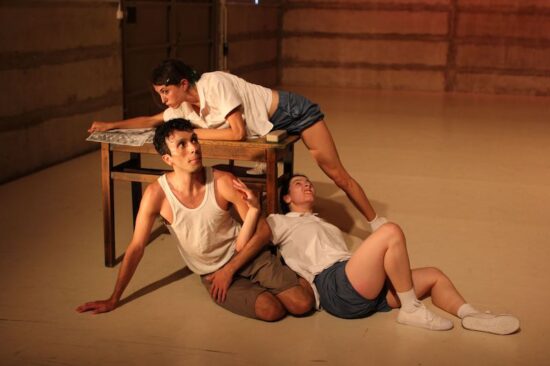
ככל שהמופע התקדם, נעשיתי סקרנית יותר ויותר לגבי ספרי החוקים שכל אחד מהרקדנים נושא איתו. אילו היסטוריות של תנועה חיות בתוך הגופים הרבגוניים האלה? אילו פרקטיקות עיצבו את הקלות שבה הם קופצים, רצים, מאזנים, זוחלים, הופכים לסוסים, לסרטנים או לקורות אנושיות?
חשתי שיש בי רצון להציץ עמוק יותר אל תוך הביוגרפיות הסמויות האלה. אינני בטוחה אם זה היה הרצון האישי שלי, או שמא ההיגיון הפנימי של היצירה משך את הסקרנות שלי. רציתי לדעת עוד לא דרך הסיפורים שהם מספרים לקראת סיום המופע, מרתקים ככל שיהיו, אלא דרך התנועה עצמה. רציתי לחוש את נקודות המוצא השונות שמהן כל אחד מהם מגיע. לרגע אחד, באופן מטאפורי כמובן, רציתי שיפשטו את המדים שגרמו להם להיראות כאחד, ויחשפו את הבדים, המרקמים והציורים שהופכים כל אחד ואחת מהם לייחודיים.
ספר החוקים של מדריך למתעמל
באופן כמעט בלתי נמנע, אותן שאלות חזרו אל העבודה עצמה. אם מדריך למתעמל מזמין אותנו לערער על מערכות של סמכות ועל חוקים שירשנו, מהם החוקים שמנהלים את העולם של היצירה עצמה?
המבנה שלה נהיר וקל להתמצאות. המורה נכנסת, הרקדנים מצייתים, סוטים לרגע, חוזרים אל הסדר, ואז מפרים אותו בדרכים מסוימות ומרתקות, אך כאלה שנבחרו בקפידה מראש על ידי היוצרת. הכוריאוגרפית היא הסמכות העליונה, וגם לקראת הסוף, כשהיצירה מתפרקת למעין רייב פרוע, עדיין יש מישהו שמחזיק את המושכות.
מצאתי את עצמי תוהה מה היה קורה אילו גם העבודה עצמה הייתה מרשה לחוקים שלה להתערער. מה היה קורה אילו אהרונה הייתה יוצאת מתפקיד המורה ופשוט מצטרפת לרקדנים? מה היה קורה אילו הכוריאוגרפיה הייתה מסתכנת באיבוד שיווי המשקל שלה, והצייתנות הייתה מתחלפת ביוזמה אישית בזמן אמת? ומה היה קורה אילו היצירה הייתה קצת פחות מהודקת וקצת פחות בטוחה?
אחד הרגעים הזכורים לי ביותר מהמופע נמצא דווקא בתחילתו. שלושת הרקדנים נעים במרחב ונותנים זה לזה הוראות קצרות. מספר, ואז פעולה. קפוץ. רוץ. גמד. סרטנים. כל הנחיה מוחקת את זו שקדמה לה ומשנה את כללי המשחק. מה שהפך את הרגעים האלה לכל כך יפים בעיניי הייתה תחושת המשחק האמיתית ששרתה בהם. לא לשחק בלשחק, אלא פשוט לשחק.
ראיתי רגעים כנים של אי ידיעה ושל גילוי. הגוף מגיב בן רגע, הפנים ערניות ופתוחות. עד כמה שהדבר נראה פשוט כשהוא מבוצע היטב, אפשר לחזור שוב ושוב על ספונטניות, ועדיין לא להגיע אליה. כאן הרגשתי שאני צופה במבצעים שבאמת משחקים זה עם זה, באמת מקשיבים זה לזה, ובאמת מסכימים לקחת סיכונים קטנים, ומזכירים לי שזהו אכן מופע חי ונושם.
*
יצאתי מסוזן דלל ותהיתי אילו מהחוקים שלי עדיין חיים רק משום שאני ממשיכה לציית להם.
אולי כך ספרי חוקים שורדים. אנחנו ממשיכים להקשיב למילים שמזמן איבדו את מקורן, ולפעמים גם את משמעותן, ובכל זאת הן ממשיכות לנהל אותנו מבפנים.
אני נזכרת באימרה הידועה: “חוקים נועדו כדי להישבר.”
גם זה בסופו של דבר עוד חוק, מתוך עוד ספר חוקים. ואני לא בטוחה שהוא קל יותר לנשיאה.
אהרונה ישראל הציגה את ׳המדריך למתעמל׳ ב4.7 בסטודיו אורה, מרכז סוזן דלל.
Reading the Rule Book
Thoughts after watching Workout Manual by Aharona Israel
Some performances leave me with images. Others leave me with questions. Workout Manual left me with a rule book I knew I had been carrying all along. I just wasn’t sure how heavy it was.
The performance opens with three dancers, Or Sassi, Gili Geva, and Ofir Kunesh, sitting with their backs against the wall and their faces turned toward us. They are talking among themselves, perhaps even gossiping about the audience slowly making its way into the Ora Hall at Suzanne Dellal. Dressed in white shirts and blue trousers, they look like model students, members of the same order. Their similarities outweigh their differences and each dancer’s individual expression, a central motif throughout the work.
Photo Ofira Zilberstein
Aharona Israel enters through the back door carrying a large book. Unlike the dancers, she is dressed in formal rather than athletic clothes. Wearing glasses, she looks exactly the way a schoolteacher is expected to look. She sits at a wooden school desk placed close to the audience and begins reading definitions and movement instructions aloud.
Gradually, we discover that the performance is based on the writings of Zvi Nishri, one of the founders of physical education in Israel. Through extensive archival research, many of the exercises he developed, and even named in Hebrew, have been reconstructed. Whenever the historical documentation left room for interpretation, the dancers were encouraged to interpret the instructions personally. In this way, the silent archive becomes a living and breathing choreography.
From this rich and clearly defined starting point, the work opens into questions about the relationship between movement and education, and between education and ideology. What happens when rules become so familiar that we can no longer see them? I found myself thinking about the invisible rule books that each of us carries.
My Rule Book
There is the old adage which goes “better to ask for forgiveness than permission” – in other words, it’s better to assume you can do something until you’re told the opposite. I found this to be miles away from my education and upbringing.
Since watching the performance, I have found myself looking at people through this surprisingly simple, yet deeply meaningful distinction throughout the mundane moments of the every day. I notice how some of the people around me act first and only afterward wonder whether they were allowed. They try, fail, exaggerate, but they begin from the assumption that something is possible. And then there are those who wait. They look for permission, scan the room to see who they can ask, and if there is no clear authority, they hesitate.
Having grown up in Soviet culture, I know that my rule book is adamant on the topic. You first ask permission, and only then do you act. This guideline accompanies almost every action I take, together with a brief moment of hesitation in which I quietly ask myself: Am I allowed?
In light of this, there was one moment early in the show that made me smile. Aharona invites the audience to sit up straight, repeating the instruction twice, just as one would expect from a proper schoolteacher, while fixing the audience with a penetrating gaze. To my surprise, her request made me want to sink even deeper into my chair. As a yoga teacher and a dancer with a classical background, this is not my automatic response. “Sit up straight” is one of the foundational rules in my personal rule book. And yet, in that moment, I closed the book for a second and allowed myself to give in to gravity’s pull.
The Dancers’ Rule Books
The three performers are highly skilled, athletic, and impressive dancers. They move effortlessly between the precise execution of forms, patterns and moments in which they are asked to dismantle both movement and language. All of this is accomplished while listening closely to one another. It is impossible not to sense the years of professional training behind them, the immense amount of work invested in this performance. It made me think about their rule books, or perhaps more accurately, their many rule books as dancers.
If we step back and look at the broader field of human movement, we discover that there is not one body but countless systems of rules. A classical ballerina, a weightlifter, an artistic swimmer, or a tennis player all share the same human body. Yet each one understands gravity, balance, effort, timing, and beauty in completely different ways. Each follows a different system of truths.
Even within the smaller world of contemporary dance there are countless rule books. Some techniques emerged from ballet, others from improvisation, contact improvisation, martial arts, or somatic research. They all exist under the same umbrella of contemporary dance, and yet each has its own internal logic, its own aesthetics, and its own assumptions about what counts as “yes” and what counts as “no.”
Photo Alma Givoni
As the performance unfolded, I became increasingly curious about the rule books each dancer carries within them. What movement histories live inside these diverse bodies? What practices shaped the ease with which they jump, run, balance, crawl, become horses, crabs, or human planks?
I sensed there was a desire to glimpse deeper into these hidden biographies. I am not sure if it was my personal desire, or the piece’s inner logic, driving and asking to know more. Not through the stories they tell toward the end of the performance, fascinating as they are, but through movement itself. I wanted to sense the different starting points each of them comes from. For a brief moment, metaphorically speaking, I wanted them to take off the uniforms that made them appear as one, and reveal the fabrics, textures, and paintings that make each of them unique.
The Rule Book of Workout Manual
If Workout Manual invites us to question inherited systems of authority and the rules we’ve been given, what are the rules that govern the world of the performance itself?
Its structure is clear and easy to follow. The teacher enters. The dancers obey, stray for a moment, return to order, and then disrupt it in carefully chosen ways, all predetermined by the choreographer. She remains the ultimate authority, and even toward the end, when the work dissolves into something resembling a wild rave, someone is still holding the reins.
I found myself wondering what would happen if the performance itself allowed its own rules to become unstable. What if Aharona stepped out of the role of the teacher and simply joined the dancers? What if the choreography genuinely risked losing its balance, and obedience gave way to personal initiative unfolding in real time? What if the piece would be a little less composed and safe?
One of the moments I remember most vividly comes at the very beginning of the performance. The three dancers move through the space, calling out short instructions to one another. A number, then an action. Jump. Run. Dwarf. Crabs. Each instruction erases the one before it and changes the rules of the game.
What made these moments so beautiful to me was the genuine sense of play they carried. Not pretending to play, but actually playing. I saw honest moments of not knowing and of discovery, of responding rather than demonstrating. The body reacts in an instant. The faces remain alert and open. As easy as it might seem when it’s well executed, you can rehearse spontaneity over and over again and still never arrive there. Here, I felt I was watching performers who were truly playing with one another, truly listening, and genuinely willing to take small risks, reminding me that this was indeed a live show.
*
I left Suzanne Dellal wondering which of my own rules are still alive simply because I continue to obey them.
Perhaps that is how rule books survive. We continue to obey words that have long since lost their origin, and sometimes even their meaning, yet they continue to govern us from within.
As the saying goes, “rules are made to be broken.”
That, too, is just another rule from another rule book.
And I’m not sure it’s any easier to carry.
Aharona Israel presented ‘Workout Manual’ on July 4, 2026 at Studio Ora, Suzanne Dellal Centre.
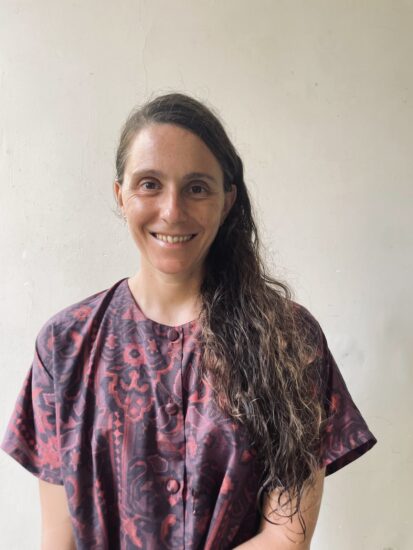 ג’ני בירגר
נולדה ב-1984 בקייב, אוקראינה, כיום חיה ופועלת בתל אביב.
יוצרת וחוקרת גוף רב-תחומית, פרפורמרית ומורה. יצירות הוידיאו-דאנס שלה הוקרנו במבחר פסטיבלים בארץ ובעולם (ביניהם Cinedans, Cyprus Film Festival, Burgundy Video Dance Festival, בית הנסן). בעלת קשת רחבה של הכשרה פיזית ואקדמית, ומחפשת ליצור חיבורים וקשרים חדשים בין גופי ידע שמדברים מטבעם בשפות שונות. בשנים האחרונות חוקרת את הממשק בין תנועה ומילים; דרכים ליצור חומר כוריאוגרפי בזמן אמת; תנועה בתוך מים ומחולות ממערב אפריקה. מלמדת שנים רבות בפרויקט “קהילה בתנועה” המקיימת שיעורי מחול עבור א.נשים החיים עם מחלת הפרקינסון (סטודיו יסמין גודר), כמו גם יוגה ופילאטיס באופן פרטי.
Jenny Birger
Born in 1984 in Kyiv, Ukraine, currently lives and works in Tel Aviv.
A multidisciplinary artist and researcher, performer, and teacher. Her video-dance works have been screened at selected festivals in Israel and abroad (including Cinedans, Cyprus Film Festival, Burgundy Video Dance Festival, Hansen House). She holds a wide range of physical and academic training and seeks to create new connections and links between bodies of knowledge that naturally speak different languages.
In recent years, she has been researching the interface between movement and words; ways of creating choreographic material in real time; movement in water; and dances from West Africa. She has been teaching for many years in the project Movement Communities, which holds dance classes for people living with Parkinson’s disease (Yasmeen Godder Studio), as well as teaching yoga and Pilates privately.