
אני יושבת בחדר ומחכה: מחשבות על “קולו של העולם שרק אני שומעת” מאת שקד מוכיח
*English follows
מאת ג’וי ברנרד
אני חולמת שאני בהיריון, בערך בחודש השביעי או השמיני.
אני יושבת עירומה בחדר הרחצה בבית שלי ומחכה. אני לא בטוחה למה אני מחכה, אבל השערות על הזרועות שלי סומרות, והבטן ההיריונית המשתפלת שלי מתכסה כולה בעור ברווז. משהו נוראי עומד לקרות, אני בטוחה בכך, ואני לא יכולה לעשות עם זה כלום. קר לי מאוד. כדי להרגיע את עצמי אני מסובבת את ברז המים באמבטיה, מנסה להוסיף עוד מים חמים, ומתחילה לזמזם לעצמי שיר. אני עורמת סבון לתוך כף היד שלי ורוחצת את הבטן ההיריונית שלי לאט, בתנועות מעגליות. “הכל בסדר”, אני לוחשת לעצמי שוב ושוב. “הכל בסדר, את בטוחה”. אני מבחינה שהברז התקלקל, ולאט לאט האמבטיה מוצפת במים, עולה על גדותיה. אני נבהלת, מנסה לשווא לסובב את ידית הברז לכיוון השני, לעצור את השטף. אני לא מצליחה לעשות כלום. אני טובעת, המים מכסים אותי, בהתחלה מטפסים עד עצמות הבריח, הצוואר, ואז כבר מגיעים לסנטר, ואחר כך מכסים את הראש שלי. אני נאבקת לצוף למעלה, אבל לא מצליחה לזוז. הגוף שלי לא נענה לי, הוא קפוא. המחשבה האחרונה שלי לפני שאני מתעוררת היא שאני כבר חייתי, אולי לא יותר מדי זמן, אבל חייתי. עצוב לי על הילד שלי, שימות יחד איתי, לפני שהספיק לחיות. הכל נהיה חשוך, ואין לי אוויר. אני מתעוררת בדירה שלי לבד. אין היריון, אין אמבטיה. אני בחיים, אני בסדר, אבל משהו מת לי, משהו מת בי.
9.10.2023
שוב החלום על האמבטיה. הפעם תוך כדי הטביעה התחלתי ללדת. התעוררתי לפני שהספקתי לבדוק אם הצלחתי להציל את התינוק.
11.12.2023
שוב החלום על האמבטיה. הפעם ידעתי שאני חולמת, וחיכיתי להתעורר. ממש ניסיתי להעיר את עצמי, כדי שהבלתי נמנע לא יתרחש, כדי שלא אצטרך להרגיש את הצער הזה. אבל החלום המשיך והמשיך, עד הסוף הידוע מראש.
20.1.2024
שוב החלום על האמבטיה.
18.3.2024
שוב החלום על האמבטיה. א’ לידי, אומר שדיברתי מתוך שינה, אומר שבכיתי. מלטף לי את הכתף ולוחץ לי את היד חזק עד שאני נרדמת.
25.6.2024
שוב החלום על האמבטיה. א’ ואני נפרדנו אתמול. כשהתעוררתי מהחלום, תפסתי לעצמי את הכתף וליטפתי אותה, מנסה להירגע. לא הצלחתי לחזור לישון, עד שהבוקר עלה.
19.10.2024
קצת אחרי ה-7 באוקטובר, הכרתי גבר. כבר בפגישה הראשונה שלנו סיפרתי לו שמאז שפרצה המלחמה, אני לא מסוגלת לזכור את כל החלומות שלי. לא שיתפתי אותו שמרבית החלומות שאני כן מצליחה לזכור כוללים תרחיש שבו אני בהיריון, כי בכל זאת, זה לא בדיוק מסוג הדברים שאני משתפת עם גברים במהלך הדייט הראשון.
האקס שלי הפציר בי שעלי לפתח טכניקה שתסייע לי לזכור את החלומות. לפגישה השלישית שלנו הוא הביא לי במתנה מחברת, והציע שאשמור אותה ליד המיטה שלי. “ככה, כשאת מתעוררת בבוקר או באמצע הלילה, את יכולה לכתוב מהר-מהר את החלומות שאת זוכרת, אפילו פרגמנטים מהם”, הוא הסביר. “החלומות הרי יכולים להיות קרקע פורייה ליצירה שלך”, הוסיף, ולא טעה. בשנה שבה היינו יחד יצרתי סרט שהיה מבוסס כולו על חלום שחלמתי בלילה.
מאז שנפרדנו, לא פתחתי את “מחברת החלומות”, כפי שקראנו לה, לא על מנת לכתוב אודות חלומות חדשים ולא כדי לעלעל בתיעוד של חלומות מהעבר. בהתחלה נמנעתי מהמחברת מפני שרציתי להתרחק קצת מהאובייקט שהפך סנטימנטלי באופן מכאיב, ובהמשך מפני שמאורעות המלחמה הלכו ונעשו טרופים וטראגיים יותר, ובהתאמה גם תוכן החלומות שלי הלך ונעשה קודר יותר. אך השבוע ראיתי יצירה רב-תחומית שעלתה בבכורה בפסטיבל ישראל (מנהלים אמנותיים: מיכל ואעקנין ואיתי מאוטנר), העבודה “קולו של העולם שרק אני שומעת” מאת הכוריאוגרפית, הרקדנית והמוסיקאית שקד מוכיח, ואחרי חווית הצפייה המטלטלת נסעתי הביתה ותרתי אחר מחברת החלומות במגירות שלי בתחושת דחיפות עזה, עד שדליתי אותה. הציטוטים לעיל לקוחים ממנה, ומתארים חלום שחלמתי יומיים אחרי שפרצה המלחמה, כזה שעדיין חוזר אלי לפעמים בלילות כמעט שנתיים לתוך הטראומה הבוערת שהפכה להיות המציאות של כולנו.
לא בכדי נזכרתי במחברת החלומות ובחלום ההוא אחרי הצפייה בעבודתה של מוכיח, שכן “קולו של העולם שרק אני שומעת” זו יצירה שמזמינה את הצופים בה להתחבר לתת המודע הקולקטיבי של החברה הישראלית בכלל, ושל נשים בפרט, באמצעות צלילה לחלומותיהן של עשרות נשים יהודיות וערביות בגילאי שבע עד 70, אותן ראיינה מוכיח. הצופים נחשפים לחלומות הללו באמצעות הפסקול המצוין של היצירה, שמתנגן באוזניות שקיבלנו עת התכנסנו מחוץ לרחבת תיאטרון ירושלים. הילדות, הנשים הצעירות והקשישות שמוכיח ראיינה נשמעות מספרות את החלומות בקולן, ולצד, תוך כדי ועל גבי התיאורים שלהן מתנגנת מוסיקה מקורית שהלחין דניאל ספיר. במשך שעתיים, הקהל רואה לנגד עיניו את החלומות מתרקמים לכדי מציאות תנועתית ופרפורמטיבית, בעשרות סצינות קטנות שמתפרקות ומתלכדות תוך כדי שיטוט מודרך בסביבת התיאטרון ובתוכו.
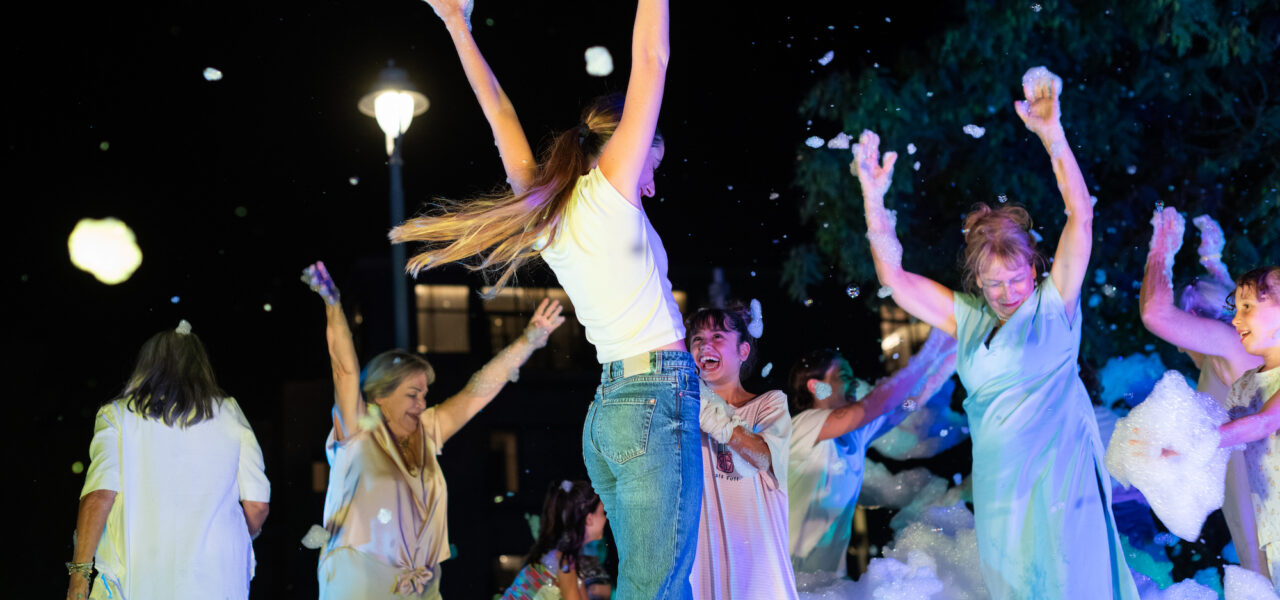
כאן נעוצה הן נקודת החוזק האדירה של היצירה, והן נקודת התורפה שלה – העבודה הכוריאוגרפית והדרמטורגית שמתווכת לנו, הצופים, כיצד נחווה את בליל התודעה הזה, את החלום בהקיץ המתמשך, הפוליפוני, שמשמיע את המיית ליבן ואת רחשי הלא-מודע של נשים רבות. ברוב המכריע של המקרים, מוכיח בחרה לייצר תנועה שהיא אילוסטרטיבית לטקסט הנשמע באוזניות. לעיתים הבחירה הזו הייתה מוצלחת במיוחד, כמו רגע שבו קבוצת ילדות צעירות (תלמידות של ביה”ס לאמנויות המחול – מרכז קהילתי ערבי-יהודי יפו) פרצו בתנועות ריקוד אקסטטיות באווירה שטותית, כאשר ברקע נשמעת ילדה שמתארת איך אזעקה ששולחת אותה לתפוס מחסה בממ”ד הפכה בחלום למסיבה עם החברות הכי טובות שלה. התמימות והנאיביות של הדמיון הילדי, שמנסה למצוא מפלט מהשגרה המאיימת, היתרגמה היטב להנחיות תנועתיות פשוטות שהילדות יכלו לבצע בקלות, לצד עבודת קונטקט עדינה שהתרשמתי לראותן מבצעות בהצלחה ובמסירות על אף גילן הצעיר. ברגעים אחרים, כמהתי לראות את קאסט הרקדניות המקצועיות המצוינות (גל לוינסון, מיכל מסקין, תמר סון, נועה קלר, תמר קמינסקי), שהגיחו בהמשך העבודה, מבצעות מהלך תנועתי מורכב יותר; למשל, כאשר אחדות מהן דיברו על חלומות שבהם הן נאלצות להימלט ונסות על נפשן, הן אכן רצו במעלה ובמורד מדרגות התיאטרון, ממחישות באופן חד-משמעי את המנוסה שבחלום.

Photo by Dor Kedmi
בסצינות אחרות, מוכיח היטיבה לבחור בחירה כוריאוגרפית מתוחכמת יותר בעיניי, כזו שבה הרצף התנועתי חתר תחת הטקסט שנשמע באוזניות או העניק לו משמעות נוספת. לדוגמה, בסצינה אחת שהתרחשה בתוך חלל התיאטרון המוחשך, ילדה צעירה נשמעה מתארת כיצד בחלומה היא עולה להופיע על במה עם יתר החברות שלה. הבחירה לשבץ גם חלום כזה, שהוא כביכול שגרתי, הייתה מפעימה מפני שהיא הדגישה ביתר שאת עד כמה מפוצלת התודעה שלנו בשנים האחרונות בין סיוטים, ניסיונות להתמגן ומחשבות על הנורא מכל, לבין חלומות סטנדרטיים, אישיים, אנושיים, כמו חלום פשוט של ילדה להופיע עם חברותיה לחוג למחול. אחרי שהרקדניות-ילדות השתרעו על הבמה עלה הקאסט של הרקדניות המקצועיות, והן ביצעו יוניסון מדויק ואוורירי, כזה שסתר חלום שתיארה אחת מהן, שבו היא עולה לבמה בעיצומה של הופעה ונוכחת שהיא לא יודעת את התנועות מפני שלא לימדו אותה בזמן. אני לא מכירה רקדנית אחת שלא חלמה חלום כזה (אני עצמי חלמתי וריאציה על החלום הזה עשרות פעמים בחיי); זו המקבילה המחולית לחלום השגור של סטודנטים שחולמים שהם מגיעים למבחן שלקראתו למדו היטב ומגלים שהמבחן בכלל עוסק בנושא אחר. לכן הרגע הזה היה קסום במיוחד: היחסים בין הטקסט לתנועה היו סותרים באופן מתוחכם וקונפליקטואלי, שכן הביצוע היה ללא רבב, והתוכן עצמו שוב קרץ לעולמות שגרתיים יותר, שבהם החששות שלנו הם לא מפני מחבלים וטילים אלא מפני כישלונות וחוסר יכולת להגשים את הייעוד שלנו, את מה שאנו חשות שנועדנו לעשות.
המעברים בין חללי התיאטרון השונים, בין החוץ לפנים ובין הסצינות, לא תמיד היו חלקים, וחלק מהסצינות הסתיימו באיבחה אחת, או התערבבו פתע באלו שבאו אחריהן. את ההערה הזו אני מציינת בהסתייגות מסוימת, שכן אני סבורה שיש משהו מעניין בהחלטה הדרמטורגית הזו שלא ליצור נרטיב סדור וליניארי של התחלה-אמצע-סוף, אלא להשאיר קצוות פרומים, לא מטופלים. החלטה זו מהדהדת את האופי הא-ליניארי והלוגיקה הפנימית המקוטעת של עולם החלומות, טריטוריה לא מודעת שבה הזמנים קורסים, כמו מתערבלים זה בזה, ופעולות חסרות פשר פתע מקבלות הצדקה או מגיעות לכדי התרה מבלי שציפינו לכך.
 הרגעים החלשים יותר בעבודה, לעניות דעתי, היו הרגעים שבהם היא לקחה על עצמה טון דידקטי, כמו רגע מעבר שבו הפסקול הסביר עבורנו, הצופים, מהו חלום צלול, מבלי להותיר לנו מקום לפרש בעצמנו שאנו עדים לחוויה פרפורמטיבית שמתחקה אחר האיכות הגופנית והמנטלית של חלימה צלולה. עוד רגע דידקטי שכזה הגיע בתמונת הסיום המתוקה, שבה הפרפורמריות התחלקו לשלשות – מבוגרת, צעירה וילדה – וליטפו זו את זה, נשענו זו על זו, כמו מחפשות אחר תנוחה נכונה למנוחה. האינטימיות והרכות שנוצרה בקרב חברות הקאסט הרב גילאי היו ניכרות והדהדו בעוצמתיות, ולכן חשתי שלא היה צורך בפסקול שהכריז בפנינו שאולי עדיף “לחלום כדי להתעורר, להתעורר כדי לחלום”.
אך למעט הרגעים הללו, היצירה זורחת במיוחד ופורטת על מיתרי הלב ברגעיה הבלתי צפויים, למשל בסצינה שבה הקהל נלקח לקומה השנייה של התיאטרון ומביט על קומת הכניסה. שם, הפסקול השמיע לנו חלום של אישה צעירה שמתארת שהיא רואה את החברות שלה, שנרצחו במסיבת הנובה, מנקודת תצפית עילית. הן רוקדות בעליזות, ולא בהכרח רוצות לחזור מהמוות; טוב להן יחד. במקביל, הרקדניות פיזזו יחד בתיאום מוחלט, והן נראו קלות מהאוויר, חופשיות, אפילו מאושרות. לרגע שכחתי שהן ממחיזות חלום על נשים צעירות שמתו, ונמלאתי עונג חושי פשוט שנבע מהצפייה בריקוד שלהן. ואז נזכרתי בדימוי שהן מייצגות, בכל הא.נשים שלעולם לא ירקדו שוב, והייתי צריכה לחנוק את הבכי שאיים לטפס במעלה הגרון.
מוכיח בחרה להקדיש את העבודה הנוכחית שלה למחקר אודות עולמן הפנימי של נשים שהתערער בזמן המלחמה. לפני כמה שנים לא היה עולה בדעתי שנשים מבוגרות, חלקן בגיל של אימי וחלקן בגיל של סבתי אילו הייתה בחיים, יאלצו לחלום שהן בשואה וצריכות להסתתר, כפי שחלמה אחת מהמשתתפות המבוגרות (גם כאן הבחירה התיאטרלית הייתה ליטרלית, אולי מדי, כאשר חלום על הסתתרות במגירה הוצג לנו על ידי אישה שמתחבאת בתוך מגירת-ענק), אך המציאות העכשווית שלנו עולה על כל דימיון. זהו סוד ההצלחה של עבודתה של מוכיח – היא לא בורחת אל החלומות כאל עולם פנטסטי-אסקפיסטי שמציע לנו היקסמות ומשכיח מאיתנו את המציאות, אלא משתמשת בעולם החלומות כחומר גלם המאפשר לה, ולנו הצופים.ות, להביט על המציאות ועל המנגנונים הנפשיים האנושיים-נשיים שאנחנו מפעילות מתוך ההכרח להתמודד עימה.
מוכיח היא כמובן לא האמנית הראשונה לעשות זאת. היא בחברה טובה עם שלל יוצרים בשלל מדיות שהחלום הוא חומר הגלם של העבודה שלהם או נקודת המוצא האסתטית שממנה מתגלגלת היצירה שלהם. מה שמייחד את העיסוק של מוכיח בחלומות, אם כך, הוא ההקשר שבו היא בחרה להתמקד: המציאות הישראלית העכשווית, זו שאי אפשר להימלט ממנה גם בשנת הלילה, זו שמפעפעת לחלומות שלנו. ראוי לשבח אותה על האומץ והאמביציוזיות של הפרויקט הזה. זוהי החלטה לא פשוטה ואף נדירה בנוף המחולי המקומי ליצור עבודה שהיא גם תלוית-מקום ונוצרה עבור החלל רחב הידיים והמאתגר של קומפלקס התיאטרון, גם רבת משתתפות, גם כורכת אינטראקציה עם הקהל ושילוב של אמצעים טכנולוגיים מתקדמים, וגם מתיכה יחדיו פרפורמריות יהודיות וערביות, רקדניות מקצועיות ו-“נון-דאנסרס”, ילדות רכות וקשישות.
 לא יכולתי שלא להבחין שהמכנה המשותף של החלומות של רוב הרקדניות, כמעט כולן בנות גילי, הוא העיסוק בהיריון או בילודה. הן תיארו לאורך העבודה חלומות רבים שנשמעים דומים לחלום החוזר שרודף אותי מאז ראשית המלחמה, וזה לא מאפיין רק אותן. בשנים האחרונות אני שומעת מחברות ומכרות רבות בנות גילי שהן חולמות לעיתים קרובות חלומות העוסקים, בצורה כזו או אחרת, בפוריות ובפיריון. מעניין לחשוב איך בעת איום ממשי ומתמשך על חיינו, הלא-מודע הנשי מהרהר בסיכוי או ביכולת של הגוף לא רק לשרוד, אלא להעמיד לעצמו המשכיות.
הרבה אחרי שיצאתי מהתיאטרון, חזרתי לביתי ואיתרתי את מחברת החלומות, מצאתי את עצמי מהרהרת בקווי הדימיון שבין החלום על הפוטנציאל הגופני להיות אם, לבין חלומות אחרים שמיתרגמים ליצירה. בפעם האחרונה שיצרתי מופע מחול, כתבתי עליו ש”נולדה לי יצירה חדשה”. העבודה של מוכיח הזכירה לי שהגוף הנשי, בין אם הוא מתעבר או רוקד על הבמה, נושא בקרבו חיים, כוח בריאה ליבידינלי, את היכולת להמציא את עצמו מחדש, להמציא לעצמו עתיד. בלילה, לפני שהלכתי לישון, עצמתי את עיניי וראיתי בעיני רוחי את תמונת הפתיחה של המופע. הקהל עמד על “גשר הסינמטק”, רצועה שמחברת בין אזור גן הפעמון למתחם הסינמטק הירושלמי ומשקיפה לעבר חומות העיר העתיקה והר ציון. למטה, במדשאות, קבוצת הרקדניות-ילדות התגלתה פתע, והן אחזו ידיים, נעות במעגל כמו בציור של מאטיס. במשך מספר דקות הן צחקו, התחבקו, התרחקו זו מזו ושוב התקרבו. כשהבטתי בהן, לרגע ראיתי בתנועתן את העתיד, ויכולתי להרשות לעצמי לקוות עבורי ועבורן שיהיה פה מקום ליצור, לחיות, וליצור חיים.
שקד מוכיח הציגה את ׳קולו של העולם שרק אני שומעת׳ ב14.8.2025 כחלק מפסטיבל ישראל.
I’m Sitting in a Room and Waiting: Thoughts About “The Voice of the World that Only I Hear” By Shaked Mochiach
By Joy Bernard
I’m dreaming that I’m pregnant, about seven or eight months along.
I’m sitting naked in my bathtub at home and waiting. I’m not sure what it is that I’m waiting for, but the hairs on my arms are standing on end, and my pregnant belly, large and distending from the rest of my body, is entirely covered in goosebumps. Something terrible is about to happen, I’m sure of it, and there’s nothing I can do about it. I’m very cold. In order to calm myself down I decide to turn the faucet and try to add some more warm water to the bath, as I begin to hum a song. I pile up soap in the palm of my hand and start to slowly rub my pregnant belly in circular movements. “It’s all good,” I whisper to myself again and again. “It’s all good, you’re safe.” I suddenly notice that the faucet is broken, and slowly the bath is flooded with water, spilling over. I panic, and vainly try to turn the handle of the tap in the other direction, to stop the flood. I can’t do anything. I’m drowning, the water is covering me, it’s rising up to my collarbones, my neck. The water reaches my chin, and then it covers my head. I struggle to float up, but I can’t move. My body isn’t responding to my commands, it’s frozen. My last thought before I wake up is that I’ve already lived; perhaps not long enough, but I’ve lived. I’m so sad for my child, who is going to die with me, before it takes its first breath. Everything gets dark, and I can’t breathe. I wake up alone in my apartment. I don’t have a bathtub. I’m alive, I’m okay, but something died for me, something died in me.
9/10/2023
Again the dream about the bathtub. This time, while drowning I began to deliver the baby. I woke up before I could find out if I managed to save the baby.
11/12/2023
Again the dream about the bathtub. This time I knew I was dreaming, and I waited to wake up. I really tried to wake myself up, so that the inevitable wouldn’t happen, so that I wouldn’t have to feel this sorrow. But the dream went on and on, until it reached its familiar end.
20/1/2024
Again the dream about the bathtub.
18/3/2024
Again the dream about the bathtub. U is next to me. He’s saying that I spoke in my sleep, he’s saying that I cried. He’s caressing my shoulder and grabbing my hand firmly, until I fall asleep.
25/6/2024
Again the dream about the bathtub. U and I broke up yesterday. When I woke up from the dream, I grabbed my own shoulder and caressed it in an attempt to calm down. I couldn’t fall back asleep, until the sun rose.
19/10/2024
Shortly after October 7, 2023, I met a man. Already in our first encounter I told him that ever since the war broke out, I couldn’t remember my dreams. I didn’t mention that the few dreams I could remember always included a scenario in which I’m pregnant, because it’s not the sort of thing I usually share with men on the first date.
My ex beseeched me to develop a technique that would help me remember my dreams. For our third date he brought me a gift – a notebook, which he suggested that I keep at my bedside. “That way, when you wake up in the morning or in the middle of the night, you can quickly write down the dreams you remember, even fragments of them,” he explained. “Dreams can be fertile ground for your work,” he added, and he wasn’t wrong. In the year we spent together I created a film that was entirely based on a dream I had one night.
Ever since we broke up, I haven’t opened my “Dream Notebook,” as we dubbed it, not for the sake of recording new dreams and not even to flip through it and recall dreams from the past. At first I refrained from opening the notebook because I wanted to distance myself from what had become a painfully sentimental object, and later because the war turned more and more tragic, and in tandem my dreams took an ever bleaker turn. But this week, after watching the multidisciplinary work “The Voice of the World That Only I Hear” by choreographer, dancer and musician Shaked Mochiach, which premiered at the Israel Festival (artistic directors: Michal Vaknin and Itay Mautner), I went straight home in search of my dream notebook.
The fragments in italics above are taken from this notebook, and describe a dream I first had two days after the war broke out. This dream still recurs sometimes, returning to me at night almost two years into the raging trauma that has become our reality.
I don’t think it’s a coincidence that I urgently recalled both the notebook and the particular dream after watching Mochiach’s work. “The Voice of the World…” is a creation that invites its viewers to connect to the collective subconsciousness of Israeli society, and in particular of women. It does so by diving into the dreams of dozens of Jewish and Arab women aged seven to 70, whom Mochiach interviewed. Some of the dreams depicted in the work are of the dancers performing in it, too.
Viewers are exposed to these dreams through the work’s excellent soundtrack, which is played through headphones we received when we gathered at the square outside the Jerusalem Theater. The girls, young women and elderly women interviewed by Shaked can all be heard recounting their dreams in the soundtrack. Interwoven with their voices is original music composed by Daniel Sapir. For two hours, audience members could see these dreams become a performative reality in dozens of little scenes that disintegrated and regrouped as we were guided on a tour of the theater and its environs.
Here lies both the immense strength of the work, and its Achilles heel – the choreographic and dramaturgical work that is supposed to facilitate the viewing experience for us and determine how we will process the polyphonic, ongoing daydream composed by Mochiach. In most instances, the artist opted to create movement that is illustrative of the text that was delivered to us via the headphones. Sometimes this choice was optimal, for example: A moment in which a group of young girls (students at the dance department of the Arab Jewish Community Center, Jaffa) broke out into an ecstatic and whimsical dance, while in the background a young girl could be heard describing how in her dream, an air raid siren that sent her to seek shelter in the safe room turned into a party with her best friends. The innocence and naivete of the childish imagination, which tries to find refuge from the threatening routine, was translated well into simple choreographic instructions that the girls were able to execute easily, alongside gentle contact work that I was impressed to see them perform elegantly and devotedly despite their young age. In other moments, I yearned to see the cast of excellent professional dancers (Gal Levinson, Michal Meskin, Tamar Sonn, Noa Keller, Tamar Kaminsky), who emerged later on, perform a more complex choreography. But their work often remained illustrative, as they ran up and down the theater stairwell while a few of them described dreams in which they had to flee for their lives.
In other scenes, Mochiach did well by going for what I thought was a more clever choreographic strategy, one in which the movement sequences contradicted the text or imbued it with further meaning. One example is a scene that took place in the darkened theater hall. A young girl was describing how in her dream she was going up on stage and performing with her girlfriends. Mochiach’s choice to include such a dream, albeit mundane, was moving because it highlighted how our consciousness has become so split between nightmares, doomsday scenarios and standard, personal dreams, like the simple dream of a young girl to perform with her peers from her dance class.
Photo by Dor Kedmi
After the young girls lay down on the stage, the cast of the professional dancers appeared, and they performed an accurate and airy sequence in unison, which actually contradicted the dream one of them was describing. The dancer who spoke shared a dream in which she got up on stage mid-performance, only to realize she doesn’t know the choreography because she wasn’t taught the moves on time. I don’t know a single dancer who hasn’t had a dream like this (personally, I dreamt a variation of this dream dozens of times in my life); it’s the dance world’s equivalent of the common dreams college students usually have about cramming for an exam only to show up and realize they can’t answer a single question because they studied the wrong topic.
That’s why this moment was especially magical: The movement contradicted the text in a clever and conflictual manner, because the dancers did their work flawlessly, not looking for a second as though they were missing a beat or a gesture. Here, too, the text referenced more banal realities, in which our anxieties have nothing to do with terrorists or ballistic missiles but rather with professional failures or the inability to fully realize our potential.
The transitions between the various spaces of the theater, between the different scenes, between interior and exterior, were not always very smooth. Some of the scenes ended abruptly, or suddenly melded into the preceding scenes. I’m pointing this out with some reserve, because I actually think that there was something interesting about the dramaturgical choice not to create an orderly, linear narrative of beginning-middle-end, leaving instead some loose ends. This decision echoes the non-linear and disrupted inner logic of our dreamscape, an unconscious territory where time melts, different events coalesce together, and meaningless actions can suddenly be justified or resolved when we least expect it.
The weaker moments of this work, in my opinion, were the ones in which the piece took on a didactic tone. One such moment appeared when the soundtrack explained to us what a lucid dream was, instead of trusting that the audience was intelligent enough to be aware that we’re witnessing a performative experience that explores the mental and physical qualities of lucid dreaming. Another such didactic moment came at the very sweet closing scene, when the performers divided into trios consisting each of an elderly woman, a young woman and a child. The women and children were leaning against one another and caressing one another, as though looking for the right posture to fall asleep in. The intimacy and softness that was created between the multi-generational cast members were very apparent and moving, so I thought it wasn’t necessary for the voice in the speakers to be telling us dramatically that “perhaps it’s best to dream in order to wake up, to wake up in order to dream.”
But besides these moments, “The Voice of the World…” shines, plucking at our heartstrings in unexpectedly tender compositions, like a scene in which the audience is taken to the second floor of the theater and made to look at the ground floor. There, the soundtrack emitted a dream of a young woman who can suddenly see from a high vantage point her best friends, all murdered at the Nova massacre, dancing. She describes them as content, noting that they don’t necessarily want to return from the dead; they’re happy together. At the same time, the dancers were moving on the ground floor in complete synchronicity, looking lighter than air, free, even happy. For a moment I forgot that they were embodying a dream about young women who had tragically died, and was filled with simple sensual pleasure at the sight of their dance. Then I remembered what image they were representing, thought about all the people who will never dance again, and had to choke down my tears.
Mochiach chose to dedicate her current work to research about the inner world of women, which has been disturbed throughout the war. Only two years back it would never have occurred to me that older women, some my mother’s age and others my grandmother’s age had she been alive, would have to dream that they’re in the Holocaust and must seek refuge, as one of the older performers shared that she’s been dreaming (in a theatrical setting that was perhaps way too literal, when a dream about hiding in a drawer who presented to us by a performer who hid in a huge drawer). I guess our reality is stranger than fiction.
Maybe that’s the key to understanding the charm of Mochiach’s work – she isn’t running off into the dream world in order to make us forget our reality and enter a magical, escapist fantasy. Instead, she uses dreams as raw materials, which allow both her and us, the viewers, to look at our reality head on and observe mental mechanisms we activate in order to grapple with this reality.
Of course Mochiach isn’t the first artist to do so. She’s in great company, right along with multiple artists who worked across various mediums while using dreams as their source material or the aesthetic entry point into their creative exploration. What sets Mochiach’s preoccupation with dreams apart is the context on which she is focusing: The contemporary Israeli reality, the reality we cannot escape even as we sleep at night, the reality seeping into our dreams. Mochiach should be commended for the bravery and ambitiousness of this project. It’s a complicated and rare decision in our local dance scene to create a site-specific work (made especially for the large, sprawling and challenging space of the theater complex) that also includes multiple participants, audience participation, the incorporation of advanced technological measures and the combination of Arab and Jewish performers, professional dancers alongside so-called “non-dancers,” young children and elderly women.
I couldn’t help but notice that most of the dancers (who were around my age) dreamed about pregnancy or childbirth. Throughout the piece, they described various dreams that ring a bit like my own haunting, recurring dream, and they’re not the only ones. In the past few years I’ve heard many friends and acquaintances talk about dreams that have to do, one way or another, with fertility. It’s interesting to think that while enduring a very real and ongoing threat to our lives, the female unconscious ponders the body’s chances or ability to not only survive, but also to form some sort of continuity.
Much after I left the theater, got back home and located my dream notebook, I found myself contemplating the similarities between dreams about the physical potential of becoming a mother, and other dreams that turn into artworks. The last time I created a dance piece, I wrote that “I birthed a new creation.” Mochiach’s work reminded me that the female body, whether pregnant or dancing on stage, is capable of bearing life and is possessed of a libidinal life force, of the ability to reinvent itself, to invent a future for itself.
That night, as I prepared to fall asleep, I closed my eyes and envisioned the opening scene of Mochiach’s work. The audience was standing on the so-called Cinematheque Bridge, a strip connecting Jerusalem’s cinematheque with Liberty Bell Park and overlooking the walls of the Old City. Downstairs, on the grass, the group of dancer-children suddenly appeared, and they held hands, moving in a circle as if they were lifted straight out of a Matisse painting. For several minutes they laughed, hugged, came apart and grew closer again. When I watched them, for a moment I could see in their movement the future, and allow myself to hope both for them and for myself that we will have a place here in this land to create, to live, to create life.
Shaked Mochiach presented ‘The Voice of the World That Only I Hear’ on August 14, 2025 as part of the Israel Festival.
 ג׳וי ברנרד היא כותבת, כוריאוגרפית, רקדנית, שחקנית ואמנית רב-תחומית אשר חיה ויוצרת בין ירושלים לתל אביב. ג׳וי היא בעלת תואר ראשון במחול מטעם האקדמיה למוסיקה ולמחול בירושלים, שם היא לומדת בימים אלה לקראת תואר שני במחול, עם התמחות בכוריאוגרפיה. היא למדה משחק בסטודיו מיה מכר, ולימודים לקראת תואר ראשון בתולדות האמנות באוניברסיטת תל אביב.
Joy holds a B. Dance from the Jerusalem Academy of Music and Dance, where she is currently attaining her M. Dance, with a specialization in choreography. She also learned acting at the Maya Behar Studio and studied toward a B.A in Art History at Tel Aviv University.
In her works, Joy explores the connections between spoken language, written language and the language of the body. She creates in dance, physical theater, experimental cinema, sound and writing. She has been commissioned to perform and exhibit her works in various dance and film festivals, as well as galleries and museums, including the Ramat Gan Museum of Art, ZUMU Museum, Machol Shalem Dance House, Alfred Gallery, Hanut Theater, the Athens International Film Festival, Kyoto Film Festival, the Brooklyn Art Film Festival, Jerusalem Fringe Festival and others.
Joy’s writing as a journalist and critic is regularly published by Haaretz, The Jerusalem Post, Erev Rav, Portfolio Magazine, Flash Art, Collectors Agenda, Granta literary magazine and other publications.