
שׁוּבִי שׁוּבִי הַשּׁוּלַמִּית מאת אפרת נחמה | בתגובה ל״פולחן האביב של פריד אל־אטרש״ מאת אורלי פורטל
*צילום אבי לוסקי
*English follows
שׁוּבִי שׁוּבִי הַשּׁוּלַמִּית
על “פולחן האביב של פריד אל-אטרש” מאת אורלי פורטל
אפרת נחמה
“שׁוּבִי שׁוּבִי הַשּׁוּלַמִּית, שׁוּבִי שׁוּבִי וְנֶחֱזֶה בָּךְ; מַה תֶּחֱזוּ בַּשּׁוּלַמִּית כִּמְחֹלַת הַמַּחֲנָיִם. מַה יָּפוּ פְעָמַיִךְ בַּנְּעָלִים בַּת נָדִיב, חַמּוּקֵי יְרֵכַיִךְ כְּמוֹ חֲלָאִים מַעֲשֵׂה יְדֵי אָמָּן. שָׁרְרֵךְ אַגַּן הַסַּהַר, אַל יֶחְסַר הַמָּזֶג… רֹאשֵׁךְ עָלַיִךְ כַּכַּרְמֶל, וְדַלַּת רֹאשֵׁךְ כָּאַרְגָּמָן; מֶלֶךְ אָסוּר בָּרְהָטִים.” (שיר השירים ז, א–ו)
בשיר השירים ישנו רגע מיוחד שבו גוף האהובה מתואר תוך כדי ריקוד, מלמטה למעלה. ‘מחולת המחניים’, שהוא כנראה ריקוד חגיגי של שני מחנות הרוקדים זה מול זה, מעוררת את הקהל לקרוא לשולמית לשוב שוב ושוב, כדי שיוכלו להמשיך להביט בה. המבט מטפס מכפות הרגליים אל חמוקי הירכיים, והגוף הנשי הופך ליצירת אמנות, “מעשה ידי אמן”. הדימוי של השולמית ליווה אותי לאורך כל “פולחן האביב של פריד אל-אטרש”, יצירתה של אורלי פורטל. גם שם חזינו בשולמית, ולא היינו יכולים להפסיק להביט ולהריע.
בניגוד למסורת המערבית של “פולחן האביב”, שבה האביב נקנה במחיר קורבנה של נערה, פורטל מציעה פולחן שבו הגוף הנשי אינו מוקרב, אלא מתגלה כמקור החיים עצמו. הערב נע בין חזרתיות לאלתור, בין קבוצה לסולו, בין הקול הגברי המוקלט לבין קולות הנשים החיים על הבמה. מכל הניגודים האלה עולה תמונה אחת: טקס של טרב, של שכרון מוזיקלי וגופני, שבו האהבה והכאב, הגעגוע והתשוקה, אינם סותרים זה את זה אלא מזינים זה את זה. וכמו במחולת המחניים, גם מבטו של הצופה הוא חלק מן הטקס: לא מבט שלוכד, אלא מבט שמשתתף, שמגיב, שמריע בהתרגשות ומבקש עוד.
“כִּמְחֹלַת הַמַּחֲנָיִם” – על הטרב ועל שני הקהלים
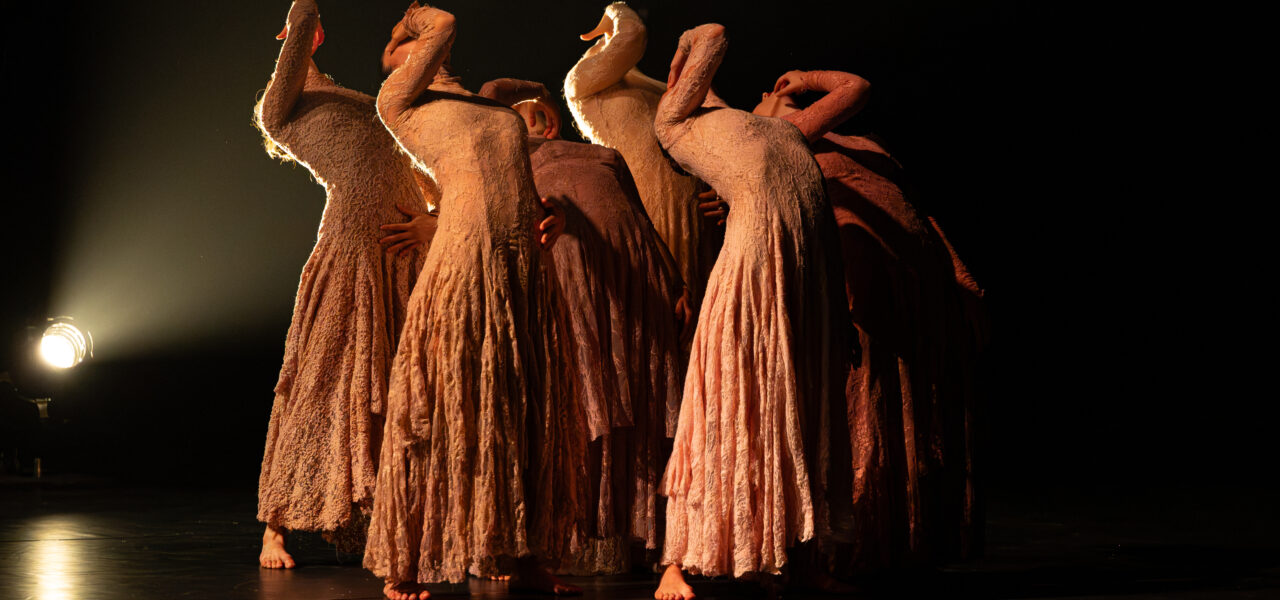
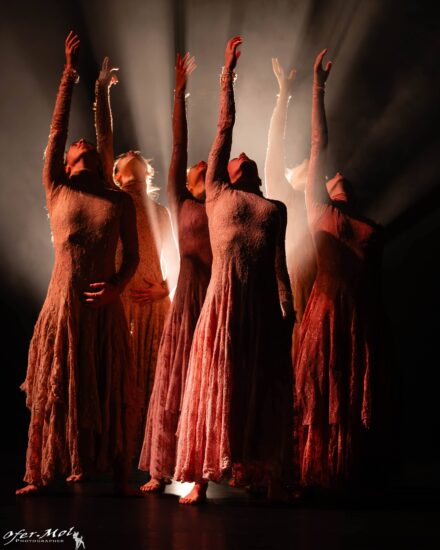
על הבמה שש רקדניות בשמלות תחרה פרחוניות, ששפת התנועה של פורטל עוברת דרך גופן כמו זרם. נענועי אגן וראש, גלים שמתגלגלים בתוך הגוף לכל הכיוונים, מכות על הגוף ותיפוף על הרצפה ועל הבשר. זו שפה מלאה בנשיות, במיניות מתפרצת, באהבה, בכאב ובגעגוע. הרקדניות חוזרות שוב ושוב על אותו משפט תנועתי ועל אותן תנועות אגן, והחזרתיות לא מעייפת אלא מעמיקה, עד שנוצרת אקסטזה שהרקדניות חוות על הבמה והיא עוברת מהן אל הקהל. זה הטרב (طرب) במובנו העמוק, השכרון שהמוזיקה הערבית הקלאסית מבקשת לעורר, וכאן הוא מתממש בגוף. מירצ’ה אליאדה תיאר את הטקס כחזרה שמבטלת את הזמן החולף ומחזירה את המשתתפים אל זמן המיתוס, הזמן הקדוש (אליאדה, 1957). כך גם כאן: החזרתיות אינה שכפול, אלא דרך לצאת מן הזמן.
ברקע מתנגנים שיריו של פריד אל-אטרש, הקרוי גם “מלך העוד” ו”הזמר העצוב”, מתוך הקלטה של הופעה חיה. מדי פעם הקהל שבהקלטה פורץ במחיאות כפיים, ונדמה שקהל נוסף נוכח באולם: קהל רפאים מזמן אחר, שמצטרף אלינו ומחזק את המעגל. ההופעה הופכת למפגש של שני זמנים ושני קהלים, שמביטים יחד בנשים שעל הבמה, ואולי אף בכל הנשים הרוקדות מעבר לזמן ולמרחב.
 “שָׁרְרֵךְ אַגַּן הַסַּהַר”: על האגן, האור והמבט
הרגע החזק ביותר בערב הגיע כשהרקדניות פסעו קדימה אל הקהל, הרימו את החצאיות וחשפו את הרגליים ואת הירך העליונה. מתחת לכל אחת הוצבה נורה שהאירה את האגן מלמטה. הבמה כולה חשוכה, ונגלו לעין רק רגליים ואגנים, בתנועת רעד וגלים. הן עמדו כך, לתחושתי, כעשר דקות. הייתה תחושה שעצם ההתבוננות בתנועה זו בלבד גורמת לכל אחד מהצופים לצלול עמוק ולהתמסר לעולמות של נשיות מכשפת.
מבט הצופים על גוף אישה רוקדת הוא מבט טעון, שלא פעם הפך אותו לאובייקט. כאן ניכר היה שהרקדניות שולטות במבט: הן מודעות לו ואף אוחזות בו מעמדה של כוח. הן שבוחרות מה לחשוף, מתי ולכמה זמן. זה אינו גוף שמוצג לעיני הצופים, אלא גוף שמציג את עצמו.
הביטוי הפואטי “חמוקי ירכייך כמו חלאים” (תכשיטים) קיבל כאן דגש של גוף ואור. עלה בי דימוי של אלות שמתחברות לאדמה דרך התנועה, כאילו דם הווסת שלהן הוא שמניע את החיים ואת העולם: לידה ומוות, כאב ויופי, נשיות וגעגוע, במעגלים. נדמה היה שהאגן שלהן עולה ויורד, רוקד ומקונן, שר ובוכה באותה עת. האגן השר והבוכה של הרקדניות כמו השמיע לי לרגע קול אמהי קדום וראשוני, מעין המיה שקודמת למילה.
“וְדַלַּת רֹאשֵׁךְ כָּאַרְגָּמָן”: על אם האלות
מצדי הבמה שרה מדי פעם אורלי פורטל עצמה ותמכה ברקדניות בקולה. המראה שלה ארכיטיפי: שיער ארוך ופזור, שמלה כחולה ארוכה ומעליה עליונית שנראית כגלימה. כך היא נדמתה לאם האלות, כאילו הולידה את רקדניותיה ונפחה בהן רוח של חיות נשית ומינית. הנוכחות שלה מבחוץ, לא במרכז, היא נוכחות של מי שמעניקה ולא של מי שתופסת את המקום. ומאחורי הדמות הזו נשמעת מסורת קדומה אף יותר משיר השירים עצמו: שירי האהבה השומריים של האלה אינאנה ושל אהובה דומוזי, שחוקרים רבים מצביעים על הקבלות בינם לבין שיר השירים. ראשונת המשוררות הידועות בשמן, אנחדואנה, כוהנת גדולה בעיר אור לפני כארבעת אלפים ושלוש מאות שנה, כתבה מזמורים לאינאנה, אלת האהבה והתשוקה, שיורדת אל השאול ושבה ממנו, מיתוס שחוקרים קשרו למחזור העונות ולהתחדשות האביב. פורטל, העומדת ושרה מצדי הבמה, נדמתה לי ככוהנת-משוררת כזו: מי שאינה רוקדת במרכז, אלא מזמרת את האלה אל תוך גופן של רקדניותיה, אולי כמו שהרעיה משיר השירים מזמרת ומלמדת את בנות ירושלים שלא לעורר את האהבה לפני זמנה: “אִם תָּעִירוּ וְאִם תְּעוֹרְרוּ אֶת הָאַהֲבָה עַד שֶׁתֶּחְפָּץ” (ב, ז).
“הִשְׁבַּעְתִּי אֶתְכֶם בְּנוֹת יְרוּשָׁלִָם”: מן המקאם אל התקאסים
במבנה של היצירה אפשר לזהות את התנועה של המוזיקה הערבית עצמה, מן המקאם אל התקאסים. המקאם הוא המסגרת המלודית המשותפת, הסולם והמהלכים שעליהם בנוי השיר. התקאסים (تقاسيم) הם אלתור כלי חופשי בתוך המקאם, לרוב ללא משקל קבוע: נגן יחיד, פעמים רבות על העוד, משוטט במקאם בדרכו שלו, נוגע בקצוות שלו, ולבסוף חוזר אל הבית, אל הלחן המשותף. כך גם פורטל מובילה את הרקדניות מריקוד משותף וחזרתי אל סולואים אישיים, ומשם בחזרה אל שותפות הגורל.
באחד הקטעים שרה אחת הרקדניות על הבמה ותופפה על גופה ועל הרצפה. היא שרה שוב ושוב את אותו שיר בערבית, שיר של געגוע ואהבה לאהובה, וכל גופה חווה את האהבה הזו. השימוש בקול לצד הגוף והתיפוף החזק על החזה הרוטט שלה סחף וסקרן. לאט לאט הצטרפה אליה מאחור חבורת הנשים, והן החלו לשיר ולרקוד יחד. הן נראו כמו חברות, אלות שתומכות זו בזו, שבהן כאב הנשיות, הלידה, האהבה והגעגוע הוא גם מקור החוזק והעוצמה.
זה גם מבנה האהבה שהיצירה מציגה: הקול היחיד יוצא מתוך הקבוצה, נוגע בקצה הגעגוע שלו וחוזר אל הקהילה שמחכה לו. בשיר השירים אנו עדים למבנה דומה: האהובה יוצאת מתוך קהילת הנשים שעמה ושבה אליה. היא משביעה את בנות ירושלים באהבתה: “הִשְׁבַּעְתִּי אֶתְכֶם בְּנוֹת יְרוּשָׁלִָם, אִם תִּמְצְאוּ אֶת דוֹדִי מַה תַּגִּידוּ לוֹ, שֶׁחוֹלַת אַהֲבָה אָנִי” (ה, ח). והן נענות לה ומצטרפות לחיפוש: “אָנָה פָּנָה דוֹדֵךְ וּנְבַקְשֶׁנּוּ עִמָּךְ” (ו, א). הקהילה היא שנותנת לה את הכוח לאלתור האישי, שבו היא מחוללת, בכל פעם מחדש, את הדרך אל אהובה.
 “כִּי הִנֵּה הַסְּתָו עָבָר”: פולחן ללא קורבן
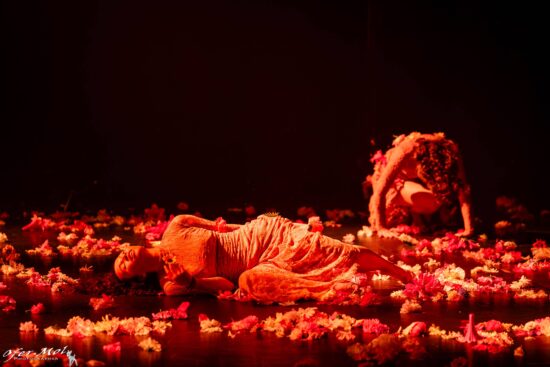
ואם קוראים ליצירה “פולחן האביב”, אי אפשר שלא לשמוע את ההד של סטרווינסקי וניז’ינסקי ושל מסורת העיבודים שבאה אחריהם, שבה הנבחרת רוקדת עד מוות כקורבן לאביב. בפולחן האביב של פורטל אין קורבן. יש בו חגיגה נשית של המיניות ושל העוצמה הנשית. הגוף מתפתל, נחבט ומסתובב, ומקריב את עצמו ואת תנועתו למען החיים עצמם, חיים שהכאב והיופי ארוגים בהם יחד. האביב כאן הוא האביב של האהבה המניצה בגוף ומתפרצת מתוכו, וכל כולה אקסטזה והתמסרות.
“מֶלֶךְ אָסוּר בָּרְהָטִים”: על הקול הגברי והאין-מפגש
לאורך היצירה נוכח הקול החזק והסוחף של פריד אל-אטרש, ותהיתי מדוע בחרה היוצרת, ביצירה נשית כל כך, בפס קול של זמר גבר. בהתחלה הוא הרגיש לי מעט זר לגוף הנשי שעל הבמה. אבל דווקא הנוכחות של הקול הגברי בתוך התנועה הנשית שכמהה לאהבה הלכה והרגישה שלמה. גם בשיר השירים הדוד והרעיה פועלים במרחב אחד, חשוף ומתעתע. הם בורחים זה מזה ונעלמים, מסתתרים ורודפים, מתהפכים בקרבם ומשתגעים מרוב אהבה: “פָּתַחְתִּי אֲנִי לְדוֹדִי וְדוֹדִי חָמַק עָבָר, נַפְשִׁי יָצְאָה בְדַבְּרוֹ” (ה, ו). האין-מפגש הזה, או המפגש שקורה במרחב הרוח, במרחב הריקוד שאינו ממשי, הוא דווקא מה שמממש את אהבתם. הקול של פריד, הזמר שבסרטיו נקרא לרוב “וחיד”, הבודד, והגוף של הרקדניות נפגשים בדיוק שם.
תנועה נוספת שבתה את לבי על הבמה: אחת הרקדניות מנערת את ראשה מצד לצד, שערה הפזור מתעופף סביבה, עד שהיא נכנסת לאקסטזה. “מֶלֶךְ אָסוּר בָּרְהָטִים”, אומר הפסוק על הרעיה ש”דַּלַּת רֹאשֵׁךְ כָּאַרְגָּמָן”, והמלבי”ם מפרש בדרך המשל: “הלא המלך שלמה אסור ברהטיהם בכבלי האהבה ולא יוכל להתנענע בלעדה” (מלבי”ם על שיר השירים ז, ו). הרהטים הם שקתות המים, ויש המפרשים אותם כתלתלי שערה של האהובה, שהמלך נכבל בהם. כך גם על הבמה: השיער המתנופף הוא כבל האהבה, וקולו של פריד, המלך, נאסר בתוכו. הוא אינו יכול “להתנענע” בלעדיה, והיא, בנענוע ראשה, מניעה אותו.
כך ממשיך פולחן האביב של פורטל לפעול גם אחרי שהאורות כבים. הוא שואל את הצופים, ואולי בעיקר את הצופות: מתי בפעם האחרונה התמסרתי לתנועה, לרגשות העזים שבתוכי, לאהבה? מה בגופי שר ובוכה באותה עת? ואיזו קהילה של נשים מחזיקה אותי כשאני יוצאת לסולו שלי, ומחכה לי כשאני שבה?
“כִּי עַזָּה כַמָּוֶת אַהֲבָה” (שיר השירים, ח, ו).
בפולחן האביב של אורלי פורטל, האהבה עזה כמו המוות. היצירה משאירה תחושה של כוח, של יצריות ושל טקסיות נשית סוחפת. ניכר שמאחורי העוצמה הזו עומדות שנים של מחקר גופני ומוזיקלי מעמיק ומרשים. ההתמסרות לכוח האהבה מחברת למקור הפנימי הפשוט והעז ביותר, שממנו נובעים החיים ואליו הם שבים.
׳פולחן האביב של פריד אל-אטרש׳ מאת להקת המחול אורלי פורטל הוצגה בבעורה מחודשת ב12.11.2026 בתאטרון ירושלים. רקדניות: נעה גרוניך, ללאל פיליורה, שקד ורנר, רוני פייגלר, ליה מור, מאיה כהנוב.
Return, Return, O Shulammite
On Farid al-Atrash’s Rite of Spring by Orly Portal
Efrat NehamaNoa
“Return, return, O Shulammite; return, return, that we may look upon you. Why should you look upon the Shulammite, as upon the dance of the two camps? How beautiful are your feet in sandals, O noble daughter! The curves of your thighs are like jewels, the work of a master craftsman. Your navel is a rounded bowl that never lacks mixed wine… Your head crowns you like Mount Carmel, and the hair of your head is like purple; a king is held captive in its tresses.” (Song of Songs 7:1–6)
In the Song of Songs, there is a remarkable moment in which the beloved’s body is described as she dances, from the bottom up. The “dance of the two camps,” probably a festive dance performed by two groups facing one another, prompts the spectators to call upon the Shulammite to return again and again so that they may continue watching her. Their gaze travels upward from her feet to the curves of her thighs, and the female body becomes a work of art, “the work of a master craftsman.” The image of the Shulammite accompanied me throughout Farid al-Atrash’s Rite of Spring, Orly Portal’s creation. There, too, we beheld the Shulammite, unable to stop watching and cheering.
Unlike the Western tradition of The Rite of Spring, in which spring is purchased at the price of a young woman’s sacrifice, Portal offers a ritual in which the female body is not sacrificed but revealed as the source of life itself. The evening moves between repetition and improvisation, between group and solo, between the recorded male voice and the living voices of the women onstage. From all these contrasts emerges a single image: a ritual of tarab, of musical and bodily ecstasy, in which love and pain, longing and desire do not contradict one another but nourish one another. And as in the dance of the two camps, the spectator’s gaze is part of the ritual: not a gaze that captures, but one that participates, responds, cheers with excitement, and asks for more.
“As Upon the Dance of the Two Camps”: On Tarab and the Two Audiences
Onstage are six dancers in floral lace dresses, with Portal’s movement language flowing through their bodies like a current. Shaking hips and heads, waves rolling through the body in every direction, striking the body and drumming on the floor and flesh. It is a language full of femininity, erupting sexuality, love, pain, and longing. The dancers repeat the same movement phrase and the same pelvic movements again and again, yet the repetition does not become tiresome. Instead, it deepens until an ecstasy emerges, experienced by the dancers onstage and transmitted from them to the audience. This is tarab (طرب) in its deepest sense, the intoxication that classical Arabic music seeks to evoke, here realized through the body. Mircea Eliade described ritual as a repetition that abolishes passing time and returns participants to mythical time, sacred time (Eliade, 1957). So it is here: repetition is not duplication but a way of stepping outside time.
In the background, songs by Farid al-Atrash, also known as the “King of the Oud” and the “Sad Singer,” play from a recording of a live performance. From time to time, the audience in the recording bursts into applause, and it seems as though another audience is present in the theater: a ghost audience from another era, joining us and strengthening the circle. The performance becomes a meeting of two times and two audiences, watching together the women onstage, and perhaps all dancing women across time and space.
“Your Navel Is a Rounded Bowl”: On the Pelvis, Light, and the Gaze
The most powerful moment of the evening came when the dancers stepped forward toward the audience, lifted their skirts, and exposed their legs and upper thighs. Beneath each dancer, a lightbulb was positioned to illuminate her pelvis from below. The entire stage was dark, and only legs and pelvises were visible, trembling and undulating. They stood like this for what felt to me like ten minutes. There was a sense that simply watching this movement was enough to draw every spectator deeply inward, surrendering to worlds of enchanting femininity.
The spectator’s gaze upon a dancing woman’s body is a charged one, a gaze that has often turned that body into an object. Here, it was evident that the dancers controlled the gaze: they were aware of it and held it from a position of power. They chose what to reveal, when, and for how long. This was not a body displayed for the spectators but a body presenting itself.
The poetic phrase “the curves of your thighs are like jewels” took on an emphasis of body and light. An image arose in my mind of goddesses connecting to the earth through movement, as though their menstrual blood were what propelled life and the world: birth and death, pain and beauty, femininity and longing, in cycles. It seemed as though their pelvises rose and fell, danced and lamented, sang and wept at the same time. The singing and weeping pelvises of the dancers seemed, for a moment, to sound an ancient, primordial maternal voice, a kind of murmur that precedes language.
“The Hair of Your Head Is Like Purple”: On the Mother of Goddesses
From the sides of the stage, Orly Portal herself sang from time to time, supporting the dancers with her voice. Her appearance was archetypal: long, loose hair, a long blue dress, and an outer garment resembling a cloak. She appeared like a mother of goddesses, as though she had given birth to her dancers and breathed into them a spirit of feminine and sexual vitality. Her presence on the periphery, rather than at the center, was that of someone who gives rather than someone who claims the space.
And behind this figure resonates a tradition even older than the Song of Songs itself: the Sumerian love songs of the goddess Inanna and her beloved Dumuzi, which many scholars have identified as having parallels with the Song of Songs. The first poet known to us by name, Enheduanna, a high priestess in the city of Ur some 4,300 years ago, composed hymns to Inanna, goddess of love and desire, who descends into the underworld and returns from it, a myth that scholars have connected to the cycle of the seasons and the renewal of spring.
Portal, standing and singing at the sides of the stage, seemed to me like such a priestess-poet: someone who does not dance at the center but sings the goddess into the bodies of her dancers. Perhaps like the beloved in the Song of Songs, who sings to and instructs the daughters of Jerusalem not to awaken love before its time: “Do not arouse or awaken love until it so desires” (2:7).
“I Charge You, O Daughters of Jerusalem”: From Maqam to Taqasim
In the structure of the work, one can identify the movement of Arabic music itself, from maqam to taqasim. The maqam is the shared melodic framework, the scale and melodic pathways upon which the song is built. Taqasim (تقاسيم) are free instrumental improvisations within the maqam, generally without a fixed meter: a solo musician, often playing the oud, wanders through the maqam in their own way, touches its outer reaches, and eventually returns home, to the shared melody. Similarly, Portal leads the dancers from shared, repetitive dancing into individual solos and from there back into a shared destiny.
In one section, a dancer sang onstage while drumming on her body and the floor. She sang the same song in Arabic over and over, a song of longing and love for her beloved, and her entire body experienced that love. The use of her voice alongside her body, and the forceful drumming on her trembling chest, was captivating and intriguing. Gradually, the group of women joined her from behind, and they began singing and dancing together. They looked like friends, like goddesses supporting one another, for whom the pain of femininity, childbirth, love, and longing was also a source of strength and power.
This is also the structure of love presented by the work: the individual voice emerges from the group, reaches the farthest edge of its longing, and returns to the community waiting for it. In the Song of Songs, we encounter a similar structure: the beloved emerges from the community of women around her and returns to it. She calls upon the daughters of Jerusalem to bear witness to her love: “I charge you, O daughters of Jerusalem, if you find my beloved, tell him that I am sick with love” (5:8). And they answer her, joining the search: “Where has your beloved turned, that we may seek him with you?” (6:1). It is the community that gives her the strength for her individual improvisation, through which she dances, each time anew, her way toward her beloved.
“For Behold, the Winter Is Past”: A Rite Without Sacrifice
And if a work is called The Rite of Spring, it is impossible not to hear the echo of Stravinsky and Nijinsky and the tradition of interpretations that followed, in which the chosen maiden dances herself to death as a sacrifice to spring. In Portal’s Rite of Spring, there is no sacrifice. Instead, there is a feminine celebration of sexuality and female power. The body twists, strikes, and spins, offering itself and its movement for the sake of life itself, a life in which pain and beauty are woven together. Here, spring is the spring of love budding within the body and bursting forth from it, entirely ecstasy and surrender.
“A King Is Held Captive in Its Tresses”: On the Male Voice and the Non-Encounter
Throughout the work, the powerful, sweeping voice of Farid al-Atrash is present, and I wondered why the choreographer had chosen a male singer’s soundtrack for such a profoundly feminine work. At first, his voice felt somewhat foreign to the female bodies onstage. But gradually, the presence of the male voice within the feminine movement yearning for love came to feel complete.
In the Song of Songs, too, the beloved and her lover inhabit a single space, exposed and elusive. They flee and disappear from one another, hide and pursue, are turned inside out and driven mad by love: “I opened for my beloved, but my beloved had turned and gone; my soul departed when he spoke” (5:6). This non-encounter, or the encounter that takes place in a spiritual realm, in the unreal space of dance, is precisely what realizes their love. Farid’s voice, the singer who was often called “Wahid,” the lonely one, in his films, and the dancers’ bodies meet exactly there.
Another movement onstage captured my heart: one of the dancers shakes her head from side to side, her loose hair flying around her, until she enters a state of ecstasy. “A king is held captive in its tresses,” says the verse about the beloved whose “hair is like purple.” The Malbim interprets the verse allegorically: “Indeed, King Solomon is bound in their channels by the bonds of love and cannot move without her” (Malbim on Song of Songs 7:6). The rehatim are water troughs, though some interpret them as the beloved’s locks of hair, in which the king becomes entangled. So it is onstage: the flying hair becomes the bonds of love, and Farid’s voice, the king, is held captive within it. He cannot “move” without her, and she, by shaking her head, sets him in motion.
Thus Portal’s Rite of Spring continues to resonate even after the lights go down. It asks the spectators, and perhaps especially the women among them: When was the last time I surrendered to movement, to the powerful emotions within me, to love? What in my body sings and weeps at the same time? And what community of women holds me when I step out for my solo and waits for me when I return?
“For love is as strong as death” (Song of Songs 8:6).
In Orly Portal’s Rite of Spring, love is as strong as death. The work leaves behind a feeling of power, sensual vitality, and sweeping feminine ritual. It is evident that behind this intensity lie years of profound and impressive bodily and musical research. Surrendering to the power of love connects us to the simplest and most powerful inner source, from which life flows and to which it returns.
‘Farid al-Atrash’s Rite of Spring’by the Orly Portal Dance Company was presented in a renewed production on November 12, 2026, at the Jerusalem Theatre. Dancers: Noa Gronich, Lalel Pillora, Shaked Werner, Roni Faigler, Lia Mor, Maya Kahanov.
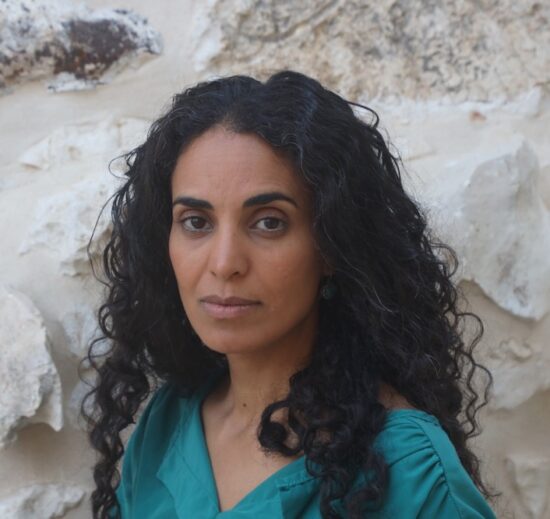 אפרת נחמה היא כוריאוגרפית, משוררת, אמנית פרפורמנס, דוקטורנטית ומרצה. יוצרת, חוקרת ומגישה בשאלה על החיבורים המתחוללים בין השפה המילולית לתנועתית ובין שירה למחול. עבודות שירה ומחול עלו בין היתר במוזיאון ישראל, תיאטרון ירושלים, מחול שלם, בית טיכו, גלריה אלפרד, פסטיבל מנופים, פסטיבל ירושלים לאמנויות, כנס מחול באריזונה, culture בוסטון ארה”ב. ספרי שיריה שראו אור: בשרירים רפויים (2019), הילד/הילדה ( 2021).
Efrat Nehama is a choreographer, poet, performance artist, doctoral candidate, and lecturer. Her artistic and academic work explores the connections between verbal and movement languages, and between poetry and dance. Her poetry and dance works have been presented at the Israel Museum, Jerusalem Theatre, Machol Shalem, Ticho House, Alfred Gallery, Manofim Festival, Jerusalem Arts Festival, a dance conference in Arizona, and Culture in Boston, USA. Her published poetry collections include With Relaxed Muscles (2019) and The Boy/The Girl (2021).