Parental Choreography: Accustomed to Fear by Ori Lenkinski
*originally published in Hebrew in the Parental Choreography column in Haaretz
In the foyer of a sports center in Vienna’s 12th district, performance artist Dana Michel explained to the small group of audience members who stuck around for the post-show chat why, as a person who cannot swim, she chose to create a piece in a public pool. “It has become very natural for me to do things I’m afraid of,” she said.
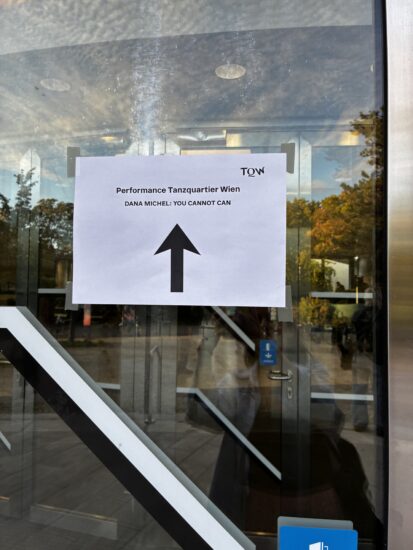
Dana Michel’s You Cannot Can at Schmelz
Dana had just finished You Cannot Can, a solo performance that deals with her ongoing struggles with deep water and with the generational trauma that left most of her family members unable to swim despite hailing from the Caribbean. Over the course of nearly an hour, Dana goes through an elaborate ritual to prepare for entering the water that includes several costume changes and many objects. The piece places far more emphasis on the preparation for submersion than on swimming itself.
I was able to see this work thanks to a family vacation derailed by a sudden bacterial infection that took hold of my younger daughter. We were meant to be traipsing through the green hills of western Austria but were forced to stay in Vienna, close to doctors and pharmacies. It just so happened that Dana, whom I had befriended fifteen years earlier in the same city, was performing while we were in town.
One of the plans we had made for our time in the country was to ride a cable car up one of the Austrian Alps. Cable cars have become a staple of our family vacations in spite of a severe fear of heights I developed as a mother. Whereas in my childhood I rode chairlifts in the Rockies without fear, I experienced a sudden onset of panic the first time my family boarded a cable car.
My kids were four and nine then and we were visiting Barcelona. One day, we visited Montjuic. We waited in a long line and finally boarded the cable car to the top of the mountain. As the car began its climb, I was gripped by a paralyzing fear.
There is a video of the moment on my husband’s phone. He continues filming, unaware of what is happening to me, while our daughters begin to notice that something is wrong. I cannot move, lift my head to look out the windows or even speak. The girls try to help me, although none of us understands what has happened.
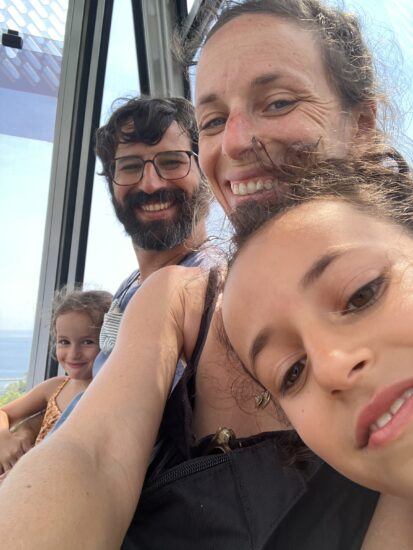
Seconds before it happened the first time.
We shrugged it off as a one-time occurrence and continued on our way, opting to walk down the mountain rather than broach this strange experience again.
Only it happened again. This time, we were in Athens and the cable car was a funicular that went up to a small church on Lycabettus Hill. I had been there several months earlier on a work trip and experienced no fear, so it seemed like a safe choice. But as we exited the train car and were met with the beautiful panoramic views of the city, the same paralysis set in.
As I see it, a normal person would categorize all skyborne activities as off-limits on family vacations and move on to other forms of entertainment. But, for a reason I could not exactly explain to myself until I heard Dana speak after her performance, I baked them into our holiday plans. On every vacation, I research the nearest cable car or funicular. My children, husband and I have developed strategies for getting through these adventures.
Usually, one of them holds my hand while another quietly encourages me, telling me that everything will be okay. They all know not to make a big deal out of it, not to photograph me, speak too loudly or describe how high up we are. They can, however, film each other. In fact, I encourage it, so we’ll have something to remember the experience by. They can also say how beautiful the view is. And they know I’ll need a sweet snack as soon as we disembark.
My habit of seeking out frightening experiences is not limited to family vacations. My professional life is full of these moments. Each new piece I make scares me half to death. Recently, I made my first work for young audiences, a piece about human life and planet Earth told by an intergalactic android and her spaceship. The ultimate heights. Children are arguably the most direct, unpredictable and unforgiving audience imaginable. The stakes felt unusually high. The process was complicated and, at many points, felt doomed. Somewhere in the middle of it, I found myself wondering, not for the first time, why I had opted to put myself through this. I seem to have developed a habit of constructing elaborate situations from which the only escape is to go through with them.
Motherhood, meanwhile, has introduced an entire universe of fears I never knew existed, most of which I have absolutely no interest in confronting.
In Vienna, we encountered one of them. Our daughter spiked a high fever on the first night, and by the second evening that fever was not responding to medication. She was hot, vomiting and very sleepy. Looking at her passed out on the fold-out couch of the Airbnb we had to vacate by 11 AM sharp the next morning, I was gripped by the type of fear parents dread. Images of emergency rooms and IV tubes filled my mind, joined by an endless list of bureaucratic tasks that needed tending to: insurance policies, hotel cancellations, finding a doctor nearby, a new place to stay. Above all this loomed the guilt of having taken her on a plane while some infection was quietly brewing in her system.
Luckily, we found a wonderful doctor who provided the care and treatment she needed. Within a couple of days, after one onion-smelling apartment and millions of phone calls to Booking.com and Airbnb, we were able to pivot our plans to allow enough time to recover before the flight home.

Schmetterlinghaus, Vienna
While my younger daughter let the antibiotics begin to work, my elder girl and I visited the Schmetterlinghaus, Vienna’s butterfly house. We wandered through the tropical greenhouse, surrounded by butterflies of every imaginable color. I worried about the daughter I’d left behind and felt guilty for leaving her, while simultaneously feeling guilty that I wasn’t doing more for the daughter beside me. Although things seemed to be improving, I wasn’t sure we were out of the woods just yet.
Ten doses into her treatment, Lev was up and about, and we could finally enjoy Vienna together.
On our last day in Vienna, we traded the alpine cable car for a Ferris wheel overlooking the city. As our carriage began to rise above Vienna, the familiar Schmetterlinge filled my stomach. My children looked out over the rooftops while I attempted to keep my panic at bay.
That evening, I left my family to enjoy the amusement park rides, most of which were far too frightening for my sensibilities, and walked through the city to meet Dana for dinner. I thought about her performance, the cable cars I insist on riding and the artistic projects I continue to take on despite the probability of rejection or failure.
It has become very natural for me to do things I’m afraid of.
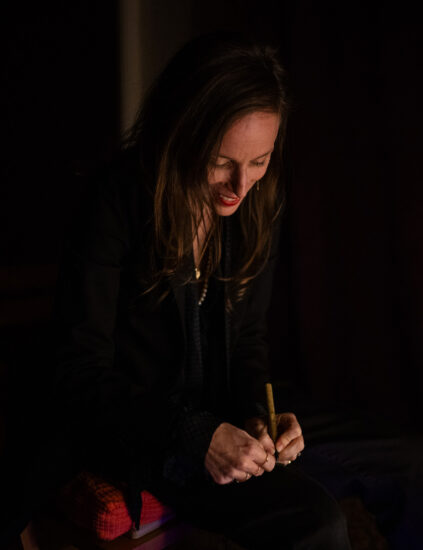 Ori Lenkinski is a choreographer, dramaturg, and arts journalist based in Tel Aviv. She is the founder and editor of Creative Writing and has written about dance and performance for publications including The Jerusalem Post, Dance Magazine, Haaretz, and The Huffington Post. Her choreographic work has been presented internationally across Europe, North America, and Asia.